
Translated material
Author, drink poison
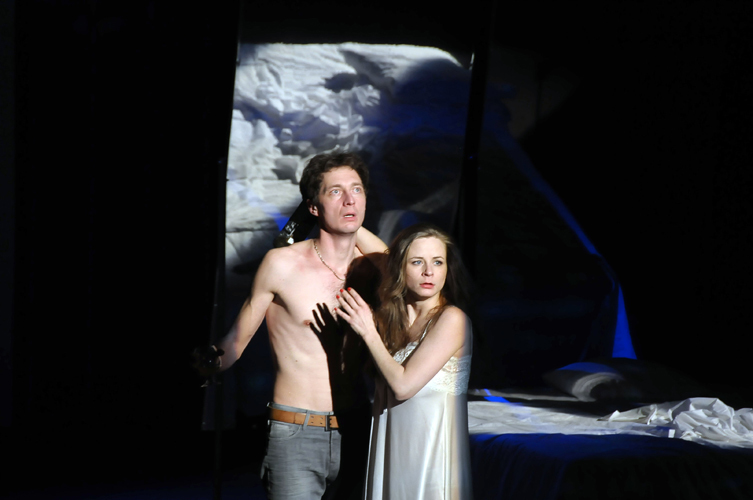
Next week, the Pushkin Theater Festival opens in Pskov , the central event of which will be a show of one of the key this season by the prime minister of the Russian regional scene - “Little Tragedies” by Peter Sheleshevsky.
About the director of Peter Shereshevsky, Petersburgers will definitely tell you that once, in the late 1990s, very young, he put the beautiful “eccentrics” in the “Russian Entreprise” and the wonderful “eternal husband” and “dog waltz” in the “comedian shelter”. Further, the story, as a rule, loses its connectedness, or even interrupted: Shereshevsky’s walking in the state of the Komissarzhevsky Theater did not have much success, the director had a local reputation of the abstruse bore, not sympathetic to the aspirations of ticket tables, in large theaters they called him irregularly and on occasion - from Down with his heart. Shereshevsky honed his individual creative handwriting not in his hometown, but in the provinces, and the nies of the Neva are poorly aware of his successes. Last year, he finally stepped into the Golden Mask program - with Ivanov , set in Novokuznetsk. And at about the same time he ended up in Izhevsk, signing a contract of the chief director with the Russian Drama Theater of Udmurtia. Pushkin’s “little tragedies” - Shereshevsky’s debut in a new position, to a certain extent his author’s manifesto and, possibly, the best performance for today.
 © Pavel Shramkovsky
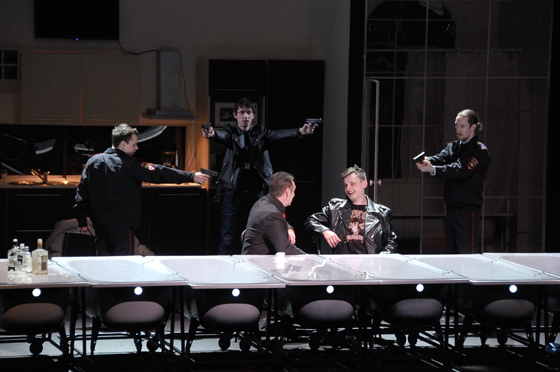
It is unlikely that this note should have been started solely in order to remind humanity that Petr Yuryevich Shereshevsky lives and works in the city of Izhevsk. The fact that in the capital of Udmurtia, because of these “tragedies”, a real civil war broke out-half of the hall applauds standing and sings to the artists on the bow, the second in anger retreats and writes no-ground letters in the instance-is curious, but these days for wars (not only theatrical ones) are enough and trifling reasons. Of course, it would be possible to focus on how it blossomed in the hands of a good director, a strong and talented troupe of the Izhevsk drama, with which only very narrow professionals were familiar with the capitals-but I risk stumble upon a misunderstanding of the editor and be sent to some specialized publication of the STD. Make big eyes due to the fact that Shereshevsky’s Pushkin heroes have modern costumes, drink beer at the station, sing songs Cure and talk with the statue of the commander under the dose of LSD, also do not want to. The play has a thousand convertible trifles, cleverly mounted with the classical text (which is what one Don Anna is worth, under the replica “How is your name?” Addressed by Don Guan, climbing into the notebook of a mobile phone, or two cheerful police officers, squandering Laure’s compliments: “As you have correctly understood how you developed it”), but they are unlikely It would be worth a separate retelling. An article about the amazing freedom of the director from the now fashionable hypocrisy would be drawn to the good text: the performance is so densely seasoned with healthy eroticism that it should cause real hatred among impotent. But it’s much more interesting to talk about the message of these “little tragedies” - far from the stamps of surface journalism, but at the same time timely.
 © Pavel Shramkovsky
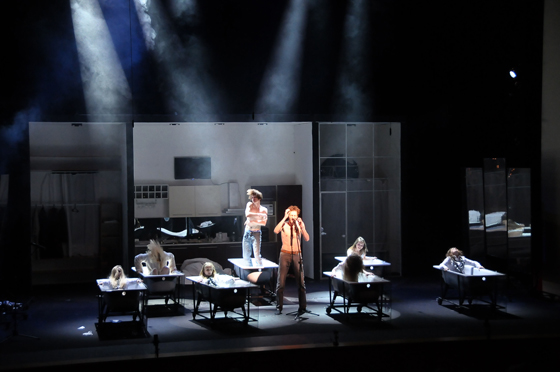
The performance begins before the closed curtain-the press conference of the hero of the day. The gray -haired and good laureate of the State Prize and international competitions, Mr. Salieri, who looked like several former and real Russian artists, will be shut off the hall of white -toothed smiles and pronounce the Pushkin monologue in a confidential manner, which turns out to be a very convenient supplier of duty answers to duty questions. "Are you called a supporter of conservative, traditional approaches in art?" -A radiant smile of half a face and an eloquent gesture: a hand attacked to the throat. Like, how tired of these conversations. In fact, Salieri was tired of any conversations, not only these. The curtain will open, exposing the interior of the gorgeous apartment of the venerable composer, and Salieri himself will throw a jacket and smile, smell at the home robe and strain the decisive Credo through his teeth: “There is no truth on the ground, but there is no truth and higher.” Actor Yuri Malashin, clearly undeservedly little-known in the country, in this role demonstrates a steep aerobatics: the maximum, almost documentary reliability of existence, sometimes causing “non-game”, the ability to keep poods on the big stage is adjacent to time with delicious acting sarcasm, sharp estimates that reveal the character from an unexpected side. Misanthropus and cynic Salieri at Malashin and Shereshevsky-a complex, ambiguous image, in some ways even pretty and worthy of pity. And this Salieri envies not at all the glory of Mozart and, probably, not his talent - but idealism, the ability to get carried away and believe.
The performance is so densely seasoned with healthy eroticism that it should cause real hatred in impotent.
Mozart (Vadim Istomin) in the Izhevsk performance is not the antipost of Salieri, they are in contact, not without reason the young genius will appear on the scene from the bowels of the very table at which the hero of the day arranged his briefing: such a surprise. Who knows, maybe this is Salieri himself in his youth? Not a hipster, not a solder-boy, not an arrogant fruit from Golden Youth-this Mozart seems to be from somewhere from the city outskirts, where it is customary to wear stupid black hats. A funny and ingenious fool, he jumps around Salieri, like a joyful puppy, bursting from the inside with his talent - as if unexpected happiness.
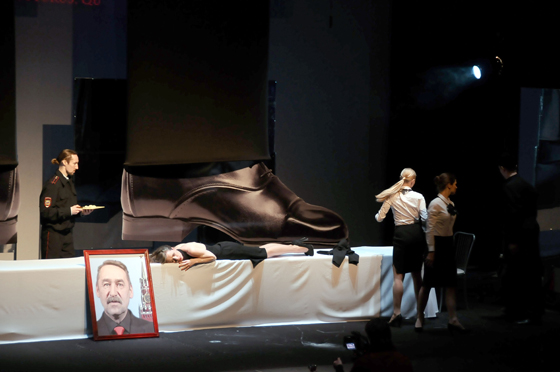
What we will see next is “Don Guan” and “The Scanty Knight” - in the composition of the performance, the essence of Mozart’s composition, which he, slightly embarrassed, shows Salieri. The artist of the performance Elena Sorochakina created a spectacular transformer decoration, easily tolerates action from the apartment to the station (scenes at the station is a clear bow to the “forest” of Kirill Serebrennikov), Square, to a television studio and a restaurant. There is even a statue of a commander, whose cyclopic boots are sinking from under the grates to the deposits of the Try Walking in My Shoes . Both of the Mozart stories are reckless: the brutal leprosy of the Rocker Don Guan (irony, drive and psychological mobility of actor Mikhail Solodyankin perfectly fit into the image proposed by the director), the bitter fraction of Biker Albert (Ivan Ovchinnikov), which deprived of the last motorcycle helmet. Cheerful thrash chippling breaks in half at the beginning of the second action. Throwing the poison into the glass of Mozart, Salieri seems to be stuffed into co -authors - and exciting jokes are turned on by tragedies.
 © Pavel Shramkovsky
Director Peter Shereshevsky well understands that the most important of the techniques of the tragedy for us today is tragic absurdity. Poisoned by Salierian poison, the stories of Mozart in front of our eyes are mutating in a frightening nonsense. Baron (Nikolai Rotov) and Albert find out the relationship on the TV show “Visiting the Duke” (“A terrible age, terrible hearts, we will meet in a week”), and video of the life of each of them is hastily blind crafts. An influential commander (very subtle work of actor Andrei Demyshev), appearing on his widow's apartment and catching her in bed with Don Guan, will only grin and tells his wife to serve borsch. And the rebellious performanist Guan will respond not to the stone right hand, but by reading the poems of Joseph Brodsky, an impeccable cataloger of the “tired culture”. The defeated rocker Guan will do what is characteristic of many domestic rockers: he will eat his gratuitous borsch, lick a master plate and tipsy on the scenes.
The main value of the performance of Shereshevsky is perhaps in the underlying issue. Really, are the eternal Jew and the equally immortal commander to blame? The visual script and nonsense in the finale - are there any fiction of our salreri who believed the algebra harmony? That is the only play that they know by heart and are ready to convey by inheritance ... Are they not the ADUEV, sincere souls, always returning us to the point of the beginning of the path? Although this is their tragedy too: in the final of the play, the poisoner gets drunk in a tavern, trying in vain to shout out the song of Grigory Leps and tell the hall something about Buonarroti. You can listen to the director Peter Schereshevsky in this matter: he himself is one of those Mozarts who were poured. It was just a strong organism.