
Translated material
1: 0: Russian kitsch beats eurotresh
In the city of Regensburg, the premiere of the opera Anton Lubchenko “Dr. Zhivago” took place.The conflict between the author and conductor of the opera and the director provided an unexpected PR event, a very decent number of journalists gathered into the remote Bavarian town. COLTA . RU decided to find out what this situation looks like through the eyes of the Germans themselves. With a kind resolution Frankfurter Allgemeine Zeitung we publish a translation of yesterday's review of the correspondent of the newspaper Kerstin Holm. The author of the translation is Anastasia Butsko.
All healthy cultures are healthy the same. All crazy cultures do this each in their own way. This circumstance made the Regensburg Theater, where the world premiere of the opera of the Russian conductor and the “multi -minister” of the music of Anton Lubchenko “Doctor Zhivago”, also the theater of current cold war between Russia and Europe, has just taken place.
Lubchenko leads the opera in Vladivostok and is in the best relations with the government, the Orthodox Church and Gazprom. At the age of 29, he is the author of seven symphonies, three operas, five ballets, eight spiritual works, as well as a three -part symphonic poem about the domestic gas production industry.
“Dr. Zhivago”, the fourth opera opera, a musical drama, written by the order of the Regensburg Theater, is especially close to his heart, says the maestro, since we are talking about a love story, which includes a fair amount of real history and politics. In addition, the classic masterpiece of Pasternak reveals to him true Russia - at a time when, hunting for Trash, Europe, wherever possible, tries to deal with Russian culture. At the same time, Lubchenko signs in love for the aesthetics of feelings, which, in his opinion, is closer to Russians than the ugly musical language of the avant -garde from Wolfgang Rome to Helmut Lahenman.
 © Jochen Quast
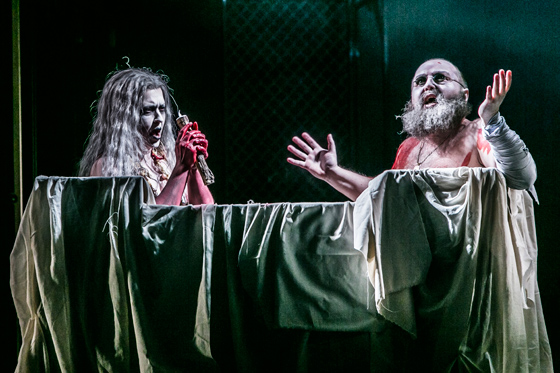
In the center of the plot of the opera (Lubchenko is also the author of the libretto) - a love couple, whose connection is torn by the civil war, revolution and family obligations. But the searches of this shock, these wounds in the musical fabric of the composition are in vain. This is a shameless hodgepodge made of classic cliches, stylizations and quotes. True, according to Lubchenko, this is what corresponds to his mission of the forerunner and pioneer of the neo -Russian Renaissance. The purpose of this revival is to resurrect those who deserve it (Tchaikovsky, Prokofiev, Mussorgsky, Rachmaninov), and use the power of their sensory world know in order to enlighten us today. It goes without saying that this “doctor Zhivago”, by the will of the Creator, can only be performed in Russian.
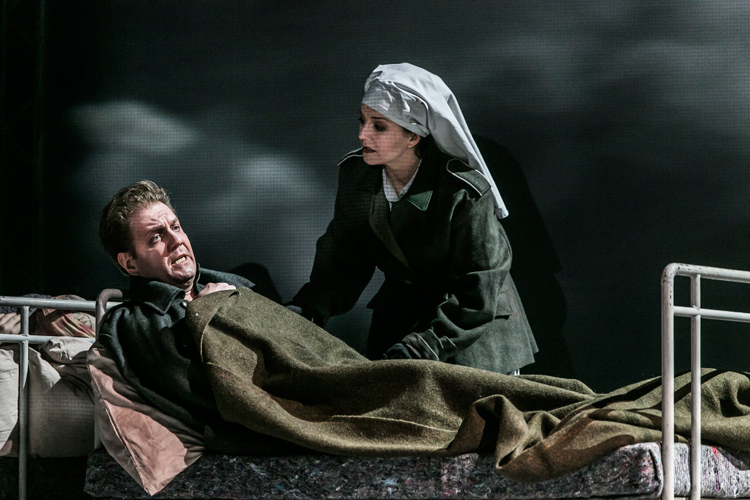
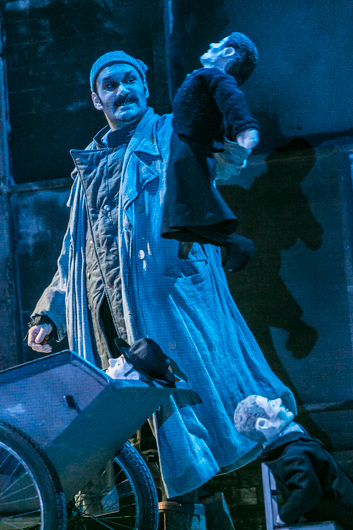
Lubchenko works extensive, like the Russian raw material industry, developing a gross product of his register. Its new three -hour composition provides for five tenor parties, apparently corresponding to the hysterical mood of the men of that era. The Theater of Regensburg had to invite four singers: two from the Mariinsky Theater, two of the theater led by the Lubchenko in Vladivostok. The doctor of Zhivago, who sings the majestic, dark baritone from Mariinsky Vladimir Baykov, is found in a military hospital, where he lies after healing, with a nurse Lara in the enchanting performance of the Regensburg Devaa Michaela Schneider (lyrical-dramatic soprano). Nine scenes are distributed for 25 years, during which the heroes find and lose each other again. This image of the artist Helmut Sturmer expresses with the help of an elevator structure that effectively sends outgoing eras, and the rotating mechanism of the scene transports the “dead” opera soloists there.
 © Jochen Quast
Lubchenko’s musical element - sound wallpaper. Like Basso Continuo , the score is permeated by a motorly pulsating pattern, structured with syncopted accents in wind and shock, as if echoes of a passing train of time - a sort of response to Philip Glasse. The numbers for soloists and choir are a la Prokofiev, Tchaikovsky, Stravinsky or in the style of spiritual chants and folk songs, and the commissar, inclined to sadism, even sings a fugue in the spirit of Bach. The main thing is that everything is loud, aggressive, fearlessly pathetic. In combination with the material declared by the tragedy, this emotionally high-legged and prolonged musical neimtropping is able to kneel any audience.
Only this music has no internal motivation. Neither nerve endings, nor blood vessels, nothing organic, connect it. The fact that this music is capable of offering us as a means of our Amusia (the diagnosis made by Adorno) is like the therapy for frigidity with the help of toys from a sex shop.
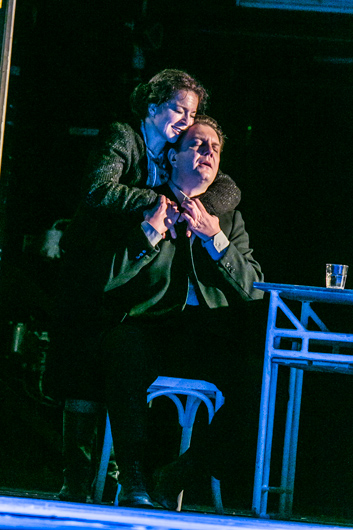
Lubchenko self-confidently stylizes himself as a messenger of the Russian tradition, this natural bastion on the path of the meaningless priority of authorities practiced by the West Trash Culture. Therefore, on the example of Sylviu Purkaret, he demonstratively creates a precedent: the fact that the director during the meeting of the heroes put vodka on the table and that in one of the scenes one of the singers had to go through the portrait of Pasternak is, according to Lubchenko, a focused attempt to coat Russia with dirt.
 © Jochen Quast
As an author and conductor, he threatened to disrupt the prime minister in Regensburg, canceled the tour of the performance in Vladivostok and even intended to sue the director of Purkaret, who allegedly fought on his Lubchenko. In Moscow, he enlisted the support of Deputy Prime Minister Olga Golodets, who, in addition to social topics, also produces culture. The latter immediately recognized in the Regensburg almost typical typical and for other Russian cultural events abroad “attempts to certain circles” to introduce a politicized dissonance into the event, causing unchanging delight among the public.
In his homeland, Lubchenko was not seen as an enemy of alcohol. But the culture of the Kremlin model, the bearer of which it is, believes in camouflage. In Regensburg, vodka on stage was replaced with wine, which did not look too realistic. And the audience really applauded. Timid cries "Fu!" They just drowned in general glee.