
Translated material
A well without a drop of oil

On January 25, participants in the Russian Antarctic expedition drilled a well to the relict lake of the East, which was isolated from the outside world for millions of years. Perhaps “alien” organisms live in this lake, unlike anything, known today, but similar to those that can exist in the under -the -sized oceans of the satellites of Jupiter - Europe or Ganyveda.
Formally, this is the second successful attempt, the first time the well in the lake was drilled in 2012 - and immediately blocked. This time, the channel between the lake and the surface can be kept open for a long time, and scientists will be able to figure out in detail whether someone in eternal darkness lives under four kilometers of ice-in the water or at the bottom of the strange lake in the world.
If only this program is not closed. Due to the sharp growth of the dollar exchange rate, the very work of Russian polar explorers in Antarctica is in question, and the decision to continue the FCP “World Ocean”, from which many scientific projects in the Arctic and Antarctica were financed, has not yet been adopted. It is possible that one of the largest scientific projects of the USSR and Russia, begun back in 1957, will be frozen just before it will begin to bring really sensational and critical results. There is a risk that the first generation of Russian astrobiologists will not cross this threshold.
***
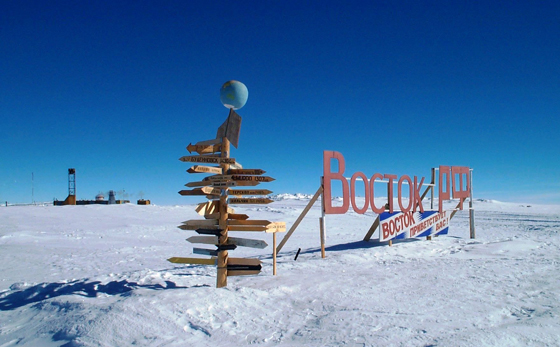
The whole story began more than half a century ago, when in December 1957 a sanitary-tractor train led by the future academician Alexei Trashnikov reached the center of the Ice Continent, to the point where the Vostok station was created. It was called so in honor of the Vostok sloop - the sailboat of Faddea Bellingshausen, on which he sailed to open the Antarctic in 1819.
It is necessary to imagine what it is - the East. To the nearest shore from here - 1260 kilometers, to the nearest Mirny station - 1410 kilometers. The temperature even in summer does not rise above 35 degrees of frost, and record heat - minus 14 degrees. Actually, there is an earthly pole of cold here, in the east the temperature record was recorded - 89.2 degrees below zero. The air here is extremely dry, the eternal cold freezes all moisture from the air. At the same time, the station is located almost in the center of the giant Antarctic glacier, at an altitude of about 4 thousand meters. This means that hypoxia is added to desert dryness and frost - a lack of oxygen, which people usually encounter in the mountains.
In the 1960s, the ice was going to drill with the help of a miniature atomic reactor, which would melt the glacier through.
You can get here only in the summer: in winter, during a polar night, the planes cannot get here. Serious goods-mainly barrels with diesel fuel for a diesel power plant-are brought to sanitary and tractor trains.
What brought Soviet people into this nightmare ice desert? To say that only scientific interest is to be serving. The work of research stations in Nyeenia and Demilitarized Antarctica is something like a “flag demonstration” in the ocean. We need to show: we are here, this is our sector allocated to us under the Antarctica agreement, and no one can take it using our absence.
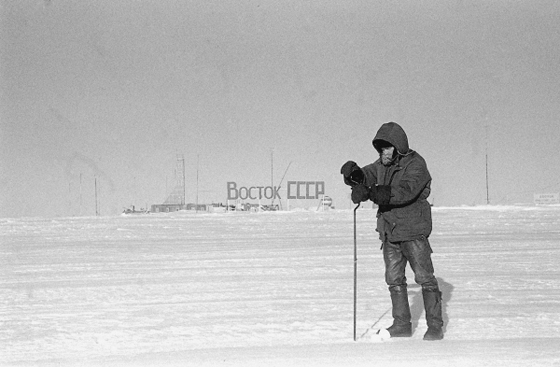
In 1960, at the Vostok station, a glacial began - with the help of artisanal thermo -bureen shells, it was possible to penetrate to a depth of 50 meters. The project of through drilling of ice was considered using a miniature atomic reactor, which will have to melt the glacier through and through. Seriously began to drill in 1967, when professionals from the Leningrad Mining Institute arrived east. In the ice they made the first well 560 meters deep.
Then no one still knew about the existence of Lake East - scientists were drilled in order to obtain a glacial core, that is, an ice column. The glacier in the center of Antarctica is slowly growing if you drill a well and get a core, in your hands you will have ice with a age of hundreds of thousands of years. Each air bubble in such ice is something like a fly in amber, a mothballed ancient artifact, which allows you to judge the state of the atmosphere in the deep past. Therefore, ice core from the Vostok station is considered one of the main sources of data on the history of climate on Earth.
By 1998, when the 5G-1 well in the east reached a depth of 3623 meters, scientists received a continuous series of climatic data for 420 thousand years. It turned out that during this time there were four glacial periods on Earth, accompanied by a fall in the concentration of carbon dioxide in the atmosphere, and found that the current concentration of carbon dioxide is a record high over the past half a million years. The theory of global warming has grown from such observations. The data from the east later were expanded and confirmed by the data from other projects for obtaining ice cores, including the Antarctic European Epica project and similar projects in Greenland.
 © ScientificIssia.ru
***
In the late 1980s, the polar explorers appeared a new goal-Lake East. This is a gigantic Underloid lake that is comparable to the state of Qatar (or the third of Lake Baikal), and it is called the last in history by a major geographical discovery on Earth. But this discovery was made not at the same time. Back in 1876, Prince Peter Kropotkin - he was not only an anarchist, but also a professional geographer - wrote that the temperature in the lower layers of powerful glaciers could greatly increase under pressure: in other words, under polar ice heat. In the early 1960s, Soviet scientists calculated that at the bottom of the Antarctic glacier, the temperature of the ice may exceed the melting temperature, which means that in the mainland, accumulations of melt water may be present.
The first hints of the existence of Lake East under a layer of ice appeared when in 1959 and 1964 Soviet scientists led by a geographer from Moscow State University Andrei Kapitsa (son of the Nobel laureate of Peter Kapitsa and brother Sergei Kapitsa) conducted a seismic sensing of the glacier. Then the scientists were able to measure its thickness, and in addition to the reflection from the bottom of the glacier, they saw another signal that took the layer of sedimentary rocks under the glacier abroad. Now we understand that these “sedimentary rocks” were lake water.
In the mid-1970s, British scientists as a result of radar sensing of the glacier in the center of Antarctica discovered areas with a “flat” reflection. Then the hypothesis was expressed for the first time that this is a reflection from the border of the Ice Voda. The largest such plot was found in the area of the Vostok station.
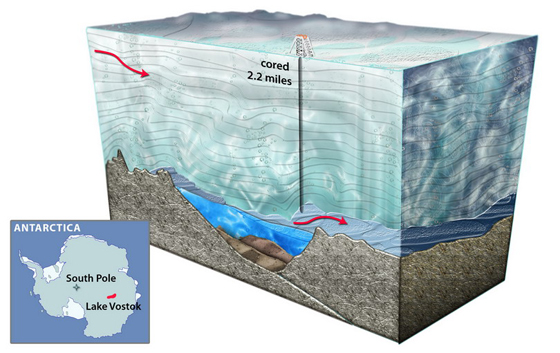
In 1996, Andrei Kapitsa, Igor Zotikov from the Institute of Geography of the Russian Academy of Sciences and their British colleagues summarized in an article published in Nature magazine, all the data of radar and satellite observations and made a final conclusion - at a depth of about four kilometers under the ice is a total area of about 10 thousand square kilometers and an average depth of about 125 meters.
At the Vostok station there is a pole of cold. It was here the lowest temperature on Earth was recorded - minus 89.2 degrees Celsius.
***
By that time, the 5G-1 well was passed to a depth of 3100 meters, and by 1998 to a depth of 3623 meters. According to Lake East, according to calculations, about 120 meters remained. But drilling was stopped at the request of the International Scientific Committee for the Study of Antarctica ( SCAR ) . Russian polar explorers were supposed to present “environmentally friendly technology”, which would eliminate external pollution in the relic lake.
The pause dragged on for eight years. During this time, French and American scientists came out of the project, who participated in drilling and paleoclimatic research (and received a third of Kern), and the drilling project became a national Russian project.
***
How not to spoil the lake? Brilling such deep wells in the glacier is no less difficult than rocky breeds. The well, left to itself, will quickly “swim” and disappear, it is necessary to make special efforts so that the drill shell does not freeze into the ice, does not get stuck in it. Over the 40-year history in the East, several drill shells were lost, which were stuck in the depths or froze in the ice.
To preserve the well, it was filled with a censer liquid - a mixture of aviation kerosene and Freon, which prevented the well from freezing. The walls of the upper part of the well were strengthened with plastic casing columns. SCAR was afraid that the bolt fluid when penetrating the Lake East could pollute it.
In 1999, Russian scientists submitted their proposals to the organization of the Antarctic Treaty . Their idea was to use the high water pressure in the lake, on which an almost four -kilometer thickness of ice floats on top. If the amount of cameline fluid in the well is not enough to compensate for the pressure from below, lake water will simply push the column of the filling liquid up, and then freeze, forming a natural plug between the lake and the outside world. In order to prevent direct contact of water with a bolt fluid, Russian scientists proposed using an inactive “gasket” - a layer of liquid polymer based on silicon, polydimethylsiloxan.
But international experts demanded that the effectiveness of this method be proved in practice. The head of the Russian Antarctic expedition Valery Lukin was indignant : “We were told: where did you check this technology, you only have theoretical developments, find some other lake in Antarctica ... But you understand-for this you need to create a new separate infrastructure, these are huge funds!”
However, Russian scientists did not have to look for the “test lake”. In 2003, the European NGRIP project ( North Greenland Ice Core Project ) reached the chipped lake in North Greenland at a depth of 3085 meters. And the penetration into the lake occurred exactly according to the script described earlier by Russian experts: after penetration, the water rose 45 meters upside down, and the toxic mixture of kerosene with Freon did not get into the lake.
In 2004, drilling was resumed - it turned out that in seven years the well did not deform so that it was necessary to start all the work again. In 2007, twice in a row, a drill shell stuck and came off from his cable at a depth of 3660 meters. Therefore, in January 2009, drilling began bypassing the emergency site from the mark 20 meters higher.
 © EPA / TASS
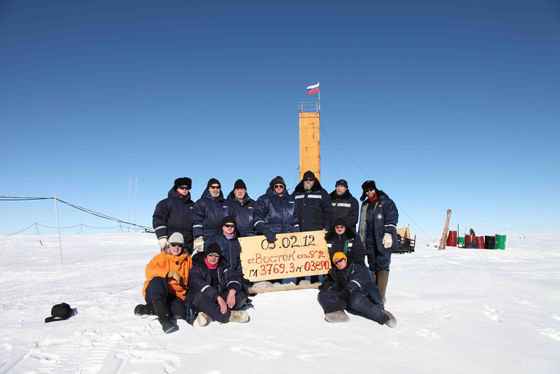
Finally, on February 5, 2012, at a depth of 3769.3 meters, the drill shell reached Lake Vostok. Scientists somewhat underestimated the pressure in the lake, and lake water rose around the well by about 500 meters up, pushing the bolt fluid, which spilled out of the well. After lifting the drilling shell, the first samples of lake water mixed with a censer liquid fell into the hands of scientists. It was this yellowish liquid that the polar explorers then brought with them as a gift to Putin when they were called to meet with the prime minister to the Kremlin.
In the next two years, polar explorers raked lake water frozen in the well to get samples of fresh lake ice. This year the drilling was continued, the drill shell went at a slight angle to the well to get into the lake at a different point. Finally, in the evening of January 25, Russian scientists re -reached Lake East.
This time everyone was calculated more accurately, and lake water rose only 45 meters.
“We wanted the pressure to be almost the same so that the water would not rise too high and that the water is“ traffic ”between the lake and the well, which could be quickly drilled,” says Andrei Dmitriev from the University of St. Petersburg, where they have developed drilling technologies for the east since Soviet times. In the future, he says, at the bottom of the well it will be possible to install a special heated device that will save it in open state. Through these “gates” it will be possible to skip probes to study the thickness of the lake and its bottom.
***
The Lake East was isolated from the outside world for millions of years, and if there is life in it, it most likely does not look like anything known to us today. However, the conditions there are very reminiscent of the situation on one of the satellites of Jupiter - Europe. Under the thick ice shell of this celestial body, a liquid ocean is hidden. The water in it is heated by the heat of Europe, which do not cool due to the tidal effect of the gravity of Jupiter.
The chances of finding life in Europe are even higher than on Mars, since there are no billions of years on Mars of liquid water, and it is now in Europe. In many ways, the conditions in Lake East are similar to the "European". The eternal darkness and the possible presence of sources of geothermal heat allow us to exist only chemoatotrophic organisms - that is, those that live due to chemical reactions and are able to do without the sun. Such organisms on Earth were found next to deep -sea hot springs - “black smokers”.
Ice of 420 thousand years, which was taken out of the well, helped to be born of global warming theory.
From the very beginning of the 2000s, scientists see a convenient training ground in Lake East for working out life search technologies in Europe.
“The Sky Lake East can be considered as the only extremely clean reservoir on Earth, capable of serving as a unique test site for finding difficult traces of life on ice bodies, such as the Jupiterian moon of Europe,” wrote scientists from the group of Sergei Bulat, an employee of the St. Petersburg Institute of Nuclear Physics, in Advances magazine in Space Research .
The first microorganisms that could belong to the lake ecosystem were found back in 1999. Then the 5g well at a depth of 3538 meters first entered a layer of ice from frozen lake water. NASA has issued a special statement, where it emphasized the similarity of the East and Ocean of Europe.
In 2004, a group under the leadership of Bulat identified thermophilic bacteria in samples of lake ice, living next to hot springs at a water temperature of 50-52 degrees above zero. Scientists wrote that the water water water is close to the freezing point (due to high pressure, the freezing point of water below zero: this is about minus two degrees Celsius), so microorganisms can occur from the outskirts of the East, where geothermal exits can be in rift zones. However, in all these cases, it was a question of single bacteria, and in addition, it was impossible to exclude the likelihood of contamination - pollution of samples with “extraneous” bacteria.
The moment of truth came in 2012, when the first samples of fresh lake water fell into the hands of scientists. The study was engaged in a group of cryoastobiology PIIAF under the leadership of Bulat.
 © RIA Novosti station "Vostok", 1984
***
Sergei Bulat, when he talked about his expectations, emphasized that we could talk about an absolutely “alien” life. The fact is that in the water of the lake there should be an extremely high concentration of oxygen (up to 0.7-1.3 grams of oxygen per liter) - water is formed from the melting “atmospheric glacier” saturated with oxygen, and it does not contain it again. Science does not know such oxygenophiles now. On the other hand, bacteria can exist at the bottom or in bottom sediments, on the border of two environments.
The first data was represented by a group of Bulat in the fall of 2012 at a conference in Stockholm, but turned out to be zero - the scientist could not find anything but pollution (biologists themselves call them the elegant term “contaminants”). However, by March 2013, the analysis of other samples made it possible to find something interesting - DNA of the bacteria that was not in the library of contaminants and was not among the already known gene sequences of bacteria in the Genbank database.
Bulat made a report on these results at a conference at the Institute of Space Studies of the Russian Academy of Sciences, and his message caused a sensation: an unknown bacterium was found in Lake East! The Institute of the Arctic and Antarctic even had to make a special statement that this bacterium has no threat to people.
Other scientists reacted to the data of the Bulat group skeptical. Firstly, they got samples of ice, chopped from a drill and approximately in a proportion of one to one mixed with a bolt liquid (that is, with kerosene and freon). Secondly, it was impossible to exclude that this is another contaminant, simply not included in the library of contaminants.
A year later, samples of “pure” ice from a red -raging well fell into the hands of Bulat’s groups. In 2014, he submitted a new report to the Cospar conference in Moscow, where he said that 49 types of bacteria were found in ice samples, all of them were contaminants, except for two, which were not able to classify and identify according to existing gene databases.
However, while these results were not published in a scientific journal, and the Bulat group itself notes that new samples of water from the lake are needed to obtain one hundred percent evidence.
Lake East was isolated from the outside world for millions of years. And if there is life in it, then it is most likely completely unlike any of the known to us today.
***
Repeated drilling and a relatively small “cork” left at the bottom will make it possible to systematically study the lake.
“The pressure will be balanced, and it will be possible to enter the lakes into the lake and study the lake, water and everything below. Брать пробы воды не в замороженном, а в “живом” виде», — говорит заместитель начальника Российской антарктической экспедиции Вячеслав Мартьянов.
По словам Андрея Дмитриева, специалисты из «Горного» уже создали и испытали зонд, который сможет добраться до дна озера и пробурить донные отложения.
«Мы считаем, что донные осадки имеют толщину порядка 10 метров. Там, как на дне любого озера, ил, и тех, кто изучает жизнь, интересует именно ил», — сказал Дмитриев.
Однако в этом году зонд уже в озеро не попадет. В феврале на Востоке наступает зимний сезон, буровики уезжают до следующего южного лета — а в Антарктике, как и во всем Южном полушарии, оно наступает тогда, когда в Европе и в США зима. Однако будет ли это «лето» — вопрос. Возможно, бурение на станции Восток будет свернуто из-за нехватки денег.
«С 2014 года мы занимаемся наукой фактически за свой счет, без целевого государственного финансирования… И вот последние новости — РАЭ вынуждена сократить расходы... Пока что речь идет не о полном закрытии станции, а о сворачивании сезонных работ, но для российской науки и это будет серьезным ударом», — пишет в своем блоге один из участников экспедиции Алексей Екайкин.
Проблема в том, что значительная часть расходов РАЭ — в валюте. Это перелеты, перевозка грузов, топливо. С ростом курса все они выросли многократно.
Еще в июне на встрече с Путиным директор ААНИИ Иван Фролов говорил о необходимости продления программы «Мировой океан», из которой финансировались исследования озера Восток. Проект программы на период с 2015 по 2030 год существует, но он до сих пор не утвержден, а значит, дальнейшая судьба проекта неизвестна.
***
Параллельно с бурением скважины к озеру Восток американцы и британцы запустили собственные проекты исследования антарктических подледных озер. В частности, американские ученые с помощью струй горячей воды пробурили скважину к небольшому озеру Уилланс, расположенному на глубине около 800 метров. Однако озеро Уилланс — проточный водоем, оно вовсе не изолировано, как Восток, поэтому степень его интересности для ученых существенно ниже.
Британский проект по бурению скважины к антарктическому озеру Эллсуорт, начатый в декабре 2012 года, был значительно более амбициозным. Это озеро находится на глубине около 3 километров и изолировано от внешнего мира примерно 500 тысяч лет. Британские ученые намеревались бурить скважину почти кипящей водой и сделать всю работу за пять дней, а не тратить годы на механическое бурение. Однако через 13 дней после начала, 25 декабря, проект был свернут из-за технических проблем — им удалось пройти только 300 метров ледника.
Поэтому пока российский проект остается уникальным.
 © eakademik.com
***
Все, кто занимается исследованием жизни в разного рода неприятных местах — в жерлах вулканов, в глубинах океанов, в стратосфере, — обязательно говорят о перспективах поиска жизни вне Земли. Возможно, это риторика, предназначенная для ушей тех, кто выделяет финансирование. В конце концов, изучение земной жизни не становится менее важным, если не иметь в виду астробиологические перспективы.
Но перспективы поиска не просто еще неизвестных бактерий, а «инопланетян» всегда волнуют публику, поэтому исследователи не скупятся и дают публике нужную «рифму».
Перспективы поиска жизни на настоящей Европе пока еще очень далеки от воплощения. Европейское космическое агентство ( ESA ) в начале 2000-х годов рассматривало проект «Лаплас» по исследованию Европы, в том числе с участием России. НПО имени Лавочкина даже прорабатывало варианты посадочного «европейского» модуля.
Однако данные о высоком уровне радиации (орбита Европы проходит через радиационные пояса Юпитера) заставили их пересмотреть планы — в 2012 году ESA официально одобрило проект зонда JUICE , который в основном будет исследовать самый большой спутник Юпитера, Ганимед. На нем тоже может быть подледный океан, хотя и не такой впечатляющий, как на Европе. Стартовать аппарат должен в 2022 году, об отправке посадочного зонда речь не идет.
Отправить на Ганимед посадочный и орбитальный модули предлагают российские ученые. Но пока их предложения не включены даже в проект Федеральной космической программы с 2015 по 2025 год (хотя и сама программа пока не принята, а в свете новой реформы Роскосмоса рассчитывать, что в ней будет много внимания уделено науке, не приходится).
В бюджет NASA на 2015 год включены средства на начальную проработку миссии к Европе — 15 миллионов долларов. Пока этот проект не включен в программу, речь идет только о предварительных прикидках. Если все пойдет по плану, зонд может стартовать примерно в 2025 году, но этот будет орбитальный зонд, которому только предстоит выбрать места для будущей посадки.
Но Лаборатория реактивного движения NASA уже финансирует разработку робота — бурильщика льда. Один из таких проектов — Cryobot — был испытан в Норвегии еще в 2002 году. Еще один — VALKYRIE — предполагает возвращение к идеям 1950 годов и бурение (точнее, выплавление) льда с помощью ядерного реактора.
Ждать экспедиции на Европу не приходится раньше, чем через 10—15 лет, и еще 7—8 лет на сам полет в систему Юпитера. Большинство космических программ концентрируется на задачах исследования Марса.
Автор благодарит доцента кафедры бурения скважин нефтегазового факультета НМСУ «Горный» Андрея Дмитриева и заведующего лабораторией криоастробиологии Отделения молекулярной и радиационной биофизики Петербургского института ядерной физики Сергея Булата за консультации и предоставленные материалы