
Translated material
Not without satanism
Krasnodar art scene is one of the most rapidly developing in today's Russia. First of all, we are talking about recycle groups (Andrey Blokhin and Georgy Kuznetsov) and ZIP (Eldar Ganeyev, Evgeny Rimkevich, Vasily and Stepan Subbotins). The latter a little less than a year ago, together with a related initiative - the Krasnodar Institute of Contemporary Art (KISI), was awarded the Innovation Prize for the amount of merits in the nomination "Regional Project". On the one hand, of course, they were nominated for sure, since it was about immigrants from one region who work largely with the realities of this part of Russia. But on the other hand, the activity of the ZIP and Kisi has long gone beyond the Krasnodar Territory: artists regularly participate in exhibitions throughout the country and in international projects.
It was all the more interesting to see the starting point of this process. I ended up in Krasnodar as a participant in the discussion about the relationship of artists and critics , but in the end I managed to talk not only about this. Coming - mostly artists and faithful visitors to exhibitions of contemporary art - all the more persistently asked questions (mostly addressed to themselves), the overall orientation of which can be formulated as follows: how do we equip the Krasnodar art process? It was evident how painfully the lack of some more or less developed in other regions was perceived-they mainly nodded to Moscow-institutions, such as art criticism and in general, the press dedicated to art, specialized exhibition spaces and more massive, but at the same time “its own”, which understands the viewer.
 © Group ZP
Moscow is not the best example, and not everything here is as rosy as it seems, there is nothing to envy, but in principle it is clear why the metropolitan situation is considered as a kind of standard. (I specifically note that I don’t exclude myself from all that was said about Moscow.) The main ships of the conversation about the art process in the Russian Federation are concentrated in the “Center”, most “talking heads” are right there. Plus money, plus museums, galleries, funds, etc. Naturally, when you encounter this, it seems that "here it is, life!" - Although it is clear that if it is not an absolutely false picture of the world, then at least very distorted. Regional scenes have-perhaps so far, temporarily-their advantages, the most important of which is an interested, and not fatigue, satellite audience, as in Moscow (and equally interested artists, and not Facebook stars, infinitely divided with each other with skepticism). Such spectators in the capital can probably be found only where the situation is completely close to a semi-official existence, in places that fall into which are associated with any difficulties, as a “electric factory” gallery , for example. In addition, any lack of the current state of affairs (not only in the field of art-about the local context, with Cossacks and crazy power, Valentin Dyakonov spoke out , who visited there shortly before me) creates a field of opportunities and enthusiasm, which as a result can result in something curious-it all depends on those who are doing this.
 © Group of SIPs
A week before the discussion with my participation in the same “Printing House” space, the place where exhibitions, lectures, display, discussions are held, in fact-the headquarters of Kisi, the exhibition of the ZIP group with the game in the name “post-observation” was opened.
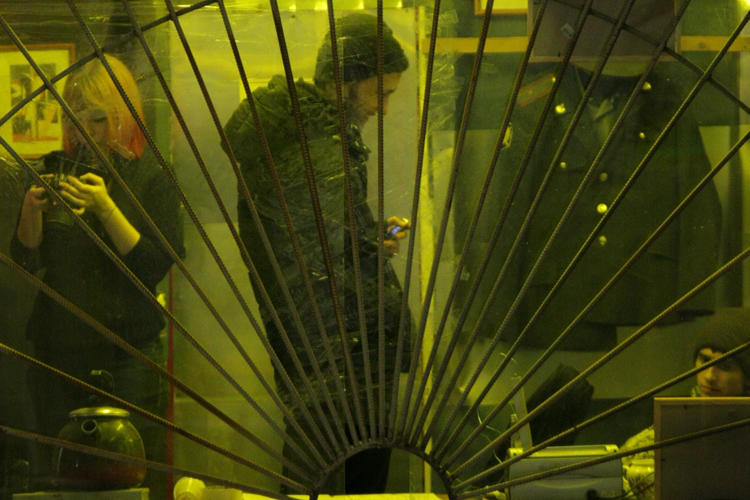
There is really a post - a real security post, there is a hostel in the “printing house”, and therefore it is a logical room located at the entrance, although not used for its intended purpose: the night duty officer, as practice has shown, is anywhere, not in this place, except for episodically. From the post, the exposition begins. You can, in principle, stay there for a long time, looking at the work that fall into view, and wondering on a map specially made to the exhibition, what is shown there. Zipa themselves do not deny such an opportunity.
 © Group ZP
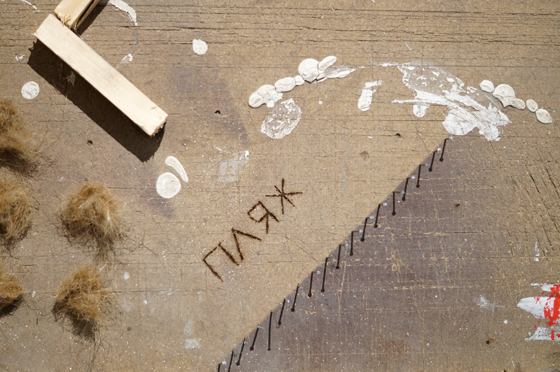
The exposition consists of separate jobs, which, as Stepan Subbotin told me, it makes sense to study on its own, and not in the general context, although this statement was challenged by other members of the group (and Stepan himself) a little later.
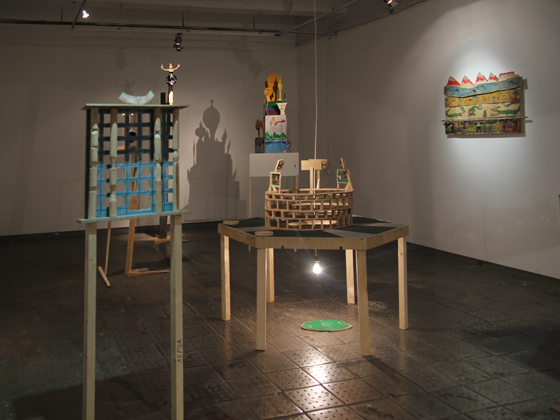
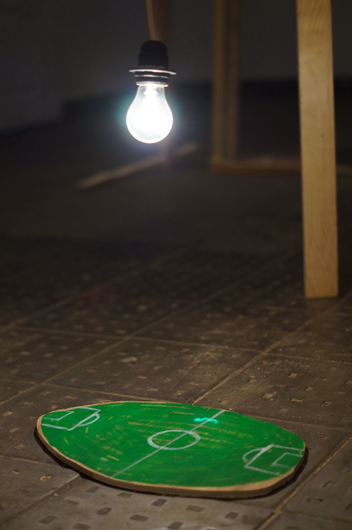
The “post-observation” continues the line, which the grouping of the ZIP began, apparently, last year’s exhibition “Utopian Skeleton” in the XL gallery. It was in some way a gap with the previous line in their activities, when they talked more about communication, community, etc.: This was interesting, but until a certain moment. And then, in the XL , and now, in the “printing house”, the exposition is built as many objects supported by specific mythology, the source works of art, iconic buildings and monuments serve as the source, this can also be some kind of area and object. Then, in the spring of 2014, it seemed to me that the selected “method” is similar to the Eskavir “rules of life”; Now I'm almost sure that this is so.
 © Group ZP
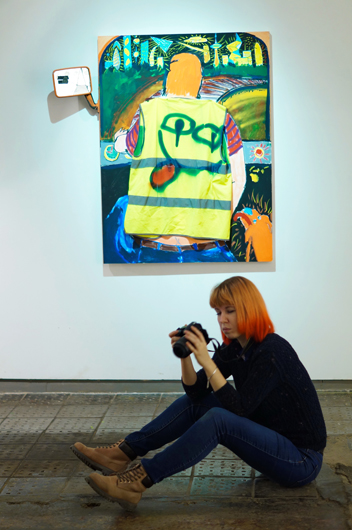
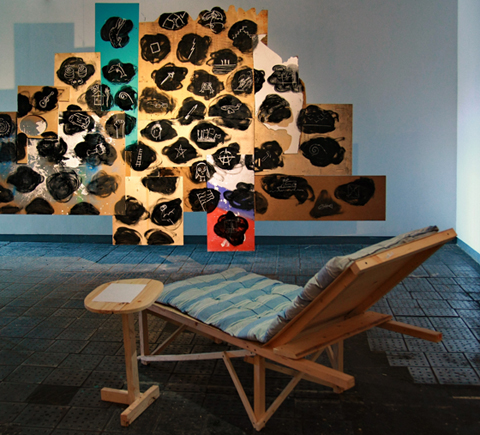
An important point: these are not static, taken post -fact from the deceased or already “past path” of the leader, as in a famous magazine, in the ZIPs, on the contrary, these fundamentally important mythologems are in a state of movement and change. The artists pick up the word or expression just dropped by someone and give him the importance of universal scale (it is possible to forget soon)-this happened with the expression “Krasnodar Romantic Satanism”, invented by Dyakonov in connection with the official monumental and those enchanting obscurantism, with which the ZIPs are not only in the confrontation, but also in interaction. Judging by the map, a large zone at the exhibition was highlighted “romantic Satanism”: there is “black” or, as the local artist Valery Kazas, brown Catherine , and the interactive figure of the Cossack, who can be twisted for the fishing line and waved a saber (probably a hint of the relations of the authorities and the Grand Cossacks). "Human Cossack Court", and much more.
 © Group ZP
A significant part of the exposition is devoted to intra -artistic issues, but these are issues that are not so important for the ZIP group, Kisi and generally there (although there is a certain binding to the Krasnodar realities), how many fully converted to the all -Russian and, if you make the necessary efforts, the world context of history. There are models of self -organized spaces, self -proclaimed museums and galleries, monuments dedicated to artists, and situations constructed due to great energy that has accumulated in a long time and has not yet found a full -scale exit.
At this exhibition, one can judge the local situation with which I started. And it contains, apparently, the solution of the problems that was discussed during the discussion. On their own, in some places, perhaps invented a bicycle (this is just not scary at all), artists are capable of working very productively in the most hostile conditions, the main thing is to follow, no matter how trite it sounds, creating a creative impulse. To bend your line, as they say. And no Moscow in this process is needed.