
Translated material
The horizon was overwhelmed

In China, its Chernobyl came - as a result of a viral attack on the Asu, the cooling system flew, and overheated rods blew up a reactor to hell. So far, a few Chinese masses dramatically plays a fragment of the film “Earthquake”, the military sent to New York their emissar-the officer of the digital troops of Chen, who should rescue from the American prison of his classmate Nicholas Hatuay (he is played by Chris Hemsworth, a constant performer of the role of Thor in Marovel film files). Hetway is a hacker serving a 12-year term for fraud with credit cards, but only he can calculate the creators of the harmful worm that threatens the world. Hetay, ringed by radio, and a few days later, the attack of exactly the same worm infuriates the price of soy futures.
At first, the investigation goes busily and meticulously: Hetay and the opera -play assigned to it either the associates or the warders go to the arrows, fight with the gorillas in the Korean restaurant, glow on the surveillance cameras, spin a chain of intermediaries and dummies, and so on. But as the fog of the war scatters, the wildest picture of the world crawls out onto the screen - the Lebanese veterans work on the drug carriers of Colombia, the crowds of armed Indians easily walk around the Beijing, and the main villain who has eaten in a carved house in Jakarta shakes the ashes in the bronze skull, rents companions and develops the world's plans dominance, not releasing from the hands of a wireless keyboard.
Yes, Michael Manna’s new film looks strongly at Bondian soaked in vinegar. This is all not at all scary and rather ridiculous than funny - even if you take into account the tendency of director Mann to documentary realism in all the details of the plot and dialogues (however, is it not so - paranoid - and there are always attempts to get to the bottom of the truth?). To delve into the details of the plot -forming intrigue quickly bothers (many viewers rightly characterize the film as simply boring) - but, fortunately, there is something to do at the “kiber” to the viewer, besides to root for the fate of the world. Mann's realism applies not only to the narrative, but also to the image, and in the case of Kibera, this image is not so much as actor Hemsworth as the world in general. The geography of locations extends from New York to Kuala Lumpur with entries in Los Angeles, Hong Kong and the Malay Province. Each of them is not just marked by action scene-the situation every time provokes the specific nature of the conflict (in the case of this film-armed), and often the battal scheme itself serves as an allusion to some spectacular episode from previous films, like “Cyber” is not discrete work, but a festive cloak from “Finds of the director”. Sea operations from the Miami Police, Strand Front Fright, and so on. The movement of bodies and bullets in space, confused pauses, during which the heroes are desperately trying to navigate in a stranger, an exotic landscape, where they were thrown by the arbitrariness of a conditional, optional plot. A series of attractions that replace the narrative, or returning the cinema to its infantile, dogful state, or throwing it forward, to the vanguard (the similarity of the early cinema, the film van and ultra-consumer genres of the commercial, the video clip and for some time of the action-blockbuster- a common place for a long time).
 © Universal Pictures
And finally, the final fight, somewhat reminiscent of theatrical mass action in Chana Chanae's usa-films: thousands of people with torches move harmoniously-indifferent statists who are lying like a sickle-ears, shallow bullets. Through this human field, an antagonist and a protagonist break through to each other in order to converge in the final chisel. The camera, previously scrupulously fixing every crack of concrete surfaces, every tile of the tile on the wall, all the flaws of the skin of the actors, suddenly go down into defocus, turning the action into a duel of color spots, the dance of lights, a kaleidoscope of colors, frankly advertising all the possibilities of today's digital cinema.
Actually, in recent years, we mean this most omnipotent digital camera in recent years, saying Michael Mann. Super -cut night shooting of shootings from large -caliber machine guns at the Miami Police - Red camera at the same time made visible everything that was previously hidden in the shade, meaningless the very name of the Neonoire genre. Or dirty brown and shaking like a criminal telechronik, the picture "Johnny D." (This unprecedented attempt to remove the historical action in the language of the police reality show caused nausea more than delight among the audience; Mann himself explains this by the poor quality of film copies from the digital original, twisting the MIF adopted by the most films about the advantage of the film before the digital projection).
Mann’s relationship with the camera was always akin to the fact that they established with Dziga Vertov and his “cinema”: fresh, enthusiastic and passionate. Fearlessness here is especially important: after all, only when appearing, the camera (both photo- and later film) humiliated the person, questioned his whole world, opening those who looked at dagherrotypes and feces, incompleteness and falsity of their own perception. This conflict between the person and the technique created by him, the creature exceeding its creator is perhaps the main of all the conflicts with which Michael Manna films are filled. Their protagonists-dexterous professionals, factum-sociopaths-are distinguished precisely by this superhuman ability to see the invisible, saddle of modernity, not becoming slaves of technology, but to master it-like John Dillinger, who armed his fighters with the latest Thompson assault rifles and an advanced, almost military, tactics of raids, put them on cars with powerful engines.
 © Universal Pictures
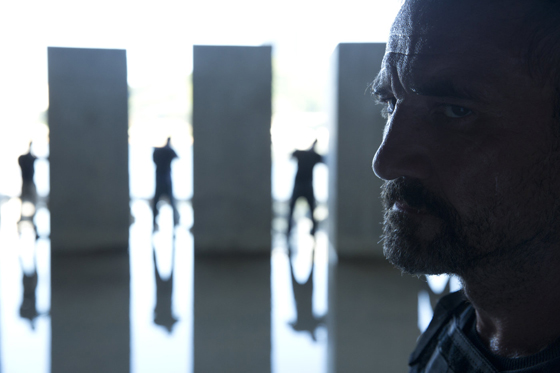
But no matter how dodgers these raiders, bear cubs and hackers are, the camera in the films of Mann always sees, knows and feels more than them. Sometimes it even seems that she looks at the immense landscape, which is important for the director no less than a close -up (for example, romantic scenes with the cooing of de Niro and Amy Brenneman, against the background of the city of lights in the “battle”, shot with the “green screen” - so that the lighting devices did not spoil, God forbid, a contrasting panorama of the night Los Angeles). In the "kiber", where Hemsworth, who knows how to push up, plays the main role, the landscape enters the game immediately. Five minutes after leaving the cramped prison, the Hemsworth Hero is at the airfield, where he flows into a minute catatonia with full paralysis of the facial muscles. The camera follows his gaze - and the huge plain space, which goes into the infinity of the horizon, makes all the words and gestures excessive.
And Mann restrains this promise of the will, given, first of all, to the viewer. A tedious action-triller is a beautiful, measured travetel-and as a film about the change of places and their aura it is no worse, but much richer than the static landscape video of James Benning, or Sharon Lockhart, or our Provmyza.
Everything is also very beautiful, close, almost tangible - but also fun. The vertical architecture of the Chinese metropolis is replaced by horizontal topography of the underground catacombs. Concrete grayness of tunnels - flat blackness of the night sea. The inexpressive linearity of the cosmopolitan, indistinguishable business centers, whose streets are so well shot-are so well-a loop of the Hong Kong subway car, which is either bamboo thickets, or to the endless row of arches that Japanese often erected before the synthist temples.
This landscape, much more heterogeneous and no less expressive than the action itself, enters into dialectical relations with the heroes-exactly as in the avant-garde films of the Japanese revolutionaries of the 60-70s, preoccupied with the repressive effect of the reactionary bourgeois environment on the mental psyche. He determines their logic and actions, externalizes their inner world (almost an anecdotal fact - in his “man” Mann selected the wallpaper pattern so that they corresponded to the mood of the hero of Russell Crowe). The visible landscape in the "kiber" always hides the invisible, behind him, like behind a painted hearth, some rusted door, leading down, is always hiding. Having descended, we literally find ourselves as if behind the scene, in the secret, shadow space of mechanisms, communications and wires, space similar to that cloudy noosphere that turns out to be a real reality of Kibera.
 © Universal Pictures
Mann's desire to visualize this hidden, inaccessible to the limited sensory capabilities of a person, sometimes even excessive - opens the film an episode, in which, by analogy with the initial scene of the Thief (macro -filming of a safe lock during a hacking), the viewer is opened with a micromyean of craft, borders on vulgarity. The camera penetrates the system unit and deeper, deeper, into the plexus of silicon grilles-and now it, a wave of bits-foles running along the fiber-optic cable to the terminal of the nuclear power plant. This is too similar to the visualization of metaphor - but manna does not care: his positivist belief in the possibility of technology excludes the very concept of metaphor.
Mann is fascinated not only by eliminating real numbers and data from the representation of real, but also to hiding its apparently. The phenomenology of Kibera is not much different from the one that video artists are concerned about, turning ordinary ordinary in the elements, into elements. That naturalistic and at the same time dreamily-dumped manner, with which Mann removes the types of sandwashing and crevice between two skyscrapers, torch marches in the jamart and shelves for dishes in a cheap Hong Kong apartment, gives out its serious concern to the representation of such basic categories as night and day, empty and excess, statics and movement. It seems that he seriously believes that the possibilities of technology will give him the ability to see the geniuses of the place, to shoot the spirits of wasteland, crossroads and embankments.
The hero can only dissolve in this throbbing landscape, stop annoying the viewer with his heterogeneity and constant turmoil, which he brings to a smooth slide show, something similar to the “landscape” British television series (a genre that has not been accidentally arising with the advent of HD- TV ), to become a blot in a sea of fire. To surrender in front of the camera, having declaring her tired, swimming look from overvoltage.