
Translated material
Fire test
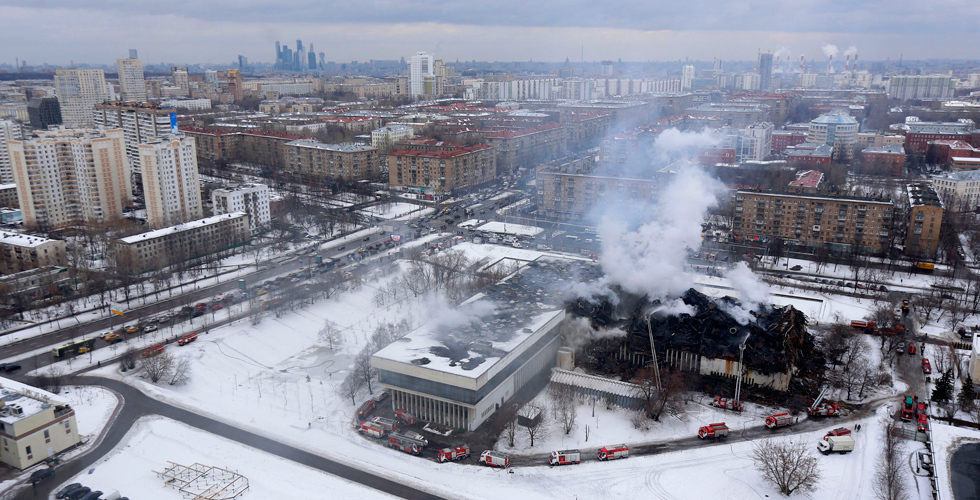
In particular, some institutions that were located in his building, including the German Historical Institute and the Center for Franco-Russian Studies, suffered from a recent fire in Ionion. Two years ago, the current director of the center Helen Mel was a coordinator of a round table dedicated to the sacredness of the book. It was made by Mikhail Mayatsky with a report, which involuntarily acquired the sinister relevance these days.
The meeting of the letter and fire was predetermined. Fire as an element opposite to water, just like it, promises a radical update, initiation, baptism, new birth.
A lot was written about the paradoxicalness of the sacred (Sergey Zenkin recreated the impressive panorama of this intellectual tradition in his recent book). The sacredness of the letter, text, the book is approved and addressed by fire. In a sense, a dark but important side of the history of the book is a fatal story of meetings of paper and fire. Paper and fire are created for each other. A person produces tons and tons of paper, covers it with his letters, then to sacrifice avenue (in Greek Holokaustos ), i.e. In an inconceivable sweat, it endlessly throw it into the mouth of an equally inconceivable counterpart, the god-Knigo-Knigodist.
But, it seems, this transcendental bookzhora was fed with paper and requires other gifts. Bobbins, cassettes, chips, discs, hard drives, mega-, giga, terabytes ...
In our rhythm of daily apocalypsis, the forecast about the “death of the book” cannot even cause a hint of fright in us. As a changeable mood of the teenager, technological delight is replaced by nostalgia for bright and, as we strongly suspect, unique meetings with the book. But either the books were different, or we are younger ...
The evolution vector is steadily directed towards better combustibility.
Modern fears about the survival of the book involuntarily homogenize its story - as if it remained unchanged over the past two millennia (and this is the age of the book in its friend - a rectangular sheet stabbed on one side). However, the process of its production, and the network of its distribution, and the practices of its consumption were greatly varied, and not only according to the temporary axis, but also in geographical and social dimension.
If you integrate the history of the book into a more extensive history of writing, then the growing tanatoid trend should be noted in the use of its carriers. Writing was evolved from stone through clay (which was made strong first through simple drying, but then firing, that is, through a meeting with fire) to papyrus and paper, thus preferring convenience - durability. The Chinese first wrote on the bones (mainly cow blades) and on the turtle shells. Then on the bamboo, until the paper was invented: the vector of evolution, as we see, is steadily directed towards the best combustibility. In addition to the fire, a meeting with water became more fatter for the carrier. If the fire threatened with rapid and unhealthy destruction, then water, damp led to slow corruption. In the latest history of libraries of libraries, measures to extinguish fires often brought as much (if not more) damage, but the fire itself.
Fire appears to be the elements of vital, but also dangerous, beneficial and merciless - and at the same time sacred and sanctifying. The fire of the hearth symbolizes the life of the house; They betray the dead by fire; Burning sacrifices, they are transferred to the gods. The whole story (and traditionally historical science considers the border between the background and history just the invention of writing, which, of course, should not be represented as a single -mopping act) is marked by fires that destroyed - from the point of view of the historian - and a lot of unique sources.
Traditionally, this sad story is being erected to the legendary fire of the Alexandrian library. This refers to the destruction of 272 years; In fact, this is a whole series of fires, from II to the 4th century AD, first made by the Romans against the rebellious province, then Christians against the Gentiles. According to historians of natural science and technology, these fires threw science about a millennium ago; She caught up with the ancient level only by the 16th century. But even before, after and in parallel with the destruction of the Alexandrian library, a mass of less ambitious ones, than in Alexandria (or Pergamum), attempts to accumulate knowledge - both in Europe and in Asia, was betrayed.
The religion of one book (what unites Christians with Jews and Muslims) is fraught with troubles for all others.
As for the European-Mediterranean area (library fires are not limited to them), the transition from antiquity to Christianity was marked by the transition from love to thoroughness and systematicity in the burning of books.
Here the peplum (beautiful costumedly-battal movie about the ancients- Le Péplum ) ends and the chernukha of real biblias begins: with the beginning of our era, the capricious and random wrecking of the ancient authorities will gradually give way to organized absolutism, aimed at strangling in the embryo of any intellectual doubts [1] .
The religion of one book (what unites Christians with Jews and Muslims) is fraught with troubles for all other books. Already Pavel (in the education of which, however, more than one book has played a role) red -combined other books in Ephesus and burns them with a large gathering of the people.
Further - more.
In475 (under the ephemeral and ignorant basilisk), the Constantinople Imperial Library burns, undoubtedly the largest in the then ochumen: 120,000 volumes. The billed zenon, who is overthrown by the Basilisk, returns and restores the library, which Leo Izavr then burns. And so on. Since many books are decorated with pictures, they (along with icons and other images) become in Byzantium the subject of disputes between iconoclasts and icon readers. Twice or three times, emperors are ordered to bring them authoritative theological books that would help to make a decision in this dispute is unsuccessfully: it is no longer possible to find these books, since they were burned in previous fires.
In the 40s of the IX century. Patriarch Fotiy is taking up the famous “Library” (or Miriobiblion, that is, ten thousandth), a description of all read (and available?) Books. But his relationship with the authorities is very conflict. In the next strife, his library is burned. From 110 of the 386 books described by him, only the Photiev resume reached us. Another 211 has not been preserved in the volume that was described by the Photius. What survived and survived these cataclysms subjected to robbery and destruction by the crusaders in 1204. But in the 1261th, Mikhail VIII Paleologists are restoring the library, which is the last before the fall of Constantinople in 1453.
109 Plavt's plays burned, almost all of Varron, 107 out of 142 books on Roman history of Titus Libya, a lot of books by Tacitus and Pliny the Elder (37 out of 500 survived).
The Turks turn out to be more ruthless to people than to books, some of which (though insignificant units) soon find themselves in the book market and is acquired by Italian Bukinists. However, for example, many volumes of the “historical library” Diodorus of Sicilian disappear irrevocably.
Constantinople, fortunately, was not the only place of concentration of books. However, because of this, there was no only place that underwent fires.
Caesarea Palestinian is a city and a deep -sea port, where Origen in the III century creates with the help of seven stenographers, seven copists and numerous calligraphers a huge library. This thinker of the Neoplatonian sourdough was discovered by a variety of intellectual, scientific and religious trends. This is also a uniform workaholic, judging by his hectes - written in six columns (from where the name) are options for the Old Testament. Valid by the Persians in 614, a library brought by the students and successors of Origen Pamfilia and Euches of up to 30,000 volumes, was burned by the soldiers of the caliph Omar in 640.
The regrettable list of losses, that is, for the most part of the burned manuscripts, is known for a long time and is familiar to us from the source -master chapters of textbooks of the history and history of literature. 109 Plavt's plays burned, almost all of Varron, 107 out of 142 books on Roman history of Titus Libya, a lot of books by Tacitus and Pliny the Elder (37 out of 500 survived) ...
The same in China, about which historians argue, 12 or 14 times “absolute disaster” occurred, that is, the combustion of “all” (or almost all) books.
The countless Christian books were burned by pagans. For several centuries, these fires were combined and alternated with the burning of pagan books by Christians. The most popular basis for burning was the accusation of books of involvement in Magic. Gentiles beat like “magical” Christian books, and Christians are pagan.
Finally, the outgoing era found an ideological compromise with the upcoming-on the Stoic-Ner Platonic base. Then the turn of the burning by Christians of already Christian, but heretical and foreign (so to speak, foreigner) books came. However, not only books were burned: paintings, mirrors, rich clothes, musical instruments - all this was subject to “Tuleslavlia”, Falò delle Vanit , bûcher des vanités .
How to forget my contact (by inexperience) with sectarians in Switzerland somewhere in the early 90s: an elderly American missionary with tears of tenderness in her eyes (for which she has been touched by her own Success Story ) told a small assembly as the main priest of the tribe in which she settled, whose daughter she successfully instructed the gospel path after long resistance, after long resistance In the end, he himself burned all his books and amulets.
Regarding China, historians argue, and a “absolute disaster” occurred 12 or 14 times, that is, the combustion of “all” (or almost all) books.
Similarly in Islam: which coincides with the Qur'an is unnecessary and what does not match is dangerous (but it can be useful, for example, for heating Hammams). When the Caliph Osman selects and plants the only correct version of the Koran, he orders to collect and burn all other lists (however, in vain: the complete unification of the text of the Qur'an is not reached today). A similar occurred in Cordov and other centers of Muslim scholarship. First, mutual intensity in competition for orthodoxy, then the destruction of the Mongol conquerors - along with buildings and their inhabitants.
Similarly - and more - with Jewish books. Pope Grigory IX in 1239 orders to use the Shabbat (and therefore the presence of Jews in the synagogues) to withdraw all their books and give one of the poor orders for examination. The verdict was speedy and waiting. 24 books of books were publicly burned in Paris between 1242 and 1244. The province also did not lag behind. The procedure continued, by order of new dads, until the 16th century.
The Inquisition (in particular, Spanish) was noted by giant autodafa in 1559 and 1560 (Qur'an, Torah, etc.). But many books finished life not at the stake, but in the private library. Philip II of Spanish himself was an incredible bibliophile, and ultimately many books from the index of forbidden books, Index Librorum Prohibitorum , ended their way in the ... Royal Library in the giant monastery of the escorty near Madrid. On June 7, 1671, one of the rockets of the festive fireworks fell into it, causing a fire raging for 15 days. Despite the dedication of the monks who threw books to the windows trying to waln the doors, etc., tens of thousands of Arabic, Greek and Latin books and manuscripts were killed.
The case of a dispute between the early 16th century is interesting between the humanist and the Catholic Johannes Reichlin and the crossman Puffercorn butter about whether Jewish books are harmful to Christianity. He is known for the Russian reading public by the “letters of dark people”, the parody-satirical work of that era, translated by N. Kun, and then S. Markish later. Reichlin was attracted to examination, and he responded with the book “Augenspiegel” , that is, “Eye Mirror, or a recommendation about whether to confiscate, destroy and burn Jewish books” (1510). The discussion was multi -part and dramatic. Reichlin was ultimately justified, but in compromise halves. More than once during the dispute, both his book, and the author himself risked burning at the stake.
As for the twentieth century, here to mention the book victims of the two world wars seems blasphemy in the face of human victims.
It is rarely said about fires caused by military operations in the First World War, and there were many of them. The Louvens library lost its 300,000 volumes in August 1914 (it has to be almost grateful to the French, who in several receptions took out the most valuable funds to Paris, in other words, robbed during the French Revolution). Between 1914 and 1915, rich libraries burned (only in France) in Arras, Tour, Bow, Douis, Chartra.
The burning of the book, according to Nahman, is what you can wish for it. So she eludes the appropriation of interpretation. The book must retreat, disappear.
But all this, of course, fades before the Second World War. In order of sad jokes: the Luvensky library managed to revive from the ashes (thanks to not only German indemnities, but also the gifts of England and Japan) was again completely destroyed and burned in May 1940 [2] .
But the same fate awaited the unique libraries in Florence, London (the Bukinist quarter was completely bombed), Leipzig (with his Museum of the Book), Dresden, Hamburg (however, the list of German cities may drag on).
If the fires of libraries as a result of raids can be attributed to side effects of bombing, then the ritual burning of books on the eve of the war was furnished as a sacred and consecrating action. It undoubtedly made up part of the Nazi neopagan cult of fire. From the ashes of the old civilization, a new - and new person should have been born. In the conquered countries, Germany combines a policy of burning books with the foster of those that may be of commodity value. But the relatively little that was taken away was mostly burned in fires caused by allies bombing.
Among the victims of fire, along with the tremendous book losses with Polish libraries, Kyiv (4 million volumes), Kharkov, Smolensk, but also such symbolic places as a clear meadow.
The paradoxical bibliophilia of the Nazis consisted in thorough selection and accumulation of books along and in parallel with official autodafa. In March 1941, the Frankfurt Institute of the Jewish question was founded ( Erforschung der Judenfrage ), whose library has accumulated more than half a million books by 1943 (the same amount was already on the way, but did not manage to get to the goal) - of course, confiscated in Amsterdam, Paris, Saloniki, Kiev, Riga, Riga, hosts which were expelled or destroyed along the way. The library and the institute were supposed to embody the dream of Judenforschung Ohne Juden - Jewish studies without Jews. Jews and the sacred nature of the book - of course, a separate topic. The fact that Abrahamic religions are the “religions of the book” undoubtedly had colossal cultural consequences, and all of humanity continues to move in the wake of this fact.
But the Talmudic tradition protects the Jews from ensuring that their immense love for Torah has grown into admiration for her. The Torah can also become an idol, and the veneration of it is idolatry, torolatry . Moreover, this applies to other books. “The people of the book” (by no means the only one, of course) with his characteristic radicalism brought the matter to paroxysm, but also to clarity. Hasid and grandson of the founder of Hasidism Rebbe Nakhman from Bratslav completes his main book in 1806. Whether the death of his son, wife or discovery of his own tuberculosis influenced his decision - here biographical information diverges, but he decides to burn the book - and burns it. She entered the tradition - under the name "Burned Book." The burning of the book, according to Nahman, is what you can wish for it. So she eludes the appropriation of interpretation. The book must retreat, disappear . To give a place in the soul to another, you need to create a void there. The same with the book. Contrary to the pagan (ancient, Greek) tradition, which puts on the logos, which leads, the phenomena makes visual, the book must retreat to give the place of uncertainty, tension, conflict. The book is akin to the name of a sacred and unpronounced tetraram. Its foundation, place, environment - silence, absence. Like the tablets of the law, it must be broken, burned to be read. Read, not being assigned, discharged, neutralized, for the answer is the worst misfortune that can be shaken with a question. Is it because the horizon of destruction of books should be provided as the abolition of answers, as a guarantee from fossilizing meaning? Another path is a text that offers different solutions, different ways (like a Talmud).
Is it not for the fires, the civilization from cultural overdosis would not have suffocated for a long time?
That fires are not the property of the past (or even the past centuries), sadly proves the fire in 2004 of the famous Duchess of the Duchess Anna Amalia in Weimar, whose trustee was Goethe and which only at the time of his death totaled 130,000 volumes.
Fiction also constantly pursues a nightmare of a fatal meeting with fire. Гоголь, сжигающий вторую часть «Мертвых душ», булгаковское «рукописи не горят», «451° по Фаренгейту» Рэя Брэдбери, «Ослепление» ( Die Blendung ) Элиаса Канетти, герой которого, «книжный человек» Кин, сжигает свою библиотеку и сгорает в ней сам. Но уже Сократ и Платон сожгли свои (соответственно поэтические и драматические) грехи молодости.
Герой романа М. Шишкина «Письмовник» также находит необходимым сжечь свои юношеские сочинения, чтобы из их пепла родился наконец взрослый человек:
Я сжег все написанное и не жалел об этом ни минуты… Мне нужно было измениться, стать другим, понять то, что понимают все, кроме меня, и увидеть то, что видит каждый слепой! <…> И знаешь, что странно — те тетради давно превратились в пепел, но себя, того, прошлого, я начинаю сжигать только здесь и сейчас.
«Конец книги», о котором так часто говорят сегодня, — не был ли он «уже всегда» вписан в бумажный диспозитив во всей его уязвимости перед пламенем? Но со сменой технологического эона меняется и главная угроза: она исходит уже не от огня, а от того «увековечивания эфемерным», которое называется виртуализацией. Разве информатизация-виртуализация не спасает в какой-то мере от огня? Да, но не для того ли только, чтобы подвергнуть текст другим опасностям? Чтобы изготовить микрофишу или скан, нужно раскрыть книгу (в частности, старинную) так, как противопоказано ее переплету. При этом неизбежны ошибки при сканировании. Периодически требуются технологические устройства для перевода с устаревшего носителя на новый (а они устаревают в разы быстрее, чем бумага). Уже сегодня многие библиотеки тратят на информатический инвентарь больше, чем на книги. Создание новых мегазданий для библиотек сопровождается отбором и отправкой под нож (т.е. на макулатуру) сотен тысяч книг.
Но разве все наши стенания и сетования не лицемерны? Если бумага пожирается огнем, то мы, читатели, разве не снедаемы всегда огнем стыда, что читаем так плохо и так мало? Разве не оказались бы мы только излишне, непомерно обременены грузом прошлого, если бы — гипотеза чудовищная не менее, чем вандализм поджигателей, — сохранились все книги (тексты), написанные в истории человечества? Разве, если бы не пожары, не задохнулась бы уже давно цивилизация от культурного овердоза (она и так жалуется на Kulturinfarkt [3] )? Разве затеряться среди книжного хлама — не такая же реальная и фатальная угроза для «хорошей книги», как пожар или потеря каталожной карточки? Разве дошедшие до нас книги Диодора Сицилийского [4] или Плиния Старшего не выветриваются из так называемой общей культуры, по сути, немногим отличаясь (что касается массовой рецепции) от исчезнувших в пламени?
И противники, и сторонники оцифровки книг указывают на то, что с переходом от бумаги к экрану меняется характер чтения. Он становится фрагментарным, дискретным. Не продолжает ли фрагментарный (в силу выеденности огнем) характер бумажного наследия человечества определять форму его потребления и после бумаги?
Выступление на круглом столе «Le livre est-il sacré?», Московская международная книжная выставка-ярмарка, 6 сентября 2012 г.
[1] «Ici, à peu de chose près, se termine le péplum et débute le film noir de la vraie biblioclastie: avec les premiers siècles de l'ère dite commune la malfaisance caractrérielle et un peu hasardeuse du pouvoir antique va laisser progressivement place à un absolutisme organisé qui vise à éteindre dans l'œuf toute errance intellectuelle». Lucien X. Polastron, Livres en feu. Histoire de la destruction sans fin des bibliothèques, Denoël, 2004, p. 55.
[2] В 70-е годы с библиотекой стряслась еще одна беда, уже не связанная с огнем: ее фонды были разделены — по четности/нечетности библиотечных шифров книг — между фламандским Лёвенским и валлонским Лувенским университетами, не сумевшими договориться о более разумном способе раздела.
[3] Действительно, нельзя ли сказать о библиотеках то же, что сказано в подзаголовке к недавнему памфлету, а именно: «Всего слишком много, и везде одно и то же»? См.: Dieter Haselbach ua Der Kulturinfarkt: Von Allem zu viel und überall das Gleiche. Eine Polemik über Kulturpolitik, Kulturstaat, Kultursubvention. München: Knaus, 2012.
[4] В порядке грустно-поучительного анекдота: полный русский перевод дошедших до нас частей сочинения Диодора Сицилийского был опубликован в 1774—1775 гг. тиражом 300 экземпляров, но в 1808 году 237 оставшихся книг, которые не удалось реализовать, были проданы на вес как бумага.