
Translated material
Tedlur of the drowned
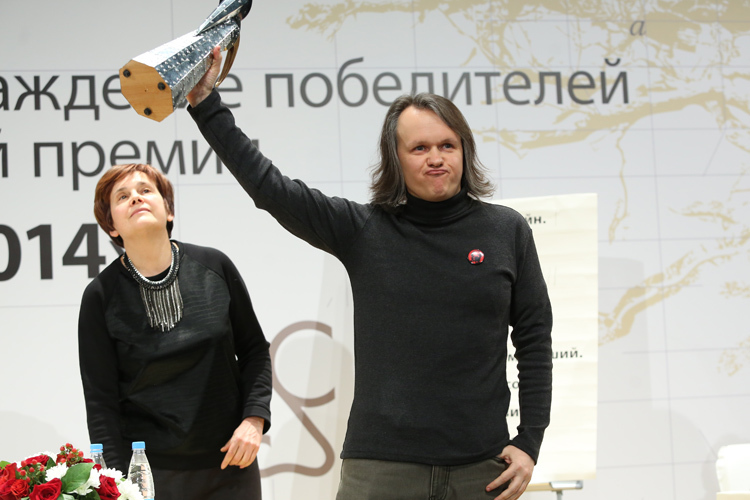
As the reader is probably already known to the reader, Alexei V. Tsvetkov (who is often called Alexei Tsvetkov Jr., which is funny, but not quite correctly, was known to the reader. The victory of Tsvetkova, who received a prize for a small book of stories and novels “King of the drowned” (M.: Common Place , 2014) was a surprise: nothing foreshadowed in the course of traditional debates of such an outcome, except for several, almost ritual, reminders that intrigue is always preserved in this award.
The debates themselves, in general, are completely non -healed, not only passed without intrigue, but probably became the first in the history of the award, when most of the time (on my estimate is 70 percent), the jury and experts discussed only one book, argued that it was more important in it - the artistic features of the language or the fact that it, according to the expert of Vladimir Mirzoev, is “more than the novel.” This is, of course, about the "telluria" by Vladimir Sorokin.
Sorokin at the end of last year received the second prize of the "Big Book", losing Zakhar Prilepin (which was regarded by many as a regrettable event); In a short list of another major prize - “Russian Boker” - “telluria” did not even get. The fact that she was waiting for a “nose” was quite strange: after all, even those who preferred other books said that they vote “with“ telluria ”in the mind.” After the announcement of the results, the audience did not exclude that in the final vote, who decided the fate of the main prize, the jury members wrote the name of Tsvetkov, being sure that everyone else would vote for Sorokin.
All this should not at all reproach Tsvetkov, who, firstly, is not responsible for this situation, and secondly, he wrote a good book. The “King of the drowned” collects works located in size - from the shortest to the longest. Compared to Tsvetkov’s works as “pop marxism”, these texts look unexpectedly soft and lyrical. Take, for example, a small story “Pricert”, the motive of which - playing consumerism in art - reminds of some stories of Pepperstein, but the modus of the narrative is a good and emphasized non -drater, which causes a prose of Valery a witch (“on the corner of caravan”) and the cheerful visionary of Yegor Radov (which, however, had, however, vizionaire and wherevered vizionelism and wherever. heavier); The irony here is barely noticeable. The book of Tsvetkov is a polyzhany and polystilistic collection, where there is a place for a real fairy tale (“Frosty Brother”), and Ommage Kalvino and Kilgore Trout (synopsis “Fourteen Romanes of Alexei Tsvetkov”), and the Oyeric quest (“King of the drowned”; dreams generally play the most important role in Tsvetkov). In the first texts of the collection, flower fantasy and futurists are simultaneously fragmented and, or something, lighter than Sorokin - despite the fact that in Tsvetkov’s prose there are also many quite dystopic motifs associated with terrorism, power, technotron civilization. But the further, the more the social is justified here in the individual, and the ease of writing is filled with a new tone - you can simply say that sadness is replaced by sadness; So, the idea of production of emptiness, almost idyllically fed in the “price”, turns into despair in the story “Messages”: in the first text, the artist fills the lack of price on his expert goods, in the second, on the contrary, the copywriter fills the goods with the help of empty verbal structures. However, the analysis of the book of Tsvetkov is a separate task, but we will return to the debate of the Nose Award.
 © Mikhail Prokhorova Foundation
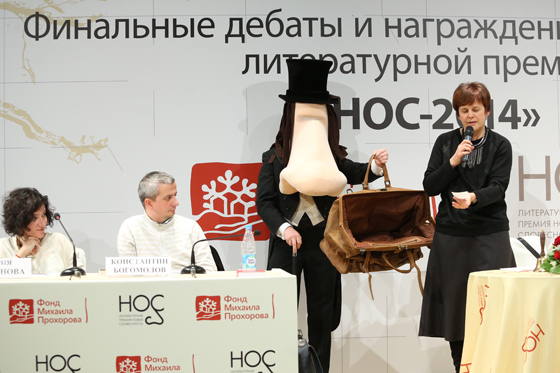
In the center to them. Meyerhold was the usual crowd. At the entrance, guests were given noses of various sizes and stripes, rubber and rubber bands. Guests scattered into groups; The official opening of the year of literature was discussed the day before, where President Putin seemed to allow writers to swear “informal vocabulary”, but they did not give a word to someone. On small pedestals there were people dressed in shape, with giant orders and hypertrophied machine guns. The “ideologist of the highest category” was written on a signs of one. “Member of the Union of Writers” - the second. What was written in the third, I did not have time to consider, because I began to demolish me to the stairs leading up: a bell rang, the beginning of the debate was approaching.
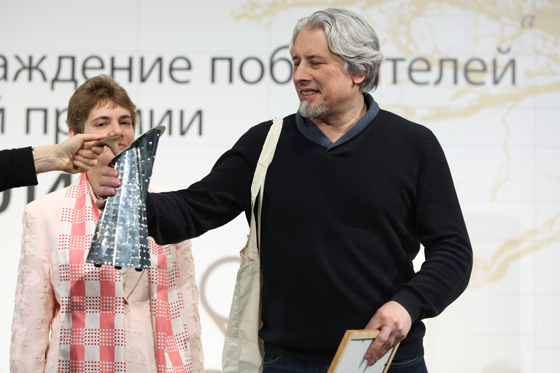
The light in the hall went out, then lit; Order -bearing figures and ascetic -dressed girls performed ballet, which interrupted the police whistle of Irina Prokhorova. "Down with the official, long live independent literature!" She said. The public was presented to the public (Dmitry Kuzmin, Konstantin Bogomolov, Maria Stepanova, Irina Samorukova, Elena Gremin) and experts ( Anna Narinskaya , Konstantin Bogdanov and Vladimir Mirzoev - the latter was absent in the hall, but recorded an appeal in which he spoke for the victory of Vladimir Sorokin). Of the authors who fell on a short list , Maxim Gureev, Vladimir Sorokin, Margarita Meklin, Alexey Tsvetkov and Tatyana Freidensson came to the debate. The appearance of Sorokin caused noise in the hall - before the beginning of the ceremony, people confidently said: “Sorokin will not come,” “He never comes.” The author of the “telluria” was immediately awarded a prize of reader sympathies - the top of a cone at a distance, from afar a little reminiscent of a grater, and in the context of what was happening - a pyramid of vitamiders from the “snowstorm”. (It can be seen nearby that this is actually a nose in overcoats.)
At that moment, the opposition of Tsvetkov to Sorokin seemed artificial heating of the conflict.
The word was taken by the chairman of the jury Dmitry Kuzmin. “Reading these books today, in a situation of war, in a situation of financial collapse ... Involuntarily, you start reading them differently,” he said. - We have to find out what to do with this modus of reading if the books that were written, perhaps, two years ago, were not designed for this. It is amazing that many somehow managed to be designed for this, up to the book of the Donetsk writer Rafenko about how the city of Donetsk was erased from the face of the earth. " Kuzmin outlined the watershed between the works of the short list: on the one hand, “books concentrated on making a diagnosis describing what happened to us, on the one hand, included it, on the other hand,” on the other, books representing “possible alternatives, other approaches to life, to society, to the place of man in society”. Irina Samorukova proposed almost the same separation. In the short list, in her opinion, books about the “world given to us” and the “alleged world” were included: if Sorokin gives a forecast “proceeding from cash symptoms”, then Alexander Milstein offers a subjective story with “live emotion” and “private person”.
Konstantin Bogomolov made a long speech that art today “does not engage in the formation, identification and direction of the audience of meanings”, but is “the zone where society unconsciously reflects the global change in the value series”. Among the values of this series, the director identified the concept of death, which in front of our eyes is desalized, ceases to be a measure. The Bogomolov saw the understanding of this desecalization in the works of Sorokin and Linor Goralik. Bogomolov’s speech caused Anna Narinskaya’s return replica: “With everything that Konstantin said, I completely disagree. No, I believe that literature and art are produced and, moreover, sublimate the meanings that they help us formulate them. A person is characterized by porridge in his head. The artist is largely different from the person ... - Then Narinskaya smiled, - the fact that he formulates this meaning, shows. " In the end, she remembered her conversation with the translator Viktor Golyshev about Orwell: “Orwell was a lot against what. He did not agree with the Communists, Labor, Conservatives. He was completely alone and expressed his disagreement with the world. And I told Golyshev a little arrogantly: “Well, what is your Orwell? Did he have a constructive program?” Golyshev said the following: “Well, what kind of smart program can have? The only thing that a smart person can do is try to understand what is happening around and how we were in this brew”. ”
 © Mikhail Prokhorova Foundation
Director of Theater. DOC ”Elena Gremin noticed that in many works presented for the award, the abundance of“ stories about Soviet childhood, chicks of weathered hands and panties in rubber band ”struck her. She singled out the books of Svetlana Aleksievich and Tsvetkova (“The change of angle changes the meaning of observation”) and added that although one of the decoding of the name of the award is “New Sociality”, when she read the nominees, it was often boring.
Of these two remarks, two discussions grew up: the first - about the ratio of the Soviet/post -Soviet in modern prose (the thesis of Irina Prokhorova that the modern Russian prose was practically not busy with the understanding of the post -Soviet era; Kuzmin and Narinskaya were disputed; the names of Viktor Pelevin and Pavel Pepperstein were called, although it could be called even with even with A dozen writers); The second, not so distinct, about the confrontation between new “literature” and “sociality”. Perhaps the former member of the jury Kirill Kobrin spoke out more interestingly and provocative, which has stated that the “nose” ceases to be a “modern” award, to the detriment of experiments with a letter, paying attention primarily to working with the resource of Soviet culture, “extremely dangerous, autarkitic, incestive, self -sufficient every time.” “This resource has always been present, it was just actualized due to a drop in oil prices.” It is worth noting another dive of Bogomolov with Narinskaya: Bogomolov did not understand why Sorokina should be awarded for “relevance”, if his novel is primarily an outstanding artistic text, which is “not boring to read”. Just in the very Sorokinsky discovery of the "New Middle Ages", according to Bogomolov, there is nothing new: "What you have not seen ten years ago signs of the Middle Ages, speaks of the problems of your optics!" (applause).
Another sharp moment of the debate was the comparison of two non-nuts: “Time of Second Hand” Svetlana Aleksievich and “Children of the Third Reich” by Tatyana Freidensson. The comparison of the chairman of the jury Dmitry Kuzmin did not turn out in favor of Aleksievich: “I can make many complaints about it, but there is one fundamental: it works with mass material, which is leveled with stylistically, and all these voices merge into one indistinguishable choir, which leads to monstrous longing. To imagine living people, albeit not very smart, not very capable, not very meaningful, sticking together - this, it seems to me, is a monstrous crime. The book of Tatyana Freidensson is arranged in exactly the opposite way. She talks about the descendants of the leaders of Nazi Germany and how each of them in some of his own, individual and unique ways tries to get rid of the fact that he is Himmler, that he is Goering ... This is an extremely instructive thing, a lesson in an individual trajectory that no one will tell you. Not to mention that it is pleasant to think that the modern Russian leadership also has children and relatives, and maybe it will be useful for them to read this book after a while. ”
Meanwhile, more and more was said about Sorokin. Konstantin Bogdanov briefly outlined the entire evolution of Sorokinsky creativity, and Irina Prokhorova, at the request of experts, said “about which” the novel “Tyluria”, comparing it with Zvyagintseva’s “Leviathan” and noting the paradox between barbarism and high technologies in it. Maria Stepanova said that reality is now changing at a pace that when reading has to make an amendment to her: “Mostly, these are the texts of peacetime, written before we are again in the space of a great story, we like it or not. The problem is that I, as a perceiving authority, are far from them. One text of Grigory Dashevsky says that the ideal reader of verses is either a lover, or a maniac who in any text is looking for an answer to a single question that is relentlessly standing in front of him. In the so -called difficult times, the only difference is that there are more such readers and this issue becomes more general ... The reality of today is described by the “telluria”. ” Stepanova went even further, calling “telluria” “the first text of the new time”. Anna Narinskaya again emphasized the swiftness of changes in society (“people are changing in her eyes, for the most part quite terrible”) and noticed that a few months ago she would defend the victory of “Second Hand of Svetlana Aleksievich. Nevertheless, paying tribute to Sorokin, she put forward a book of Tsvetkov as a speaker as a talk about the same, only at a much more delicate level. ” As an example, Narinskaya led Tsvetkov’s story “Mandarin Workshop”, which tells about the old worker, who made tangerines from certain chemical materials and at the end of the work inserted small green stars in them (“each master has a slightly its own, from an individual box”); However, he always dreamed of going to the workshop where they make lambs. "You read and think: my God, what Sorokin would have done to it!"
 © Mikhail Prokhorova Foundation
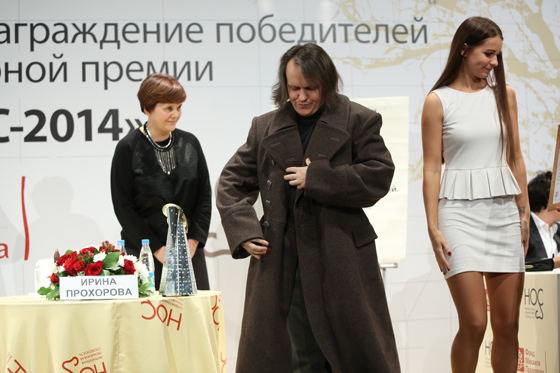
At that moment, the opposition of Tsvetkov to Sorokin seemed artificial heating of the conflict. Dmitry Kuzmin admitted that all the jury members reasoned, referring to “telluria”, and noticed that the award in the fate of such a novel would hardly add or reduce. He called “Tedluria” a wonderful book, however, expressing two claims to “hit the writer of Pelevin” and to the final of the novel, which proposes the figure of “naked man on naked earth” in the form of the last version of Escape (which is not entirely true, because the last chapter of “telluria” is about the forest hermit, a self -sufficient man). He nominated, however, other books: “Together with everyone” by Margarita Meklin (where it is about the fact that bodily and sexuality is some gate, the path to another dimension ”) and the“ conqueror of the ornament ”Maxim Gureyev (“ For me it was the only new author on the list ... The story has all the material that we could expect from the literature that is written today ... But all this is subordinate to the fiction of the fiction of the conquest Ornament: the space in which the whole corps of realities is immersed is built according to ornamental laws, which allows you to somehow live with it ”). The former member of the jury of “Nosa” Konstantin Milchin enthusiastically responded to Gureev’s story: “A wonderful method, a wonderful new literature and beautiful new sociality.” However, the Board of Elders of the Prize, which, according to Mark Lipovetsky, chose, between a work where the collapse of history is experienced joyfully or sorrowfully (“Time of the Second Hand”), and the work, which claims that there is nothing tragic in the collapse of history, is just a new state of time (“Teleluria”), gave her collective voice Sorokin. He won the audience vote. After counting the votes, the books of Sorokin and Tsvetkov entered the superfinals, and this meant that five jury members would hold a final secret vote. According to his results, the winner was named - Alexei Tsvetkov. Turning in a gray overcoat brought right there, a somewhat confused winner said: “Thank you! I did not expect that the texts that would enter my book would be so highly appreciated. And now I have something to poke in other people's affairs. ”
While the premium conflict was discussed on the sidelines, in the south-west of Moscow, the INION library began to burn-and in the collective screams of horror, which were distributed after a few hours, the onset of new dark centuries has been remembered more than once or twice.
Colta.ru plans to return to discussing the results of the Nose Award in the near future