
Translated material
Critical demand
The government does not hide: imported drugs that are dear to the crisis will become a difficult problem - for pensioners and chronicles, first of all.
The anti -crisis plan of power provides for an additional 16 billion rubles. for the purchase of medicines and the protection of domestic manufacturers. The New Times sorted out how and how much we will be treated at the pharmacy counter, an elderly woman in a black coat carefully counts five hundred -ruble bills: “Wait, there is still a trifle,” she takes out a paper heap from a pocket, from which yellow five -coic coins fly along the counter. In Soviet times, Lyudmila Petrovna worked as the head of the department in the Ministry of Trade, today - a pensioner. According to her observations, since December prices have risen by 15-30 %. In the pharmacy, a woman at the box office is indignant through the road: “After all, the day before yesterday my tablets were 157 rubles!” “And today is 190,” the girl shrugs her hands behind the counter. The director (she asked not to name either the surname or the pharmacy number) is recognized: in order to save customers, they already had to reduce the retail margin by 2 %. “Wholesale suppliers raised prices in December,” she says. “And the medicines from the list of vital, the prices for which the government set, the suppliers for some time completely stopped shipping.” In the third pharmacy, Alla Ivanovna, a pensioner, buys an anesthetic drug: “It has become very difficult to get a prescription for free medicines in a clinic, doctors prescribe the cheapest ones that are poorly treated,” Alla Ivanovna herself in the past, worked in the district hospital. The pharmacist says that the old people did not buy less medicines: “If they used to be taken in the nearest pharmacy, now they go with notebooks, rewrite prices and compare. Often come in - look and leave. After an hour and a half, you look, they returned again - it means that they didn’t find anything cheaper. ”
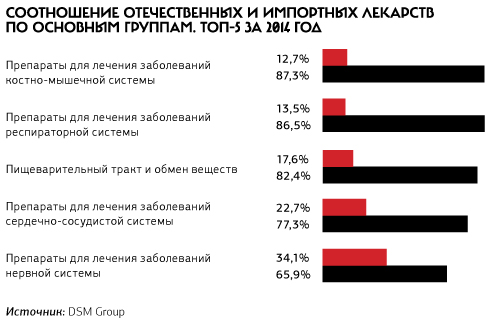
A headache is the share of imported drugs in our market, according to 2014, amounted to 76 % (see infographics on page 12).
Oleg Tomarovsky, an increase in the NT doctor, was increasing, in almost any industry of medicine there is a serious dependence on imports that the domestic pharmaceutical industry cannot cover: “these are oncology, cardiology, drugs for the treatment of systemic diseases, a number of drugs for the treatment of infections, primarily HIV infections.” Director of the Center for Social Economy David Melik-Guseynov predicts an increase in medicines for medicines this year at the level of 20 % and a reduction in imports by 10-15 %. According to him, now is not the time for system measures: “During the crisis, they do not work, you need a manual control regime, you need to sit down and negotiate with each major market player to fix the price, for the discounts and volume of deliveries.” The director of one of the large divisting companies, who agreed to talk on anonymity, does not expect anything good this year: “Over the past three months, prices have jumped by 15 %-suppliers have raised prices, and we have to because the costs of the ruble and inflation are growing costs.” Already by summer, the interlocutor believes, some medicines may disappear from the market if manufacturers do not arrange a purchase price.

However, it is good if by summer. In Sevastopol - according to official statistics - for the year the drugs went up by 33 %, while the townspeople say that it is difficult to buy anti -inflammatory and antihistamines in pharmacies, there are no protozoa and glucose for droppers, which, in conditions of limited supplies, are primarily sent to clinics. In Crimea, “pharmacy” tours to Ukraine have already begun, where medicines are still noticeably cheaper and the assortment is wider. For example, an anti -inflammatory gel in a neighboring country costs 85 hryvnias (369 rubles), and in Sevastopol 465–490 rubles. or the drug for the treatment of joints - 810 rubles. in Ukraine and 980 rubles. In Sevastopol.
Life at the cost of a barrel of the government in the anti -crisis plan adopted on January 27 promised 16 billion rubles. to compensate for the costs of increased medicines. This money will go first to hospitals. At the same time, the next clause of the document introduces a restriction on the admission to trading in public procurement of imported drugs, if there are at least two applications for the supply of Russian -made goods. That is, two different suppliers can offer the same medicine, and hospitals will not be able to purchase an imported analogue, although so far they have been obliged to conduct tenders and choose only the cheapest drugs, usually generics.
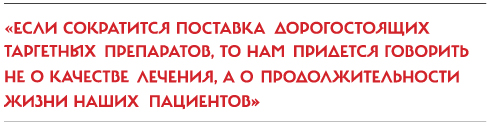
The director of the oncology of the Siberian Branch of the Russian Academy of Sciences, Yevgeny Choynzonov, told NT that in oncology the share of imported drugs exceeds 60 %: “If the supply of expensive targeted drugs is reduced (one course costs up to 100 thousand rubles), which are aimed at a certain target, for example, with pursellane or kidney cancer, we will not have to talk about the quality of treatment, but about the life expectancy of our life. patients ". Translated into Russian: there will be nothing to treat, it will only remain at least somehow support life.
“The government’s proposal will lead to a curling of competition, and, as a result, to raising prices, the risks of the quality of the drugs will increase,” said Vladimir Shipkov, executive director of the Association of International Pharmaceutical Manufacturers (AIPM). He insists that on the part of the member companies of the association, which accounts for 60 % of imports, there will be no serious shortage of drug supply, unless the government make rash and politicized decisions, such as compulsory licensing
* * Registration and production of drugs without the permission of the patent holder. It was used in Zimbabwe, Thailand, Ecuador and several more countries. .
The author of this initiative, the head of the Duma health care committee, Sergei Kalashnikov confirmed NT that the government is now considering the question of introducing compulsory licensing of some expensive but vital drugs protected by international patents for the treatment of cancer, AIDS, orphan (rare) diseases. At the same time, Kalashnikov is convinced that this year there will be no reduction in drug imports: "This is a highly profitable business."
In hospitals, according to a resuscitator of Tomarovsky, there are medicines for the first quarter of the year-they were purchased in the fall. But what will happen next, is not yet very clear: “We will save on everything and look for cheaper methods of treatment,” says Tomarovsky.
Academician of Choynzonov complains that now he has to monitor the ruble exchange rate and the cost of a barrel of oil, because the fate of patients and employees of his institute directly depends on this. According to Choynzonov, thanks to the program for the modernization of the oncological service conducted in recent years by the Ministry of Health, the industry has a margin of strength for a year: “If the situation with the supply of clinics with medicines and equipment will in the near future worsen and fail in a year, then the problems will begin in all regions.”
To increase the lack of the necessary imported drugs that are not registered in Russia (that is, they have not received a certificate of Roszdravnadzor), has been solved by a “shuttle” way for many years-ask someone who is going abroad to bring the desired drug.

This is a particularly acute problem for cancer patients, for people with epilepsy, with a diagnosis of “multiple sclerosis”, for children with cystic fibrosis and other orphan diseases. But the rules have changed. On January 23, the Law of 532-FZ entered into force, which punishes up to 8 years by the import of drugs “for the purpose of sales” that have not been registered in Russia. At the same time, the name can still import such drugs for personal use, but you must be prepared to prove that the drug is really necessary for a person. If you are taking medicines not for yourself, but, say, for a person who is chained to bed and cannot go abroad, then lawyer Alexander Harutyunov, who has been engaged in this problem for several years, advises to stock up on all possible papers: a document from the Ministry of Health, which says that such a patient needs precisely this medicine on life indications, with a receipt from the patient himself. Without these papers, it will be difficult to prove the absence of selfish intent: “The very concept of“ sales ”in judicial practice, for example, drugs, is interpreted very widely - even donation or treats are recognized as marketing.” The director of the Life Foundation (it helps children with oncology) Ekaterina Chistyakova confirmed NT that the document from the Ministry of Health, which is issued at the request of the clinic, is quite enough: "There are no problems with drugs for our wards yet." The only trouble is that not every hospital will send a request to the Ministry of Health for permission to import an unregistered drug - doctors are required to prescribe what is on the market.
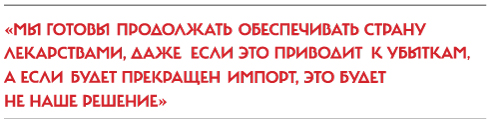
The stress scenario of the medicine is a product of critical demand, therefore, chronic patients and patients of the clinic will be the first to notice problems with imports when they will have to switch to domestic analogues of expensive Western preparations. But this will not be limited to this, the marketer of Melik-Guseynov is sure: “This year the process of leaching from pharmacy shelves of cheap drugs will intensify-it is more profitable to trade expensive drugs.” But the market in ruble expression will grow, because the demand for medicines is always stable. But Vladimir Shipkov, whose association represents the interests of drug manufacturers, refuses to give any forecasts for the next year, because he does not know what rules of the game will be in a few months: "We are ready to continue to provide the country with medicines, even if it leads to losses, and if the import is stopped, this will not be our decision." But the doctors have much less optimism: if the crisis and sanctions are delayed, then this will discard our healthcare in the eighties of the last century, Academician Choynzonov is sure.