
Translated material
Cash loading
One of the main events of January is changes in the leadership of the Central Bank. And this is a strategic loss of the Central Bank.
The country's main bank may lose its autonomy. The reduction in the key rate of the Central Bank last Friday, January 30, the market perceived exactly like that. Meanwhile, the loss of independence of the Central Bank will be expensive for everyone 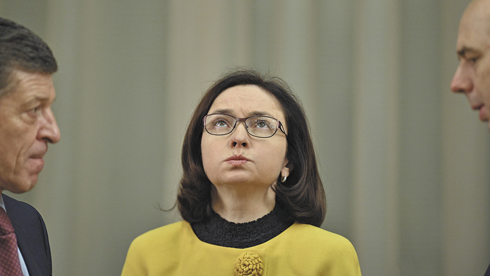
Other appointments were expected, which, however, did not occur. But at the end of January, the government again spoke about the independence of the Bank of Russia and spoke in the most unpleasant key to the Central Bank. First Deputy Prime Minister Igor Shuvalov, discussing at a meeting of the government on January 29, the technical issue (disagreements arose between the monetary regulator and the government about the principles of self-regulation of the financial market),-blamed the deputy head of the Central Bank Sergey Shvetsov to the “manic” nature of the desire of the Central Bank of the executive branch. The tirade was intended for the public-the coordinator of the economic policy in the government of Shuvalov openly informed the Bank of Russia team that the previous status quo, which had developed when Elvira Nabiullina headed the Central Bank in the summer of 2013.
Not that “who are you at all?”, But “sorry, move” - so the officials in the presidential administration qualify. The government, meanwhile, emphasizes: the goal is by no means to demolish the invisible fence around the building on Neglinnaya, which has existed for the past 22 years, there are no business tasks. However, the decrease in the key rate from 17 % to 15 %, which followed on January 30, took the market very negatively, the ruble immediately fell to 70 per $ 1 - and this is with stable oil. On the market they spoke that both the White House and the Kremlin immediately pressed the Central Bank, although so far there are no specific evidence. But there are concerns.
It would seem a gang with Neglin , something to worry that two new deputy representatives came to the Central Bank - people are quite experienced and technical, and another deputy chairman (from Ksenia Yudaeva) took part of the previous powers? In fact, there are at least three reasons for unrest. The first - personnel changes in the Central Bank do not occur at the end, but directly in the process of developing the strongest financial crisis in Russia. The second - what is happening reflects the urgent problems of the authorities in Russia as a whole. Third: Information about what is happening in the Bank of Russia is data on the strength of the entire power structure.
Unlike the USSR State Bank, the Bank of Russia did not have leaders who would not tell legends about other power offices. The stubbornness of Viktor Gerashchenko, the recklessness of Tatyana Paramonova, the equanimity of Sergei Dubinin. Sergey Ignatiev was known on the Krasnopresnenskaya embankment as a man in an excellent suit and glasses, the broken arrow of which was fastened with island. For many in the White House, this is a terrible characteristic: to choose the key to a person who does not matter that a colleague, immersed in the rituals of prestigious consumption, is thinking of him.
The aura of the country's chief banker is largely attached to the profession - this is not a Russian feature. Financial reporters, for example, accurately guess “people from the Fed”: this is not only an elusive style in clothes, but also a special expression on the face. You won’t confuse the latter with anything - a combination of neutrality, easy boredom and a slightly disgust part of an idiot, who asks inaccurately formulated questions. The power of the Central Banks around the world is both an ultra -high educational qualification for those admitted orally, and the absolute regulation of the banking market, completely incomparable with any other market.
What was supposed to know about the new chapter of the Bank of Russia in the summer of 2013 Elvira Nabiullina, fit into his own legend. Firstly, the head of the Central Bank is included in the circle of government professionals, whose loyalty Vladimir Putin does not consider it necessary to check. Secondly, large ranks in international financial organizations invariably said to their Russian partners: “What are you worried about, you have Nabiullina.” Thirdly, according to legend, some important decisions of Nabiullin informed the president not in advance, but a post-fact.
Limiters , however, the degree of real freedom of the Central Bank in the choice of solutions should not be exaggerated. The same Rosneft in the fall received in the financial market according to a scheme that cannot be implemented without a direct participation in it of the Bank of Russia, more than 1 trillion rubles. The story of the company’s lending without the quotes of the omnipotent Igor Sechin for an amount comparable to the cost of the White House anti -crisis plan, is unlikely to fit into the principles and concept of the team Nabiullina. Nevertheless, neither protest, nor “leakage”, nor even doubts that this should not happen, the Central Bank did not express. The market immediately perceived this as a payment by Nabiullina for maintaining independence on other issues: obviously, there are instructions of the Kremlin, which she performs without discussion.
Nevertheless, if these “mandatory payments” were taken out of brackets, the Central Bank remained free: the transition of Nabiullina from the Minister of Economics to the post of head of the Central Bank of the Russian Federation was accompanied by an unspoken, but intelligible commentary “from above” - she was entrusted with the full power in the Central Bank, a monopoly without reservations and seizures. The presidential administration officials even said with some bewilderment and resentment that when Nabiullina raised the key rate in December 2014, she had not even consulted Putin in previously. But is it possible?
Then these offended conversations (“How did you not consult?”) Was conducted in the corridors of power in an undertone. Therefore, the appointment of Dmitry Tulina, and then Alexander Torshin, in the Elvira team (among the officials of the government and the Kremlin, the Panibracy is always a recognition of the status, “we do not need patronymic”) is now being discussed in a raised mood. We said!
There really is news. The point is not even that Tulin, and even more Thorshin, is the “Varangians” in the Nabiullina team: most of the subordinates of the head of the Central Bank never worked in the Ministry of Economy. The point is the very independence of the Bank of Russia, more precisely, what is meant today, in January 2015.

The Russian authorities after 2008 became extremely small and cramped: there are practically no strangers in it . At the end of January, rumors were spreading in the ministries: late on Friday in the former office of Nabiullina, Minister of Economics Alexei Ulyukaev, Minister of Finance Anton Siluanov and the head of the Central Bank gather in the former office of Nabiullina, to discuss without further ears, how to resolve the problems accumulated since the beginning of the crisis in relations. At night - so that no one would hear how many years familiar to each other are the highest government officials yelling at each other - they yell as only friends can.
In principle, for the corridors of the authorities in Russia, this is completely normal. Friendship is a variant of the norm.
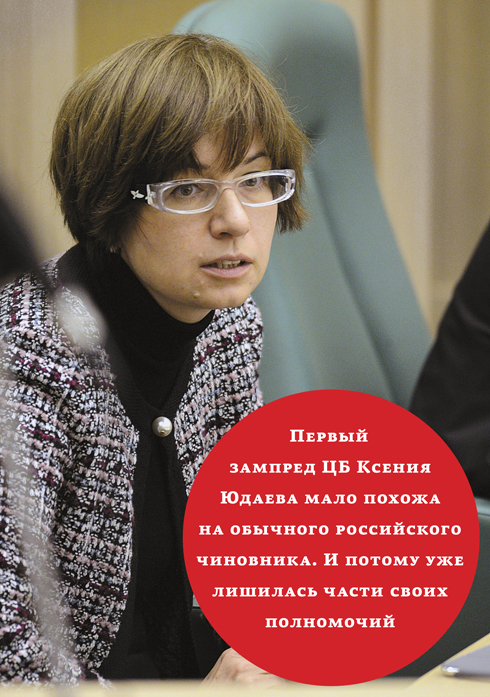
Ksenia Yudaeva, First Deputy Head of the Central Bank and the former head of the expert department of the Presidential Administration, perfectly filed into all aspects of these rules. In the summer of 2013, there was only one question: will Yudaev go to increase with the Nabiullina team or will it be independent? Both that and the other was possible. On the one hand, Yudaeva had coordinated the Russian agenda in the G20 and G8 for several years, was perfectly integrated into the informal friendly network of economists in government circles, its personal value for the Russian government quite allowed independence. On the other hand, the structure of power in the Russian Federation makes a team game, led by a “politician from Putin’s environment” more efficiently and more reliable. Yudaeva chose the Central Bank.
What is the value of a Russian official, how is it determined? There are standard answers to this question, but in the case of Yudaeva there is an important addition: it, as a scientist-economist, is quite well quoted in the referred magazines.
This is not to say that this kind of activity of the Russian government is not to the liking. Not at all. As a hobby, economy metrics or games theory is no worse than hunting or versification - if there is enough time for it. Nevertheless, the place of the scientist in Russian corridors is an adviser, expert, specialist; The leader should not limit his business approach to external things as intellectual honesty or contradiction of the theory of empirical needs. Already at the beginning of 2014, when Ksenia Yudaeva unexpectedly informed the Gaidar forum about the danger of stagflation in the economy of the Russian Federation, this created a universal feeling of awkwardness. Firstly, a significant part of the officials simply did not know this term. Secondly, aloud to assume that in the foreseeable future, inflation in Russia will exceed 10 % per annum, and GDP growth will decrease to zero-this can afford the cabinet scientist, but not an economist-practitioner. The practitioner is guided by the message of President Vladimir Putin to the Federal Assembly - it also reported the need to reach the five percent growth of GDP after the final victory over inflation in the next five -year plan. In addition, Yudaeva herself wrote these messages when she worked in the presidential administration. Thirdly, even the coordinator of the entire monetary policy of the Central Bank of the Russian Federation cannot afford to submit to dry schemes from the Western textbook, and even more so, from some articles of some American NBER Institute.
The banking community of Yudaev also criticized - both for slowness in making important decisions, and for problems in the information policy of the Bank of Russia. However, it should be remembered: the regulator plays against the market and in real time, so it is always wrong - if only because it does not allow to earn. In any case, the experts did not have a sharp rejection of the “theorist” strategy.
However, what was forgiven when everything was not so bad (the political elite in Russia is very suspicious of any fundamental, even if it explains itself as intellectual honesty - for example, what does not say goodbye to Alexei Kudrin) - it became intolerable with a double devaluation of the ruble. A friendly network did not work on the actual removal of Yudaeva from the management of monetary policy colleagues and economists preferred to be silent.
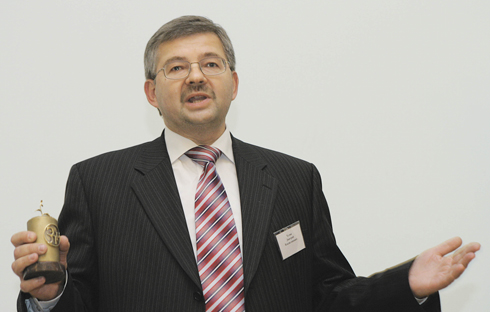
Dmitry Tulin - the new first deputy chairman of the Central Bank worked at the Bank of Russia under the previous head of the Central Bank. The ruble lost by Yudaeva and the color of the tie actually passed to him, the main danger of the Elvira Nabiullina team is how its opponents look against the background of the Central Bank. The criticism of the Nabiullina team in December 2014 in the Kremlin was reduced to two reasons. The first - the Central Bank is mired in theorizing, while the unique and distinctive economy of Russia requires a purely pragmatic approach and does not tolerate all these Samuelssons. Economists are ultimately needed as flexible experts in the service of really significant people and their interests. The second is Yudaeva just a woman. Well, a woman. But, generally speaking, for such serious matters as a monetary policy, a man needs, and not some, forgive the Lord, girl. Well, what is it, are we playing toys here, or what? We have a safety advice here.
The combination of uncomplicated sexism with class hatred for a long time did not work until, finally, Vladimir Putin surrendered, which such arguments usually do not act on. For him, this is also a defeat. The collapse of the ruble, which is quite natural with a completely catastrophic decline in prices for the main export goods of the Russian Federation, in December 2014 became a test not so much on economic as the management competence of the Russian authorities. It is clear which image loss for the Kremlin was the fact of replacement during the crisis of the key deputy Central Bank - after all, in the ECB, and the Fed, and in the National Bank of China, they are aware of who is in this area in Russia. But there are priorities above the title. For example, respect for the point of view of old friends and partners: this one is a stranger, we do not need such.
All that Elvira Nabiullina could do in a situation of pressure was to maintain the right to a formal monopoly on the management of the Bank of Russia. The powers of Yudaeva were partially transferred to the competent member of the team of the former head of the Central Bank Sergey Ignatiev - Dmitry Tulin, in recent years, occupied by teaching. During his appointment, the market, for which the light hatred of the regulator is natural, did not express his enthusiasm. As, however, and discontent.
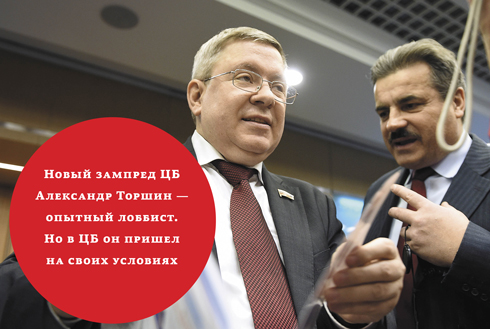
The emergence of Alexander Torshin, who also worked earlier in the Bank of Russia, also shows the true scale of problems in the Bank of Russia, the team of Nabiullina. Torshin is one of the oldest and most experienced Russian lobbyists, a long-term first vice speaker of the Federation Council, an important player in United Russia. Torshin is able to help the Bank of Russia with external communications - but, apparently, on its own conditions. These conditions, apparently, suggest that the Central Bank becomes a structure integrated into power on a common basis.
And this is a problem. And it is more important than even a ruble that excites everyone. The independence of the Central Bank in Russian conditions is primarily independence from lobbying and political pressure, from crafty “pragmatism”, from the pressure of incompetence that flourishing in other branches of the authorities (the issue of corruption in the Central Bank is a separate and important one, but has not yet been related to this story). According to the results of January, the team of Elvira Nabiullina will now have fewer opportunities to resist the planting of the corporate culture of the Kremlin or the White House, which is so different from the corporate culture of the Central Bank.
It would seem that we care about how the “centrobankers” with Neglinnaya will look and feel, what ties and facial expressions will be, will they be ulcerative, like Yudaeva, or outwardly flexors, like Ulyukaev, or some more? The economy is arranged in such a way that it is precisely such circumstances that are significant for the pocket. In countries where the Central Bank is customary to indicate how to manage the cash market, many have money with money.
Do not even think why this is so - just remember.
Photo: Alexander Miridonov/Kommersant, Anatoly Zhdanov/Kommersant, Peter Kassin/Kommersant, Sergey Avduevsky/ITAR-TASS