
Translated material
How does attention work?

The lecture of the Polytechnic Museum was performed by Maria Falikman, senior researcher at the Cognitive Research Center of the Filfak Moscow State University and the leading researcher at the Cognitive Research Laboratory of the Higher School of Economics, with the story of what such attention and how it is studied. Colta.ru publishes the decryption of the lecture "I would like to notice."
What is attention? Psychologists have been on this issue for many years. Is it at all? Maybe we simply call “attention” a way to increase the effectiveness of other cognitive processes taking place in our brain? In general, one or several attention? The first and easiest way that a person applies to everything incomprehensible is a comparison. Attention, as a completely incomprehensible thing, is constantly compared with something, use a variety of metaphors. It depends on what attention has been compared with how it will continue to be studied. The founder of scientific psychology, Wilhelm Wundt, compared consciousness with the field of view, and attention with its focus. Wundt’s student, English psychologist Edward Titcheener, who studied from him in Germany, it seemed that Wundt’s metaphor did not grab one important property of attention, namely the effort that we put, focusing on some object or event that struck us. Titchener compared consciousness with the wave, on the crest of which there are the most powerful impressions, and on the periphery - all the rest. Another classic of psychology, who lived and worked on the other side of the ocean, William James, the brother of the great American novelist Henry James, believed that consciousness is like a stream that could not be measured with spoons. The flow is continuous, unique, unique to everyone. He is always directed somewhere, he cannot flow in all directions at once. This orientation is attention. What do we get using these three metaphors? Obviously, the three main properties of attention at any individual point in time. In the light of the metaphor of the field of view, we can talk about the volume of attention: for example, the number of children for whom the teacher can follow during a walk, not losing sight of. In the light of metaphors, the waves can measure the power of the impressions that are represented in our minds. In the light of metaphors of the stream of consciousness, we can talk about the direction of attention.
Psychologists have been studying attention in laboratory experiments for more than a hundred and fifty years.
But all this is related only to the moment here and now. And if you look at the process in time, we get a set of so -called secondary properties of attention, the first of which is the ability to distribute it between different tasks. Some people distribute attention more efficiently, others are less effective. Someone talks on the phone and at the same time reads a tape on a social network, and someone cannot. Someone listens to the interlocutor and at the same time leads the car, and someone can not cope with such a task. One may not be distracted from reading or solving a crossword puzzle within 15 minutes, and the other has a time for attention, and if you ask him to solve a simple example of adding in large quantities, sooner or later he will begin to sculpt errors, as his attention will lose stability. And what happens in time with orientation? She can also change. We switch attention from one task to another, from one object to another. The switchability of everyone is different. Moreover, when a person says that he has a bad attention, this can mean both high and too low switching. When they say about the schoolchild “he is inattentive in the lessons,” they mean that the switchingness is high. Attention jumps from the notebook by the window, from the window on the back of the neighbor, back into the notebook and so on to infinity. When they talk about the poor attention of the elderly, then, as a rule, they mean low switching, when it is difficult for a person to distract from what he is busy now.
Attention is one or several of them?
Psychologists distinguish several varieties of attention. For example, attention that is aimed at objects or events in the outside world: beautiful salute, someone's touch, the smell of delicious buns. Such attention is called sensual, or perceptual. And there is a different kind of attention when we seem to look inside ourselves. Such attention is called intellectual. In the picture of Jerome Bosch, the “magician”, a man with eyes pulled out and an open mouth, is not able to distract from the manipulation of the magician, and in the meantime, the team of pickpockets borrows a wallet from a man. This attention is sensual. The famous sculpture of Rodin “Thinker” is a person attentive to his own thoughts is an example of the intellectual attention. It happens that we pay attention to something that attracts besides our will. I have one favorite demonstration. (The chair pushes with force, and he falls on the floor with a roar.) You could not help but notice the fall of the chair. Such attention is called involuntary. True, at the same time you continued to listen to what I say, and in the same way you read the book, trying not to be distracted by the noise in the subway. The attention that we control is called arbitrary.
The famous sculpture of Rodin “Thinker” is a person attentive to his own thoughts is an example of the intellectual attention.
Psychologists have been studying attention in laboratory experiments for more than a hundred and fifty years. The person is shown pictures and ask him to celebrate or find him something on them-for example, to find one with two pipes among twenty houses-and then they look at how successfully he coped with the task. In the 60s, registration of eye movement was actively used. These were very laborious experiments: a suction cup was put on the eye, a mirror that reflected light on the suction cup, and everything was recorded for hundreds of thousands of kilometers of photo paper, which the researchers, crawling along the floor of the laboratory, deciphered for months. As soon as they invented the contactless registration of eye movements with the help of instruments fixing the position of the pupil, the researcher got the opportunity to see where the subject's gaze is directed, and suggests that it was there that his attention was directed there. And although the direction of gaze does not always report where attention is directed, the registration of eye movements has become very fashionable. And not only in fundamental science, but also in purely applied research. For example, in advertising they like to build “thermal cards”: show people a booklet or site page and look where, when looking at a free look, the human gaze falls, and then color the so -called heat cards, marking the places of the most common look for the gaze, and blue - the least frequent fixation.
Where does the attention "live"?
The last thirty years, psychologists have actively looking for a place where attention has been “living”. But neither the electroencephalogram that determines is the brain in a wakeful state or sleeps, nor functional magnetic resonance imaging, which allows you to see which zones of the brain are involved in solving certain tasks for attention, do not give an answer to this question. Most researchers somehow share the point of view that attention is represented in the brain at once several systems. For example, the famous American psychologist Michael Pozner suggested that there are three such systems. The first is vigilance. Maintaining a certain level of readiness to respond to a particular signal. It is this system that is involved when we are commanded "to start - attention - march." It is this mechanism that turns on when someone says: "I will say something very important now." Apparently, the key zones of the brain participating in this process are subcortical zones. The second system is orientation. I say: "Look there!" And you switch attention to what I point to. A number of brain zones work here, but the parietal bark of the right hemisphere is considered the key - that is why its defeat during a stroke leads to the fact that a person ceases to notice the events taking place in the left corner of the field of view. For example, he eats food from the right half of the plate, but does not eat from the left half, because he does not notice it. If the damage is bilateral, then a person cannot manage attention at all. He fixes the object, and cannot turn his gaze to another object - for this he has to close his eyes, shake his head and even leave the room. A similar phenomenon is observed in babies: in one or two months, the child still does not know how to be distracted from what he looks at, and even can start crying, because he can no longer look at the same thing. But in his case, the parietal bark simply does not ripen - a little time will pass, and the task of switching attention will not be difficult for him.
Most people do not notice the appearance of the gorilla, because they are passionate about the calculation of the number of programs of the ball and players in white T -shirts.
And finally, the third system associated with arbitrary control of attention. I will show you one of the classic tasks on this topic. I will show words and ask to name their color. (The word "green", typed in green letters, appears on the screen.) It is very easy. And now? (The word "green", recruited by red letters.) Appears on the screen.) It is already more complicated. Because the connection of this very conflict resolution system is required. Michael Pozner proved that each of the three systems is characterized by its own chemicals, or neurotransmitters that serve them. With vigilance, naturally, norepinephrine is associated, with the orientation system - mainly acetylcholine, and with the conflict resolution and management system - dopamine. In addition, Posner introduced a genomic analysis of attention and its violations into practice. In particular, he discovered the genetic basis of the very fashionable today's attention deficit syndrome. Why is it important? Because, for example, by conducting a genetic analysis of the development of attention in a student, we can say whether his hyperactivity is really medical in nature, or it is just the shortcomings of education, or a consequence of the insufficient maturation of the cerebral cortex, or something else.
What prevents us from being attentive?
What prevents us from being attentive? Cognitive psychology has been trying to answer this question for sixty years. This direction appeared in America in the middle of the 20th century in connection with the rapid development of computer technology. People who worked on the creation of the first personal computers were asked by the most unexpected questions: is it possible to teach a computer to think? Is it possible to teach a computer to choose the necessary information and even understand it? When psychologists looked at these questions, they realized that they themselves did not yet know the answers to them. And they began to study human perception, memory, including, of course, attention, including, moreover. Naturally, they started with the fact that they came up with a new metaphor: they suggested that the human psyche works in a way as a computer. And since the technical device has a long -term and short -term memory, it means that a person should have such a memory. Since the computer has restrictions on the processing of information, it means that a person also has such restrictions.
Why is the dead elephant right away?
Restrictions, in turn, can be of various kinds. For example, the limited throughput of the processing system - and then attention is understood as a function of selecting the necessary information, as protection against overload and spam. Restrictions can also be an energy nature - for example, restrictions on power that we can spend on problem solving. The oldest metaphor-since the 1950s-compared attention to the radio engineering filter, which misses part of the information and does not miss. I like the metaphor most of all - and on it I will build my whole story - which compares attention with the searchlight. At one time, she even appeared impetus to a more detailed study primarily visual attention. Psychologists wondered: how is this stain of light arranged? Is it homogeneous or heterogeneous? What part of the field of vision does it cover? Of course, the question caused the largest wave of research: and this scoretorist of attention - what is it necessary for? Answer: For everything. For example, look out of the window and see where my car is on the parking lot. Or get a box with buttons and find the right one in it, which right now you need to quickly sew on a coat and run on. I will show you a few pictures in a row, and you, please try to find a white vertical strip on them.
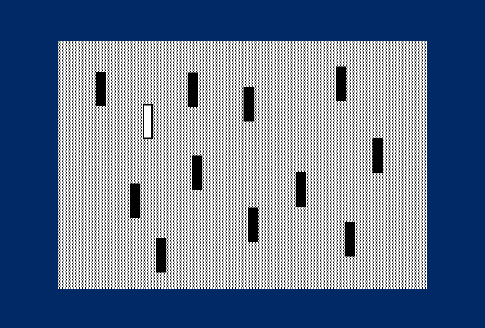
Found, yes?
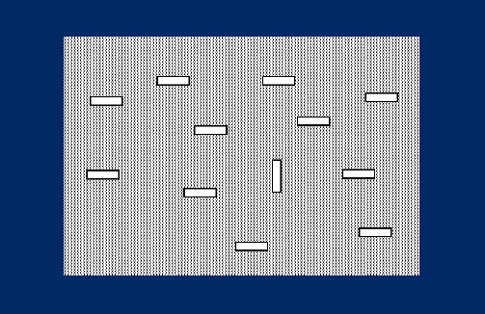
Have you found it too?
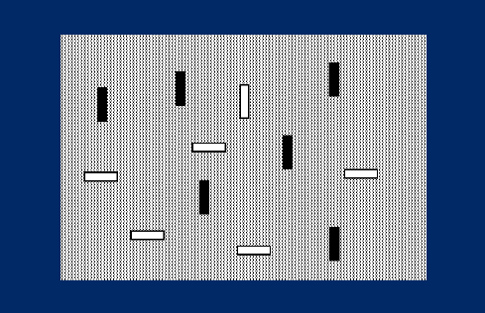
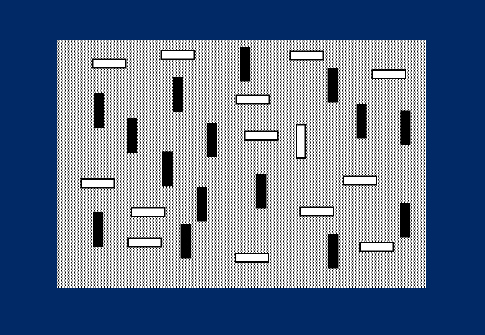
In the first two pictures, a white vertical strip jumped itself. It was immediately clear where this strip was. In the third picture, you also found this strip, but still looked longer than in the first two, and on the fourth - even longer. Why? Because in the first pictures, this line was distinguished by a single sign: all the lines were black, and it was one white, all were horizontal, and it is one vertical. In the other two pictures, the strips were different: black, and white, and horizontal, and vertical. That is, our strip had several common features with those stripes next to which it was located. It turns out that if what we are looking for different from the rest with only one sign, then no matter how much distracting objects we introduce, a person will find the desired object with the same speed. Roughly speaking, a person in red among people in black can be seen immediately. The American psychologist Anne Traisman, who in the 1980s, proposed the theory of integration of signs in the 1980s in the 1980s, explained something like this. She had the explanation: when we are looking for something, at first we process the color separately, separately the curvature of the lines, separately the slope. Then the information about these signs is reduced to a single map of the locations. And if on some one sign-for example, color-we have a single object that differs from the rest, then our attention will immediately “grab it”. If there are several signs, then attention will be reduced from one place on the map to another, collecting entire objects from signs until we find the right one.
Naturally, the first question: what, in fact, to consider the basic features by which information processing without participation is possible? It is quite simple to answer - what jumps out is a sign. We check the accuracy of the said. Find an object that differs from everyone else.
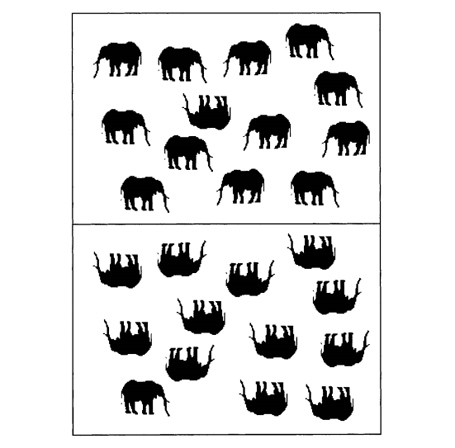
Why is the dead elephant is right away, but, on the contrary, the legs that are erect among the legs lying up - not immediately? Studies of visual search are practical in different areas well known to all are. For example, luggage inspection at airports. What happens when a person begins to look through hundreds and hundreds of suitcases, bags, backpacks, running along the tape past him? He receives a picture, having examined which must make a decision: whether there are objects prohibited for the transport in the bag or there are not there. Do not believe it, but the main problem of this task is that most often there are no such items. This phenomenon was even invented by the name - "The problem of rare objects." Due to the fact that there are no objects-in the same way, fortunately, x-rays are rarely found in screening diagnostics confirming the presence of cancer tumors-a person gets used to that they are not there and does not see them point blank when they appear. Unless he is autistic. Very recent studies have shown that people with autism syndrome cope with such a task better than experts. For them, problems of rare objects simply do not exist, while professionals have very, very frequent. In fact, this problem was discovered back in the 1970s, in the studies of Ulrik Naysser, on the basis of which the famous video with an invisible gorilla was created in the 1990s:
Most people do not notice the appearance of the gorilla, because they are passionate about the calculation of the number of programs of the ball and players in white T -shirts. This phenomenon is called "blindness by inattention." In a completely new study by Harvard Professor Jeremy Wolf, experienced radioologists showed this picture of the lungs and asked if everything was in order with him.

More than 80% of specialists did not notice the gorilla in the lungs, because gorillas do not live in the internal organs. Look at the screen - now one item will not be right before your eyes.
Didn't you see? Here - in the lower right corner. In psychology, this mistake has its own name - "blindness to change." In the university town of Chicago University, there are two psychologists - Daniel Simons and Daniel Levin - put an experiment: on the street to the naive test subject, a person approached and asked to show the way to the university library. Within a few seconds, while the subject explained the route, two “workers” carried the door between the interlocutors and the experimenter replaced his partner - but the naive pedestrian of this substitution did not notice with a high probability.
Several years ago, students of the Higher School of Economics successfully repeated this experiment in the Tekstilshchiki metro area: the subjects noticed the substitution only when a miniature girl found a miniature girl on the site of a tall young man.
Ну и два слова о том, что происходит с психологией в последние годы. Ученые активно изучают так называемое совместное внимание — то, что происходит с нами, когда мы находимся среди других людей. Предполагают, что ребенок обогащает и накапливает словарный запас и способы эмоционального реагирования на события окружающего мира, сонаправляя свое внимание с вниманием родителей. Мама говорит «собачка» и смотрит куда-то, и ребенок, прежде чем успевает сообразить сам, что происходит, смотрит туда же, куда и мама. То же касается команды врачей, которые вообще словами не разговаривают во время операции, все их общение сводится к обмену взглядами.
Куда делся мячик? Самые догадливые поняли, что он остался у экспериментатора в руке. А всем остальным, естественно, показалось, что мячик улетел в небо. А если экспериментатор не будет следить взглядом за мячиком — никаких иллюзий, да? И становится абсолютно очевидно, что он его не кинул. Собственно, подобные приемы в ходу у фокусников и карманников. И те, и другие пользуются нашей способностью сонаправлять взгляд со взглядом другого человека. В последние несколько лет объявили даже о создании нового научного направления, обозначенного как нейромагия — попытка изучения мозговых механизмов внимания, стоящих за ошибками и зрительными иллюзиями, которые создают фокусники. Что забавно, статья, где впервые было заявлено это направление, вышла в очень серьезном журнале за авторством двух нейрофизиологов, четырех фокусников и — неожиданно — одного бывшего карманника. Спасибо вам за внимание, а есть оно или нет — решайте сами.
Записала Наталья Кострова