
Translated material
Russian image
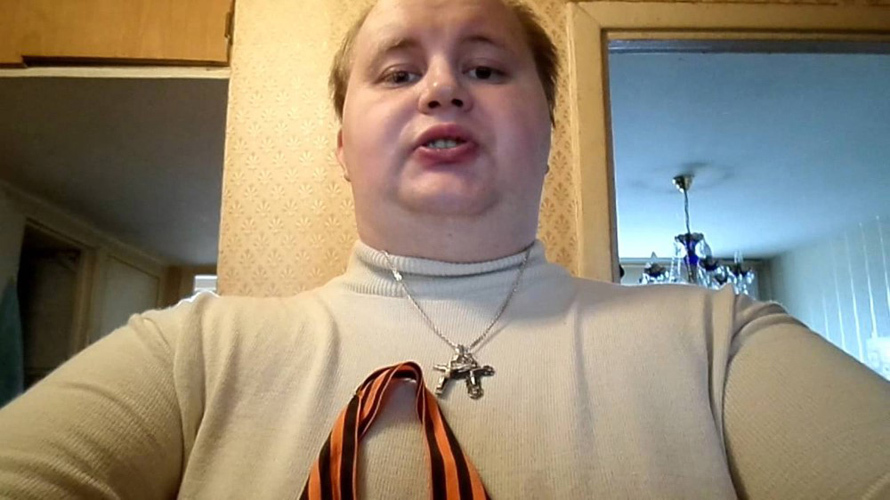
The recently ended Rotterdam film festival presented the audience from Russia with an unexpected, shocking surprise - the film “Fools here is not a place” Oleg Mavromatti (the picture was part of the author’s program of Evgeny Gusyatinsky “Signaless Propaganda”). About why the movie liberation of the famous Video Sergey Astakhov is something much more than the sum of the Found Footage plots, says Olga Shakin.
A round head appears in the frame - pure goodwill from the “Wizard of the Emerald City”. A cross hangs on her nose. Mysteriously turning his eyes, the head in the church pulls: "I, Astakhov Sergius ... I love and love to eat!" The telephone chamber leaves the face and begins gently, in circles, caress the eggs hissing in the pan with sausage. From the recipe for “peculiar sausages with a bay leaf”, the host of the culinary and worldview show will spread to the Masons, from there-to the assortment of the beloved shopping center, and there it will reach the bright holiday of Easter. “It was my new Orthodox video. Smok-chok! Bye!"
Sergey is twenty -nine. He has a bunch of psychoneurological diagnoses, drinking mom and young stepfather, who clearly hopes to survive the rest of the family and remain the only owner of the living space. Previously, Seryozha was open gay, but recently returned from smart people who subjected it to cross. Now in his round head is an amazing mixture of Orthodoxy, autocracy, nationality, homophobia and love for jokes. He chases the above in the video monologues that he laid out on YouTube . Their artist Oleg Mavromatti was mounted in the picture “There are no place for fools here”, which, in the aggregate of artistic and ideological, formal and meaningful virtues, can be called the Russian film for decades.
Before continuing the story about the film of Mavromatti (it was just shown in the Rotterdam program), it is worth making a couple of the most popular claims made by the author. First: Mavromatti laughs at a person who is sinful to laugh at. No, everything is wrong here! “There are no place for fools here” is not a comedy, but a much more multi -layer thing: there are moments of social drama, the drama of loneliness, an existential horror, even a life -affirming story about growing up. Astakhov, by and large, is not a character, but a full co -author, which is indicated in the credits. Mavromatti - as he himself repeatedly claimed - is a curator who, having the artist’s work before the viewer’s eyes in a certain order, provides this artist with a new space for self -presentation.
 © Supernova / Cinefantom
Claim number two: plagiarism. A couple of years ago, on the Internet, a video work of the founder of the site Loo.ch Anatoly Ulyanov “My Orthodox Video”, mounted from the same Astakh material, appeared. In fact, it was Ulyanov who acted as a condescending surfer, who found another marginal curiosity in RuNet and, from a certain distance, condescendingly admiring it. Mavromatti moved from antithesis to synthesis and analysis - overcoming the distance, took the object not in his hands, but by the hand and made it a subject, a full -fledged author of the study of how he affects the tender, infantile consciousness, grossly grinding his propaganda. And here Sergey Astakhov - on his own initiative - turned into Crash Test Dummy .
The main laboratory value of the Astachian speeches is in their immediacy. In the space of traditional values, such people are called psycho (which it is sinful to laugh, but which are not sinful, for example, to beat), and in the conditional West - "personalities with alternative development." For ourselves, we denote: Astakhov is a big child, smart and extremely creative. Its monologues are a pure children's diary, proof of which is a simple linguistic analysis. Since neither structurally prepared a performance, nor reproduce the prepared speaker is capable of, improvisation based on other people's samples - advertising, poems, sermons, ads becomes the main technique. When Astakhov says that he will read his poem now, he looks like a child who is important that he will speak in the Tarabar language: neither a poem nor a tongue exists, the imitation of one and the other will be composed on the go (“My name is Astakhov Sergius, and you are Anyuta Bondsa. You looked into my eyes, told me“ I love me. ”Your eyes are cheerful, and my black, gray, gray, gray, gray, gray Green, serious and sad ”). It is difficult to improvise phrases in real time - therefore, Astakhov constantly resorts to repetitions and transfers that become his signature linguistic sign (“Russia is nature, music, resources, culture, morality, youth of forests and fields”). From there - clumsiness in the selection of epithets ("amazing juices", "juicy ripe tea"). The author seems to play in a Lego of an official-advertising novel, making unprecedented hallucinogenic constructs from his sparkled details: “Our Orthodox faith includes Islam, world religion, and Judaism, world religion, and another world government.” This resembles punchline from the old "Eralash": "Rome is the capital of London, and London is the capital of Paris." All this aphasia is layered by a sincere and dubious tone borrowed from the media space, which gives any incredible the status of instruction.
 © Supernova / Cinefantom
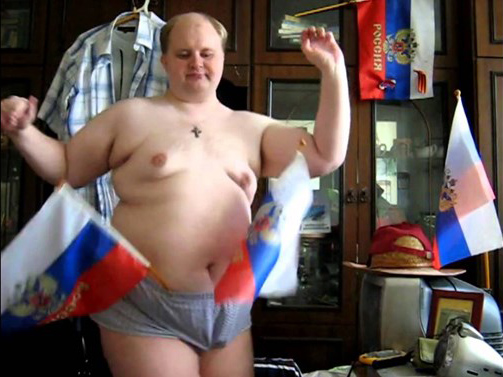
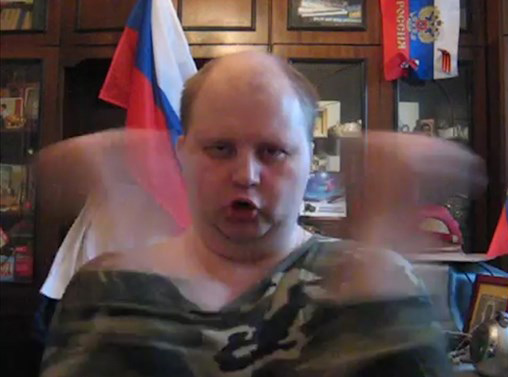
Now from the content of the speeches we will move on to the one who pronounces them. In the appearance and behavior of the speaker, almost all the components of the “Putin majority” are represented with parody of the identity of the “Putin's majority”: the lips painted with violet (carnival pop culture), a cross stretched on the nose (peculiarly understood Orthodoxy), an eternal plate with food nearby (the simplest consumerism), a camouflage T-shirt and Georgian ribbon tape (militaristic patriotism), dancing in spacious fluttering underpants (rude posttotalitic eroticism of society, where there were no “sex”) against the backdrop of a state flag stretched on the wall only a quarter of a century ago. “Hurray, cheers, cheers! Bravo, Bravo, Bravo! Success, success, success - Russians, Russians, Russians, Russians! ”
The most interesting thing begins when the program, which was invested in a pliable, greedy to impressions, is susceptible to Astakhov’s head, begins to fail, first encountered with sincerity, and then with the obvious analytical abilities of the narrator. Here Astakhov is slightly lost, violates the automatism of his own smoothly current speech - the next ideological stamp was eliminated from his head, and he searches for the right word.
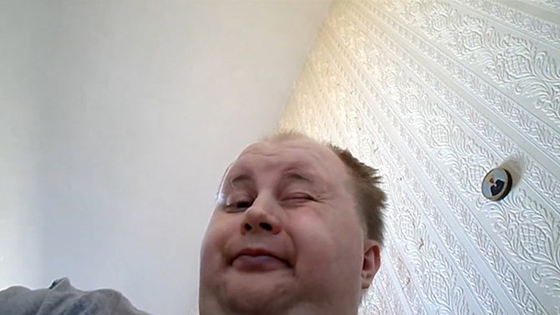
But he begins to compare the reality he himself, that is, is trying to combine the abstract and domestic areas, to make the only, probably, a thing that can save Russian society that has escaped from specific horrors to saving ideologems. For a long time and with reverence, listing numerous relatives (the cult of the family!), Astakhov suddenly adds: only together we do not go anywhere, we all lie on the couch, and I am only all day. Recommending himself as an “Orthodox figure”, the speaker suddenly adds quietly: “Let the guardian angel find out who put me on the psychiatrist and ... made a disabled person.” The speaker decisively protests against “to give our children to foreigners and same -sex people” - and then, in contrast, his freely dangling, not crowded out of the unconscious floods us refuting all the above monologue: “I love men and men. And they love me because I am a man. I am a man, and you are a man, we are created for each other ” - and Astakhov, winking at one and the other eye, kisses the screen juicy: an action that will happen again more than once; Teenage rituals, girlish secrets. Desire enters into complex, contradictory relations with imposed, ideological, totalitarian. Sergei Astakhov looks like a child who, in order to please his mother, tries to pretend to be more strict than herself. This says to parents: "And we will not buy this, it is expensive, right?" He does not think so himself, he does not imagine what is expensive and inexpensive. He only knows that it is indicative not to want something-the best way to get it someday, and continues, repeating “expensive, I don’t want”, to devour his eyes on the coveted toy. So, on the example of a person whose brains are repeated by imposed ideologems, but in fact they are not amenable to them, Mavromatti describes a scheme for the interaction of a modern Russian with propaganda.
 © Supernova / Cinefantom
Through the social drama of the hero (and the full co -author of the film), the buffoon comedy turns into a horror and helps out to a pure tragedy - smoothly and at ease. All the same sincerely, Astakhov continues the enemies: he transfers the enemies of Russia (all continents are used), lists the weapons of Russia (Satan's missiles appear, and after radioactive weapons, sexy suddenly comes). And soon the hypnotized viewer discovers himself for listening to the next synonymous series: “The end of the world, the Last Judgment, Apocalypse, Armageddon,” Sergius whispers sweetly. “Chaos, poverty, hunger, masturbation, homosexuality, gluttony and gluttony, apostasy.” Having plunged into the mystical crucible and telling us about the project of his own satanic Bible, the Orthodox Sergius returns to the kitchen and unexpectedly sober, not a sour and not sweet voice summarizes: “You probably noticed how lonely I am.”
Having taken a marginal to co -authors, Mavromatti builds a Russian model from the so -called majority. The English -language slogan of the painting “The Outsider who Wanted in” accurately informs us of the reason for what is happening: universal loneliness, universal exclusion from mythical “83 percent”. And he offers a recipe: try to re -equip your consciousness so that instead of the total abstract slogans, ideas about the most diverse discrete manifestations of the human. The lamentations of Sergius to the final turn into pure poetry: “White and black people, girls, girls, guys, guys, boys, men, men, gays, lesbians, masturbations, nudists, are running around the villages, runs around the villages. Yes, it's us.