
Translated material
An exhibition of Soviet design will be held in Moscow
An exhibition of Soviet design will be held in Moscow
 © State Research Museum of Architecture named after A.V. Shchuseva
February 20 at the State Research Museum of Architecture. A.V. Shchuseva will open the exhibition “Soviet design 1920-1960. From constructivism to modernism. "
The exposition was based on rare objects that demonstrate continuity in the development of Soviet design from constructivism to Ar-Deco, the Stalinist Empire and functionalism ..
According to TASS , the coorganizer of the exhibition, the director of the Eritage Gallery Kristina Krasnyanskaya, the feather from 1920 to 1960 was chosen because it covers all the main stylistic directions of Soviet design.
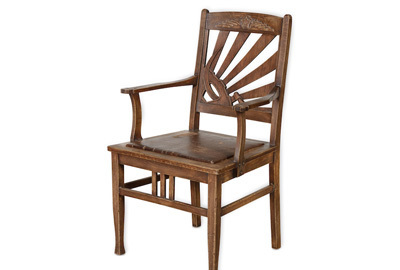
The earliest piece of furniture, which entered the exposition, dates back to 1929 - this is a chair according to the project of Boris Iofan, an architect of the house on the embankment. “The chair has a rare provenance: it belonged to the famous writer Trifonov, the author of the novel“ House on the Embankment ”,” Krasnyanskaya explained.
The furniture of the Stalin Empire era is presented in the exposition with a transformer and radio chair, which were made by order of the Opera and Ballet Theater. CM. Kirov (now the Mariinsky Theater), for a gift to the chairman of the Supreme Soviet of the USSR Mikhail Kalinin.
Soviet modernism is represented by the work of designer Yuri Sluchevsky in the 1950s and 1960s. The furniture of Sluchevsky, who largely continued the tradition of avant -garde, clearly demonstrates the original modular system developed by him, which regulates the ratio of the height and width of the furniture structure, focused on the average growth of a person.
Also, among the most interesting exhibits, a headset made in the 1930s according to Igor Krestovsky’s project for the house-Komenn “Bread of Communism” under the Smolensk agricultural cabinet, and furniture, performed according to the project of Nikolai Lanser for the Lenin Museum in Leningrad. Work on the design of this furniture set was not carried out in architectural workshops, but in “Sharashka”-“Special Design and Technical Bureau”, where repressed architects that performed orders for the arrangement of nomenclature interiors, including the Moscow Kremlin, worked under the supervision of punitive bodies.
In total, the exposition will include about two hundred objects from museum and private collections, which will be demonstrated in the context of architecture presented by design graphics and photographs.