
Translated material
"On FSE and Fruz!"
Inflation in Russian diaries of different years
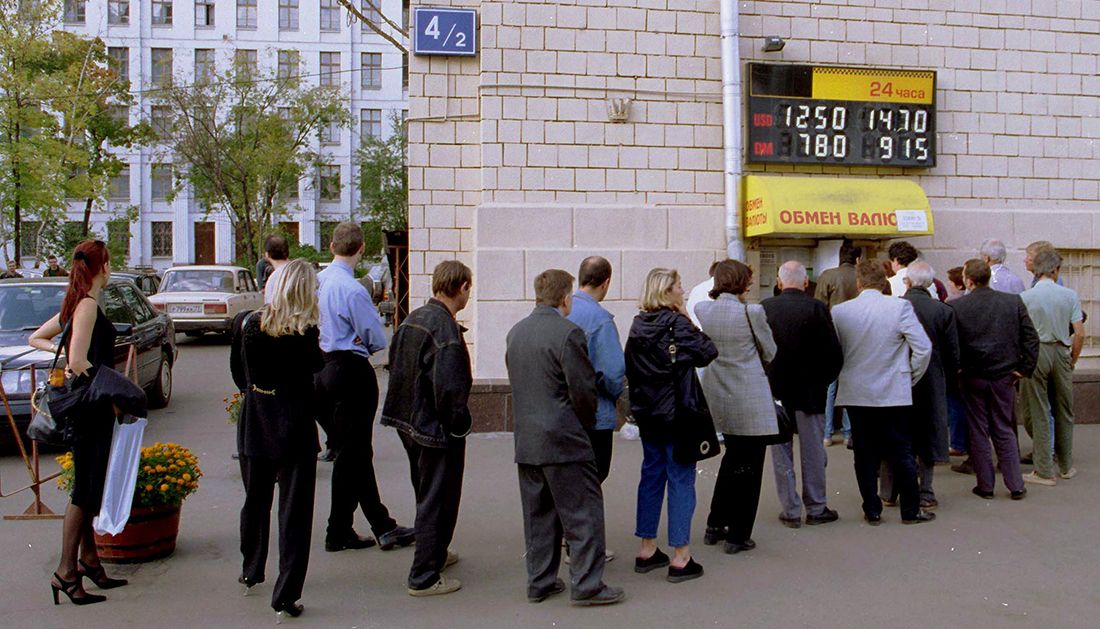
In Russia, prices are rising . For the new series of the joint project "Medusa" and "Prozhito", we have collected diary notes on how people experienced inflation races from the time of the First World War to the 1998 crisis.
“Prozhito” is a network project of historian Mikhail Melnichenko, who plans to collect, digitize and publish all personal diaries written in the Soviet period of Russian history with the help of crowdsourcing. When compiling a selection for Medusa, Prozhito is not limited to the Soviet period.
Sergey Yesin, Rector of Lithuanian Institute, 62 years old
September 5, 1998
Obninsk
A cold, went to Obninsk. On the way, I drew attention to wildly inflated prices at McDonald's. In Obninsk on Saturday, panic: salt and matches were bought in stores. The lean oil, which I focus on, costs 30 rubles already. He read a lot of his students and wore manure in a greenhouse. The Bolsheviks, of course, will not come to power, the second time a miracle does not happen, but doesn’t Svetlana Molchanova be retrained from the church headman for the second time to the secretary of the party organization?
Vetkin, an employee of the research institute, age is unknown
January 25, 1992
Kazan
In "Argum. and facts ”printed a letter from one woman. She talked about the following case: a man went into the dairy store, looked at the price tags - 1 liter of milk - 70 rubles, pulled out a gun and began to shoot into the air. Sellers lay behind the counter. The man shot and left calmly - apparently he took his soul.
In the bread store, coupons are not required for the second time. We still have more than 200 rubles. I have ended money. I eat for coupons in the student canteen of KAI. Now all students are given 270 rubles per month. Talons. Eh, there would be a xerox, I would print fake coupons. Surely who has the opportunity to do this. You can buy products in the buffet for these coupons. Here someone is profiting! Today in the store I saw how one type of southern look bought up in the store all the available Bond cigarettes for 7.20. Now the cheapest filter cigarettes are in cooperative kiosks 9-10 rubles. That man bought 27 blocks. In five minutes I earned almost a thousand rubles ...
Sergey Semanov, historian, 56 years old
December 31, 1990
Moscow
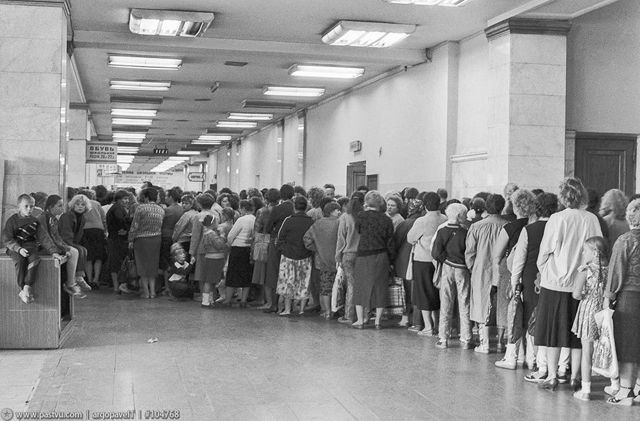
The depreciation of money is monstrous, it is felt monthly. Before the New Year, alcohol prices jumped incredibly, and most importantly - brazenly. Today, at 12 hours he walked past the next beer, where he had not been for several years, - the queue plus dirt and so on. And suddenly - nobody to the people, the hall is semi -empty. After waiting, he went to the distribution, the former modest women and men replaced the thieves' barns, I rustled on them, they brazenly sent me where they should, even threatened - they poured beer into the cylinders for removal. Yes, of course, in Detroit and Paris there are places where even during the day there is not a trace during the day, but there is a large choice where to go, but with us? Here it is, complete lawlessness, not crime even, but that it will grow, the end of this in the coming years is not expected, for the current public forces that gave rise to order (the king - Stalin - parliament), there can be no and cannot be. The Marxist mammoth must rot, and only then on purified soil ... But it will not even be at the beginning of the 21st century.
Nikolai Worknov, physicist, poet, 42 years old
February 28, 1978
Moscow
I drove to Moscow. He himself wanted to buy a player, and his mother-aunt Lida's birthday present, which coincides with the 25th anniversary of Stalin's death, March 5. I did not buy either one or the other. In Moscow, crowding on the occasion of tomorrow's increase in prices. It is already known - gasoline 2 p., Instead of 0.95. Coffee approximately 20 p. But, dry wine, a blow to the "high -paid". Is this what am I highly paid?
I decided to start a grossbekh and start the economic analysis of “To make the ends Meet”. Coincidence: today at the same time, the “Pupsik” ended with the warranty period and warranty mileage - it was bought on February 28 77, and upon returning from Moscow, the meter showed 20013 km. The service, they say, is too noticeable. We will learn ourselves. Still, 70 liters of gasoline today I have a stock of old coupons, but I was too lazy to grab 2 canists into Moscow. The poverty is damned.
<...>
One category of beggars has almost disappeared - those who were sitting on the ground in a crowded place, exposing their injuries. I remember the sailor perfectly under the Znamensky gates in Yaroslavl. He had no legs at all, not a centimeter, and the hands of both hands. He sat in a uniform and a vest, gathered in a disheveled woman. It was in the war, they gave him - just get it. Then once I saw how he was washed in a bathhouse.
<...>
According to the program "Time" about prices-not gu-gu. But for the first time in a long time - not a word about inflation and unemployment in the West. About the lack of water in Palermo - yes, there is no neutron bomb - yes, about the struggle of workers for their economic rights - no. Safe Bet, which will not happen tomorrow.
<...>
Jobs: Goskotsen is sitting - what to raise prices for? Well, come on alphabetically. A? - Cars? B? -Petrol? IN? - Wine, vodka? Etc. They reached the “f”, they cannot come up with. To Leonid Ilyich - for what? - On "f"? He is on FSE and Fruz !!
Victor Starkov, poet, 32 years old
December 17, 1963
Orekhovo-Zuevo
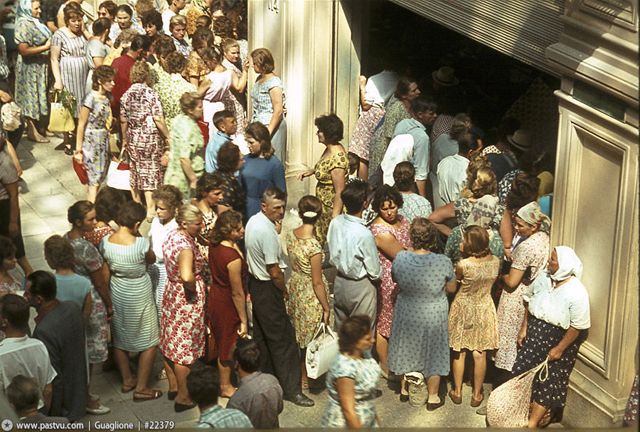
After N.CX came to power, the party steadily shows “care” about the growth of the living standards of the people.
The first manifestation is the increase in fruits. The second manifestation is the so -called price equation: the prices of non -way goods were reduced, and rose rose. From a mathematical point of view, perhaps such an equation came out in favor of the people, and from a worldly point of view is exactly the opposite. The third manifestation is the exchange of money, the deception of the people. The main loss of the people is psychological. We are not used to counting old hryvnias for money, this attitude was involuntarily transferred to new dimensions: and new ones, wow! - Old rubles. The state is very into the hands of this psychological loss of the people: the price equation is rotated by their increase.
I remember another joke. The American says to the Russian: “Here we have freedom! I want, I’ll go to the White House, shout: “Down with the President Eisenhower!” “And nothing will happen to me.” Russian to him: “Think! I want to go to the Kremlin, shout: "Down with the president of Eisenhower!" “There will be nothing to me either.” The bitter meaning is in this fun joke. Laughter through tears is something too Russian, but it has never been as too much as in our pro-Soviet time.
Alexander Boldyrev, Orientalist, 38 years old
December 28, 1947
Leningrad
Exactly a month ago, on November 28, I went to a savings bank in the morning to remove 300 rubles from the book. (Torah and I did not have enough salary). There was nobody in Sberkassa, only in front of me a roughly poorly dressed person with a red weathered face took out 5,000 rubles from his book. I also drew attention to his gloomy, almost evil expression. And a few hours later, in the same savings bank - and in all savings banks and banks of the city - fiercely crumbled, fond, hummed and “passively fought” a huge distraught crowd of “removing” depositors. The cashier was instantly exhausted, and only applications were accepted the next day. At the same time, another crowd with the same spontaneous rage cleared state and commission stores. Prices rose to monstrous sizes, everything, lying on the shelves for years. Faded people dragged paintings, carpets, vases. There was a great transformation of money into things. Within three or four days, the population was madly mad, huge billion sums were moving. Then everything calmed down. Only at the collection points there were many hours of queues. And even the reverse investment in the savings bank began. The whole variety of wild rumors was replaced by one certain: the exchange of old money will be done at the place of work - two or three salaries.
Then, on Sunday, December 14, at 6 pm, the “famous announcer” read a resolution on monetary reform throughout the country - “The last victim”. It suddenly became clear: everything that is on his hands is burning in a ratio of 1 to 10. A few minutes later, on all the streets, from all sides, the townsfolk rushed to all the savings bank, thinking in naivety to have time to shift their cubes to books. Alas, savings banks were closed from one in the afternoon! And they took it to an hour! Three oblique ones burned with Torah, about 5 on the suburban.
Lyubov Shaporina, Translator, 67 years old
September 28, 1946
Leningrad
The intimidation of the layman continues, and the desire to intimidate and shake the unfortunate Soviet man is completely clearly felt. He turned into Akakia Akakievich, but his position is more tragic. On September 15, prices were raised incredibly: black bread 3.40 instead of 1.10. The roll instead of 2.95 - 5 and 8 rubles. Meat 30 (after 10), etc. At the same time, Zhdanov called Akhmatov a harlot from the height of the throne, and the newspapers are full of calls for the rise of ideology, partisanship, etc. Today, they suddenly stopped giving white bread on the work card; It was canceled on letters and additional cards. You can take flour boots in return [1 NRZB.], But the oils do not give the second decade and closed the yeast factory. There are no yeast anywhere.
<...>
The DiLatorskaya told me the following: Akhmatova called that in half an hour the secretary of Harriman, a professor of such and such. The situation at A.A. Wretched, no comfort, no things, there are different curtains on the windows. Somehow put in order, she invited two friends and accepted the professor. He spoke Russian. After some time, he again comes at 8 o’clock, sits up to 9, 10, 12. Akhmatova does not know what to do, because you need to treat a person. She has a common house with Punin - they went to bed, and the door to them was closed. Five people gathered three cups, served with acidic cabbage. He sat until 2 a.m. Maybe he was waiting for the departure of his friends and wanted to talk to her alone? They say that Akhmatov is very fond of England.
Sofya Ostrovskaya, translator
September 21, 1942, 40 years old
Leningrad
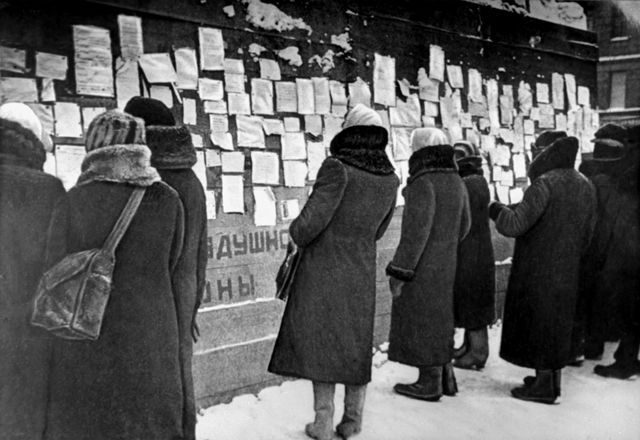
Cold. In the morning +4. From a broken window in my room, it blows a prediction. On the streets sunny, deserted, quiet. The whole war in the south: on the outskirts of the city of Stalingrad and on the approaches to Mozdok. We have silence and the expectation of storms. There are crazy prices in the markets: kilos of potatoes - 250, cabbage - 90. Today I bought potatoes for the first time: 4 small things - 41 p. I ordered from speculators: white flour - 625, millet - 600, rice - 700. On oil - 1800 and for sugar (sand) - 1300 - there are no finances. The money is generally a disaster. I live some extraordinary combinations of random sales and exchanges. For postcards I received, for example, 400 gr. tobacco. I rejoice, because this is a free application, so to speak!
<...>
September 23
On the streets are deserted. In the markets of the crowds: they buy, sell frantically hating each other. They sell cards, pots, wicks, banks, fur coats, pieces of sugar, cigarettes, card issues, artificial flowers, Danish porcelain. The currency standard is bread: 350 p. kilo. Fluctuations in prices for things are elusive and arbitrary:
Male silk socks, new - 250 gr. = 105 p.
Ladies darned and worn stockings of the lowest quality - 400 gr. = 140 p.
Male drapo coat - from 70 p. up to 400 p.
Living kitten - 4 kilos of bread!
Ladies Winter Coat - from 80 p. And above.
Ivan Shitz, historian, 55 years old
March 14, 1929
Moscow
<...>
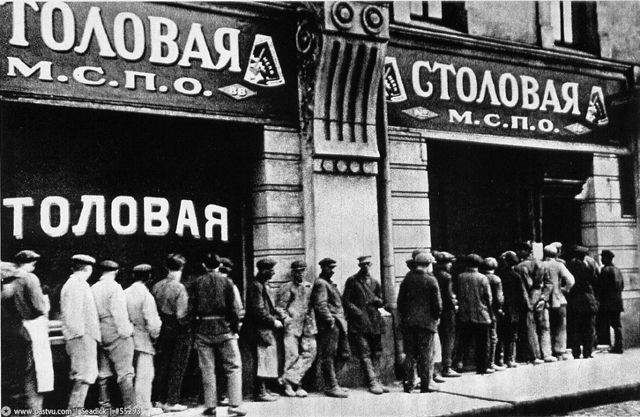
And at the shops - the queue. And nails, soap, tea, electric. There are no light bulbs, papers and many more. And the eggs cost 2 p. 40 K. A dozen in private shops, because in cooperatives they rarely give 3-4 eggs (half of the musty) at 95 kopecks. A dozen.
Trotsky is stirring in the West. Our workers are “protesting” against his betrayal, and the audience feeds rumors about leaving the GPU comrade. Berries. Narkomfin Bryukhanov, in response to many written requests - is it true that the industrialization loan will be forbidden to sell to banks, gave an explanation in the newspaper that all loans are completely free (!) That all loans are bought in banks without limiting, that they will also act with bonds of the loan for industrialization when they find themselves in the hands of the owners; but: because the loan is made so that the workers devote part of their earnings to support industrialization, then the return sale of loans to the bank is equivalent to reducing the loan amount, and the next, selling - deserter on the front of industrialization; Therefore, before sale, let everyone think about whether it is possible to cut himself in anything else rather than in a loan.
<...>
Folklore. A pardon sentenced to shoot the Russian and Jew is promised if they indicate a way to raise a chervonets and bring the dollar to the decline. The Russian refused to solve the impossible problem and demanded an execution. The Jew thought and in the morning announced his simple, quick and cheap tool: change the governments.
Alexander Sudoplatov, military, 18 years old
August 2, 1920
The village of Akhtari (c. 150 km from Krasnodar)
<...>
In Crimea, 1 pound of bread cost 300 rubles, here is a duck - 50 rubles, goose - 100 rubles. A jug of milk is 17 rubles. And in the Crimea, the bottle before leaving reached 500 rubles. We have thousands of money. Less than 250-ruble there is no paper. Give Baba such a piece of paper, she will open her eyes: "Where will I get the surrender to you?" Copons, brands, and Soviet rubles, and Donsky will begin to count.
Often ours, without waiting for surrender, wave their hands. It is not necessary, they say, change, and a surprised woman receives for a jug of milk instead of 17 rubles - 250. This will all affect prices later. Our bosses are wise, but not quite. It issued an order not to pour money in the Crimea in the Crimea, so as not to cause a high cost. But this is not enough, it was necessary for the new territory to release special money and announce this to the population of the villages, for each rank to give fodder and salary in accordance with the cost of products here (comparing with the Crimean). So our "audience", having a little money, would not rush like that. After all, this is a disgrace, even embarrassed. Everyone carries geese. In the morning, everyone will gut the goose, at noon two or three, in the evening a duck or chicken. By the evening of the present day, all this is already affected. The goose costs not 100 rubles, but 500. Thank God!
Tomorrow there will probably be 1000 rubles, and there are 10-15 thousand, and the Crimean prices here will be “impeded”, and again we will eat bread with Ostyuki, since white will be 300 rubles. Probably, residents are not particularly happy with our arrival.
Mikhail Theological, historian, 50 years old
Shashkovo
July 29, 1917
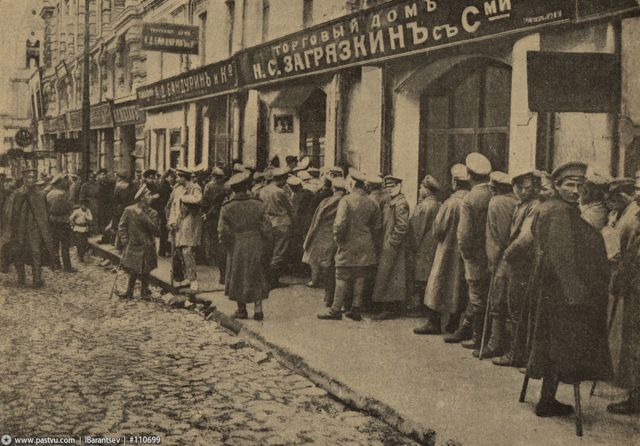
Saturday. L [iz] left early in the morning at 5 o’clock. In Rybinsk, as she usually does it here on Saturdays, and returned to 12 not only with meat and herbs, but also with a bag of rye flour. Nevertheless, how much life here in relation to food is better furnished than in Moscow! There are at least all the main necessary, and even meat. Everything is terribly expensive, but there is, and you do not need to be a servant stand in lines, as in Moscow. But the high cost is directly terrifying. What was worth 15 kopecks before is now 1 p. 15, and all in the same proportion. We are no longer a ruble, but something less than a frank. I managed to work a lot. Today the beggar approached our dacha. I made him a nickle, but began to make a remark that now you can earn money, etc. But he objected to me: “I am bad! Bad! I don't need money! " - And he looked at me with such clear, meek and smart eyes that it became ashamed to me. How many times did he give himself the word of such comments to the asking not to make. Rye is already compressed. On birches, yellow, gold branches appear ". "Remember, soon the sheet turns yellow, yours quickly go on May!"
Returning from a walk, I felt the heat and lay down in bed in a fever. The second time in the summer! Badly! I read an article on monetary circulation in the “Russian Vedomosti”, which proves that the money circulation after the revolution has become much worse than it was in the old manner. Over the first two years of the war, there were 6 billion pieces of paper, and the new government over the past 5 months has already issued them by 6 billion. The day of the war, in an old manner, cost 15 mili [ions] rubles, now it costs 70–75 million rubles. “Russian Vedomosti” wittyly indicate the reason for this increase: a terrible increase in wages to workers working at the treasury, and the pieces of paper get stuck in their hands without turning in % paper, as capitalists with the profits do. That is why all the need is created for new and new credit tickets.
So, the monetary appeal is worse, the food case is worse, there is nothing to say about military affairs, there is absolutely no court and police. What got better after the coup? Freedom? But ministers receive the right to close newspapers, ban congresses and meetings, and, finally, the Minister of Justice Zarudny (what name! And cadet) shall submit a bill to grant two ministers - internal affairs and justice - by agreement without court to arrest administrative and * in certain areas of persons acting counter -revolutionary or dangerous for the revolution! Where are these freedoms that it remains from them and how does all this differ from the old order?
Georges Maurice Paleolog, Ambassador of France to Russia, 57 years old
September 29, 1916
Petrograd
The economic situation has recently worsened. The persecution of life is the cause of universal suffering. First -necessity, necessarily persuaded us, in comparison with the outbreak of war. Firewood and eggs are even four times, oil and fifth soap. The main reasons for this provision, unfortunately, are as deep as obvious: the closure of foreign markets, the clutter of railways, a lack of order and lack of honesty in the administration. What will it be when you will have to be considered soon, in addition, with the horrors of winter and with cold tests, even more cruel than hunger tests?