
Translated material
Hungarian Prime Minister preferred good relations with Russia to the US partnership
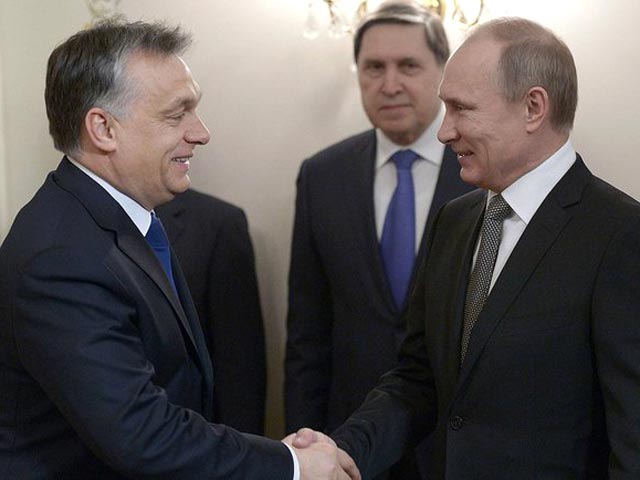
Hungary Prime Minister Viktor Orban, in an interview with the local Hir TV channel, said that in foreign policy the main task of the country is to maintain mutually beneficial and friendly relations with Russia and Germany. The United States called the Hungarian prime minister an important partner for the country, but not included in the "center of attention" of the foreign policy of Budapest, writes RBC with reference to Reuters.
"If we want to ensure sustainable safety, peace and peace in Hungary, then we must rely on two powers that are present in Central Europe powerfully and in the long run, - Germany and Russia," Orban said. According to the Prime Minister of Hungary, the country's foreign policy strategy is built in such a way as to have "friendly, balanced, correct, honest and mutually beneficial relations with these two countries."
The United States is important, but for the country's foreign policy it is not primary, Orban noted.
In turn, Washington accuses the prime minister of Hungary of authoritarianism. In October, the United States included six people from the Hungarian government, accusing them of involvement in corruption. Orban then stated that Washington was using these accusations against Hungarian officials as a “cover” to strengthen its influence in Central Europe against the background of the Ukrainian crisis.
The United States now not only intervenes in the domestic policy of these states, but also take an active part in it, Orban said. He emphasized that thanks to the conflict with Russia because of Ukraine and negotiations under the agreement on free trade between the United States and the European Union, American interests in energy and trade policy have become especially noticeable.
Recall that the position of Hungary in relation to Russia against the backdrop of the escalation of the conflict in Ukraine causes the concern of European and American politicians who even called the orban of Putin's “mini-copy”. The Prime Minister of Hungary does not support sanctions against Russia and openly accuses Washington of trying to draw Budapest of the Western conflict with Russia.
"They want to draw us into a conflict that will not bring us anything good. The relationship between the United States and Russia takes the form of a Cold War, and we do not want to take part in this," Orban said in a television season at the end of December.
On February 2, Hungarian visited the Chancellor of Germany Angela Merkel, she tried to convince Orban to support the general European policy against Russia. The joint press conference Angels Merkel and Viktor Orban sometimes took place intelligently,RIA Novosti notes with reference to the euoobserver publication. In particular, the German Chancellor attacked the Hungarian prime minister for the attitude of his government to the opposition, civil society and the media.
She even openly argued with him because of the interpretation of the concept of "democracy." "Honestly, I do not understand what the word" non -liberal "means when this relates to democracy," Merkel said. The Chancellor had in mind last year’s speech Orban, in which he stated that he was building a “non -Beliberal” state in Hungary, and as an example he cited Russia and Turkey. Answering Merkel, Orban noted that democracy should not be liberal, and the one who believes otherwise tries to elevate one scientific school over everyone else.
On the eve of the visit of the Chancellor of Germany in Hungary, a demonstration was held with the participation of several thousand people who called on the government of Prime Minister Viktor Orban to maintain relations with the West. The protesters held the posters and shouted slogans, demanding that Hungary stay in the European Union, far from the orbit of the Kremlin, as well as calling for the resignation of Orban, accusing him of limiting democratic freedoms, encouraging corruption and diplomatic conflict with the West.