
Translated material
The presidential was flashed
On February 4, viewers watched how the head of Russia is in the worship of Vice-Prime Minister Arkady Dvorkovich for the fact that in dozens of areas the train was abolished. A day later, the first 40 compositions of hundreds of lifted people resumed the movement, the joy of this celebration of humanism overshadows only the knowledge that this abolition of trains was prepared for a long time, and each step leading to it was approved by Putin himself.
The scale of the highest good deed is not so great. 300 trains thrown out of the schedule for the last month will be resumed, but no one is going to return almost 900 electric trains that were liquidated in 2012-2014. The number of new wagons purchased by Russian Railways, as decreased from year to year, will fall. All of this “rolling stock”, equipped, if you use the standards of the XIX century, class 3 wagons, will dilage and decrease in the number. Presidential mercy is only a hitch in this process of decline.
If the culprits of the scandal dared to object to Putin, they would recall that they acted according to the logic of the system he created.
Suburban passenger companies (PPK) - the "daughters" of Russian Railways, whose co -owners became regional administrations, were created from the very beginning as "daughter for flogging." Their unprofitability was predetermined. The scheme of their organization was adjusted to the benefits of the Yakuninsky Russian Railways, which retained the infrastructure and rolling stock, receiving a subsidy from the treasury and rental fees from the PPK and at the same time getting rid of losses brought by suburban transportation (read more about this on page 14).
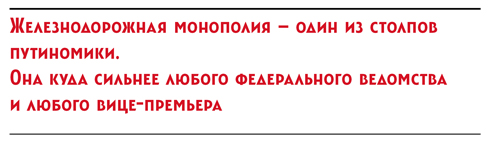
Vladimir Putin once approved just such a scheme. Which is understandable. The railway monopoly is one of the pillars of Putinomics. It is much stronger than any federal department and any deputy prime minister. Only those "reforms" that she likes are authorized.
It is no less clear that the regional authorities could not cover the losses of “their” PPK, having owed them almost 40 billion rubles today. Regional budgets are disorganized by Putin's "May decrees" in 2012. It was they who were entrusted with the fulfillment of a pre -election promise to increase salaries to state employees. Over the past year alone, the debts of the Russian regions increased by 22 % - from 1.49 trillion rubles. up to 1.82 trillion rubles.
Not to mention the fact that the regional officials-subsidies are not at all inclined to live with the needs of their citizens, and Moscow still did not force to report for electric trains. Their smooth abolition fled perfectly into the logic of the third year of the “optimization” of government, along with a reduction in the number of hospitals, educational institutions and other objects boring to the authorities.
Another wave of liquidation of electric trains, if something has stood out against the general background, so only a violation of smoothness. Vast territories suddenly lost a railway message at all. A lot of small towns that once flourished, thanks to the proximity to the railway, and now empty, have fallen into transport isolation. This flexion in stateliness will somehow correct, without changing its essence.
Although it is this policy, the subordinate mania of supercentralization, is precisely guilty of the decline of the Russian hinterland. People run away from there, small settlements are gyreing, the temptation to "save" on unprofitable trains is growing. The victims have a holiday now. But it will pass, and the system will remain. Not lucky. And in the literal and figurative sense.