
Translated material
School of growing up

Colta.ru, the educational portal “Your History” and the Foundation “Lessons of the Nineties” launch the joint special project “School of the 90s” , in which famous teachers of history and literature will take part. It will be dedicated to the era of the 1990s in the context of Russian history. For the most important period in the latest history of Russia, we will look at the main signs of that time and its key events through the eyes of practicing teachers.
But for starters, at the request of Colta.ru, a direct participant in the historical events of that time Alfred Koch wrote an essay that we purchased in the 1990s and lost after.
The 90s have now become history. The key people who did it then are already dead: Yeltsin, Gaidar, Chernomyrdin, Dudaev, Berezovsky ... We will never know much. We only guess a lot. However, what remains in memory is enough to draw some conclusions.
What were these 90s? A huge, huge “thaw” or real step of Russia to freedom, which cannot be fully played back? Five years ago, I would say a step towards freedom. And now it is obvious that the "thaw."
The path to freedom was not as simple as it seemed to us in the early 90s. Then we were led by naive economic determinism: we need to build new economic relations, and they will create new people who will be a guarantor of the irreversibility of changes.
Why did we easily agree that the 90s were “dashing”? That it was a time of decline, collapse, degradation ... After all, this is not true!
The relationship was built, but they did not create new people. From the cultivation of enterprise, a craving for freedom is not born. And what is it from? How to arouse this traction in people? How to explain that freedom is a natural state of a person? What is it normal, but vice versa - no?
In solving this problem, we did not advance on the iot. Yes: private property, market relations, promotions, banks, trips to the West ... But the main task-the creation of civil society-has not been solved. There is freedom - we use. No - they wiped the snot and left again in the kitchen. Silence with a coutine in your pocket.
In this regard, the 90s were useful only because they answered the question negatively: new economic relations did not create new people. Woland was right: people are the same ...
What then was the benefit from them, from the 90s? And such that we have matured. We saw the world. We learned (maybe so far the most superficial look), how complicated it is. We were completely not ready to integrate into it. We did not have a non -communist elite, completely organically integrated with the free world. Now she is. Thousands and thousands of Russian-language graduates of the best universities in the world are the fruit of our openness of the 90s.
We also matured that they became more critical of our leaders. The worshiping in the early 90s of Yeltsin is now perceived as a drunk, not far and cynical is cunning, “fly”, betraying those ideas that only led him to the imperious Olympus.
We now do not build illusions regarding the fundamental of the fourth power. The vast majority of journalists turned out to be banal cowards and sales skins. And now we know that the media will not protect our freedoms. And for this we seriously hoped in the early 90s. It turned out that freedom of speech for the media begins and ends where there is a monetary interest and there is no danger in the most rude and primitive sense of the word.
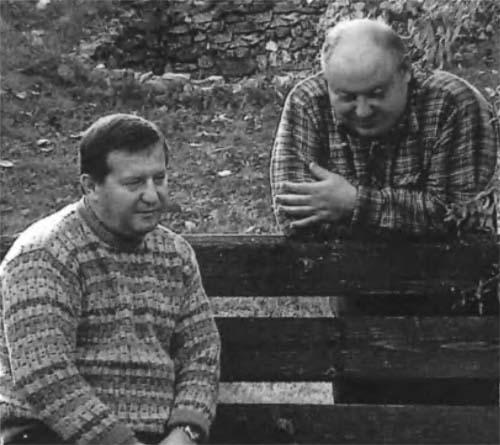 © Photo from the personal archive of Alfred Kokha Alfred Koch and Yegor Gaidar
In general, the 90s showed that the degree of dependence on money in people is much higher than it could be assumed at the beginning. It turned out that we simply did not see real money. As soon as they appeared, the relativism of morality turned out to be worthy of its separate theory of relativity.
The 90s were a time of freedom. But this freedom did not give rise to a single image that gives rise to optimism. Gaidar’s tragedy is the image of the 90s. We ourselves abandoned our freedom. Someone exchanged her for money. Someone is the opportunity to resonate with impunity. Someone-as, for example Yavlinsky-remained in the pose of eternal reproach. Now his controversy with corpses is not interesting ...
Why wasn't it joyful for us from that freedom? Why did we easily agree that the 90s were “dashing”? That it was a time of decline, collapse, degradation ... After all, this is not true! Nevertheless, the mass consciousness has already agreed with this. And now this must be perceived as a given. Is this the merit of the Kremlin agitprop of the zero? Or did the grains lay into fertile ground?
It seems to me that the whole problem is that some kind of displacement mechanism turned on. The people supplanted their betrayal of freedom into the subconscious. And he explained this by the fact that the 90s were not at all expensive. And then the helpful agitprop dumped a bunch of arguments for him. The people in agitrope found self -justification for their cowardice and laziness. That is, it is not like that they blew their heads. No! He was given a dish that he longed!
The main lesson of the 90s is that, it turns out, you need to fight for freedom. Freedom, falling from the sky, is not dear to anyone. Moreover, you begin to understand the value of freedom only in the struggle for it. You will not replace a police battleship on the ribs with any reading smart books. Monkey humiliation. The lawlessness of the court. The cynicism of the impunity of power. These things bring up better books.
Yes. We made many mistakes. But we were not malicious. Perhaps we were too arrogant and naive.
When freedom left us, we, like a fox in a famous fable, began to scold her: she was immature, and tasteless ... And she surrendered to us to a damn mother ... and for the tasteless - what to smoke? We will wait for the next one, which will be better than the same, tastier ...
We did not know all this to ourselves in the early 90s. And in the end - they already guessed. In the early 90s, we believed that we destroyed the Soviet monster once and for all. It turned out to be too naive. The Soviet monster was not in factories and factories. He sat in our heads. We are too tired of adulthood, when every day we need to think about the daily bread. Be sober and cold -blooded. After all, carelessness is the lot of children.
Tired, we rushed to look for a leader who was happy to hand themselves to: Volodya, prince! Take our bowels. But for the fifth and twentieth salary/salary/pension - like a bayonet! Lada? Well then I ran? Will I play with the boys in the yard? And then it was too hard for me to be hard in the 90s. He broke his whole head, how to feed his family. It turned out - all such nimble around. Once - and I'm already in fools ... I'm not used to it ...
In the 90s there was a lot of shooting and blood. It was October of the 93rd . Was the first Chechen. But then it seemed to us that, nevertheless, in general, we almost bloodlessly broke up with the Soviet Union. That the shooting of the Grachevsky tanks at the White House prevented a large civil war. But no ...
We realized that a Chekist revenge and impending fascism became a fee for bloodlessness. And in the fight against him, it will be not easy to avoid big blood. Are we ready for her? Do we want freedom at this cost? Do we understand that now Ukraine is fighting, including for our freedom? What exactly is there now this very postponed civil war?
By the way, the 90s ended not in 1999. They ended in 1998, when the government of Chernomyrdin was resigned . From this moment, the whole state machine was engaged in solving only one problem: the search for the successor. In the process of this search, she quietly transformed, and she had a substitution of target: instead of the task of reforming, the task of holding power appeared. She is engaged in solving this problem to this day.
The 90s did not make us happier, but they made us wiser.
Many believe that this transformation began earlier, even in the 1996 elections. I will not argue. But, having worked in the government until August 1997, I can say that the tasks of reforming then still had a serious priority. This can be seen at least in the pace of privatization, which sharply decreased to zero in the 98th ...
I asked a lot of questions here. I have no clear answers to them. But the fact that these questions have arisen is also the merit of the 90s. Until the 90s there were no questions. They appeared later, as a result.
In the 90s I was 29 years old. Now - 54. A quarter of a century ago, a new story of my country began. And the first decade of this story will be as important for its understanding as the 20s-for understanding the Soviet Union.
Yes. We made many mistakes. But we were not malicious. Perhaps we were too arrogant and naive. But the 90s became our (as, indeed, for all) school of growing up. At first, our actions determined book knowledge. And it was at least something in the country in which the knowledge of a new life was completely absent. Now we have personal experience. This is a completely different matter. And this, too, is the result of the 90s.
Summing up, one might say, paraphrase Socrates that the 90s did not make us happier, but they made us wiser. We learned to ourselves and about our country as much new as we have not learned for the previous 50 years. Even the war did not give the people as much understanding of themselves as the 90s gave. Because immediately after the war, Stalin knocked out of the people this new knowledge. And the 90s remained. And we got rid of some illusions about our account. But the past after the 90s 15 years brought new illusions. And now we have to survive them ...
The material was prepared as part of the special project “School of the 90s” , launched by Colta.ru with the support of the educational portal “Your History” and the “Lessons of the nineties”.