
Translated material
Portrait of Mr. H. Kh.
Who is actually devoted to the first edition of Shakespeare's sonnets

For more than 400 years, literature historians argue who was the mysterious “Mr. W. Kh.”, The addressee of the initiation, who accompanied the first edition of Shakespeare's sonnets. Did he have an attitude to one of the heroes of the sonnet cycle and is it not hidden under these initials by someone close to the poet himself? The recent discovery of the American literary critic Dzheffrey Kaveni seems to make clarity to this question - perhaps we are talking about the book publishing house William Holm. At the request of Medusa, Shakespeared Dmitry Ivanov (Philfak Moscow State University) explains the essence of the Kaveni hypothesis.
Author and publisher
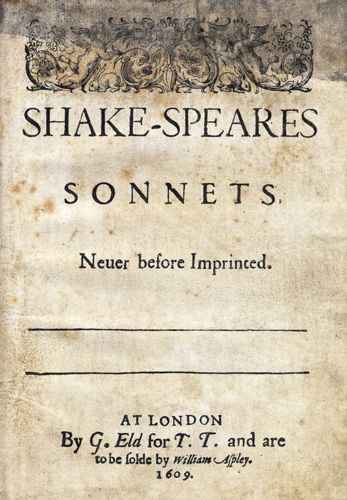
Shakespeare's sonnets are one of his most famous works and are only inferior to Hamlet in popularity. At the same time, the source of texts of almost all sonnets is a single lifetime publication with a rather confusing story. It was released in London in 1609 by the book publisher Thomas torp.
There is no doubt that these sonnets belong to Shakespeare. Firstly, Torp published them under his name, and none of his contemporaries-neither then nor later-the authorship of Shakespeare did not dispute.
Secondly, back in 1598, a certain Francis Mreamed published a book in which he described modern English poets and playwrights. Shakespeare is mentioned in it several times as the author of excellent comedies and tragedies, as well as “sweet -sounding” sonnets, “known to his close friends”. Mream himself did not shine with his mind and taste, but, scientists believe, conscientiously collected opinions that went to London theatrical and literary circles - at that time it was a rather narrow world, where everyone knew everyone.
Thirdly, two sonnets to the dark-skinned lady, the 138th and 144th and the numbering of the torp, albeit in a slightly altered form, were published in the poetic collection “Passionate Pilgrim” around 1599. This collection, also signed by the name "U. Shakespeare ”, includes only five works that are really recognized by Shakespearean, and the remaining 15 are either written by other poets or are still not attributed.
Finally, fourthly, a large number of roll calls were found at the level of images, motives and allusions, and sometimes simply verbal coincidences between Shakespeare's sonnets and his other works. First of all, these are two of his early poems, “Venus and Adonis” and “The abduction of Lucretia”, the comedy “Virgin Efforts of Love” and the tragedy “Romeo and Juliet”.
But what was the attitude of Shakespeare to the publication released by the torp cannot say anything definite. Judging by the data that we have today, the publication was a “pirate”, that is, released without the knowledge of the author. For example, the collection contains a large number of typos, which is unusual for those editions of Shakespeare, in the preparation of which, it is believed, he took an active part. In addition, although Shakespeare was at the peak of popularity in 1609, the torp does not contain either the usual author’s initiation or a warning. On the other hand, Torp was a respected master, a member of the London guild of book publishers, and would not just risk reputation.
Young friend and "Mr. W. Kh."
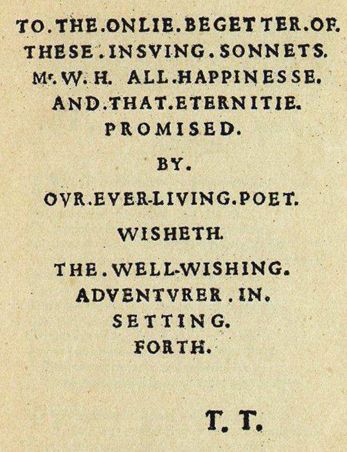
Without dedication, the collection of Shakespearean sonnets, released by the torp, did not remain, but the publisher himself inserted it. It is believed that it imitates the form of a mourning Roman inscription: all words are typed in capital letters, each word is separated from the following point.
That. The only one.
TO WHOM. Obligated. His own. Appearance.
The following. Sonnets.
Mr. W.Kh. All happiness.
I. Eternal. Life.
Promised.
TO HIM.
Ours. Immortal. Poet.
Wishes. Well -wisher.
Disappropling. Publish. THEIR.
In the light.
T.T.
(per. A.A. Aniksta)
There has never been a dispute about who T. T. is - everyone agrees that these are Thomas Peat initials. But the personality of the mysterious "Mr. U. Kh." (in the original - mr. WH) gave rise to so many versions, research and publications that even their brief retelling within this article is impossible. We only highlight the main thing.
A special difficulty is the word “begetter”, used by a torp in relation to “Mr. U. Kh.” (To the only begetter of these Ensuing Sonnets Mr. Who ...). In what sense did you use it torp? In the English language of that time, it could mean a person who served as an instrumental reason for the emergence of “following sonnets”, and in the most different sense: he could be their “father”, “Creator” and “The Head” at the same time.
Some scientists suggested that Torp could keep in mind someone who simply handed him the manuscript of Shakespeare. However, others, like the overwhelming number of readers of the XIX -XX centuries, preferred to think that we are talking about a person who inspired Shakespeare to compose sonnets. Since it is well known that most of them (usually they talk about the first 126 sonnets) are devoted to the poet’s unnamed young friend, it turned out that “W. X." - These are the initials of his real prototype.
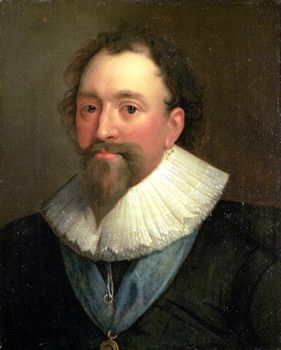
It remained only to find a suitable historical face surrounded by Shakespeare. Of course, some initials were not enough, and the enthusiasts had to turn to the sonnets themselves for the lack of other sources - as if they were a real novel in verses, and even written in the footsteps of real events.
Meanwhile, based on the content of individual sonnets and the entire cycle in general, it is quite difficult to understand something definite about specific life circumstances connecting the poet and his young friend. It can only be established in the most general form that a friend is younger than the poet and higher than his public position, as well as that other poets - rivals of the lyrical hero of the cycle are looking for his locations. In addition, a friend and poet unites the passion for a dark -skinned lady, who, as you can understand from the cycle, gives his mercy to both of them. Finally, although the poet is invariably treated with love and admiration, their relationship goes through a serious crisis.
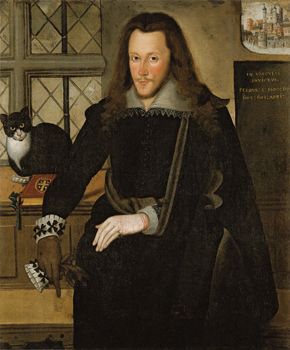
Despite such meager information, the most real “applicants” for the role of “Mr. U. Kh.” Two aristocrats are considered, with whom Shakespeare was undoubtedly familiar. This is Henry Rizli, the third Count Southampton, the addressee of the dedications of the two poems of Shakespeare, and William Herbert, the Third Count of Pembroble, to whom the publishers of the First Folio, the first meeting of Schelkespeare's plays, dedicated the fruits of their labor in 1623. True, the initials of Henry Rizley are not “who”, but on the contrary, “HW” (Henry Wriothesley). The appeal “Mister”, used by a torp, is inconceivable to both titled persons.
Countrymen and colleagues
The discovery of the American scientist Jeffrey Kaveni returns us to the version that "Mr. W. Kh." It is necessary to look not surrounded by Shakespeare, but, more naturally, surrounded by Thomas torp. Kaveni found that Torp could thus honor the memory of his fellow countryman and colleagues, the late publisher William Holme, who died two years before the publication - in July 1607.
In his article, on the website of the scientific publication, notes & queries Kaveni proves in detail that the torp and hill could not help but know each other close enough. To do this, the scientist had to raise a lot of archival data, but as a result, he managed to draw attention to the figure of the hill and his possible role in the publication of Shakespearean sonnets.
In short, Kaveni's conclusions come down to the following. Both book publishers came from Chester, from respected families belonging to the city elite. In the 1580s, both arrived in London and entered the apprentices in book publishing shops, crowded around the Council of St. Paul. The hill, apparently, was older than the torp, his disciples, which at that time lasted at least seven years, ended in 1588 or 1589, and the torp was hired only in 1584. The first became a free member of the guild of book publishers and opened his own shop in 1590, the second - four years later.
Thus, both could know each other from early childhood, still in life in Chester. More likely, it is likely that fellow countrymen who worked side by side in a narrow circle of book publishers and printers met and made friends in the years of apprenticeship. Finally, both showed interest in the publication of theatrical plays. In particular, Kaveni installed, both published the works of Ben Johnson and George Chapman, famous poets and playwrights, with whom William Shakespeare was friends and competed (it is believed, for example, that the chapman could be a prototype of a span poet from the Shakespearet sonnets cycle).
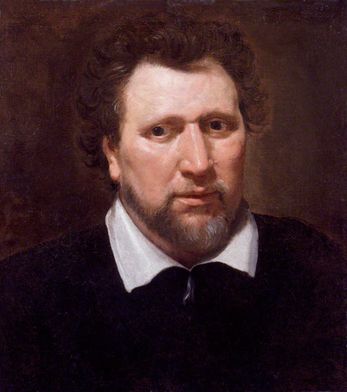
Another argument in favor of the fact that the torp and the hill could be connected by close professional and friendly bonds is their constant cooperation with the printer George Eldom and Edem Islip, well confirmed documented. The Islip, for example, printed Johnson’s play “Anyone outside of Him,” and Eld released Shakespeare for the “Sonnet” torp. Eld and Islip, in turn, worked with each other-and here we are talking about a narrow circle of professionals who, willy-nilly, knew each other well.
Kaveni considers it necessary to note another circumstance. It is known that Thomas Torp, Ben Johnson and Eden Islip were associated with Catholics living in England, who could not openly confess their faith in a Protestant country. The hill religious views could not be established, but it seems that he also had sympathy for Catholics. If this is so, then the connection between the torp and the hill becomes even closer: it was dangerous to publish proskatholic literature, and it was preferable to do this in your own circle. By the way, recently the version has been gaining popularity that Shakespeare, at least in his youth, could be associated with English Catholics (even if this did not affect the content of his plays).
Further, Kaveni proceeds to the events of the summer of 1607. He managed to establish that the hill died at the end of July, and nine days after his funeral, Torp and Eld registered three plays in the registry of the book publishers at once (Torp - one and Eld - two). This register was the only document by which the ownership of a particular essay was protected at that time. True, it was not about copyright in our understanding - the owner of the manuscript and, therefore, the recipient of income in the event of its publication was the one under whose name it was entered into the register.
Two months later, Eld declared himself the owner of two more plays. It is curious that these four plays, which he got from nowhere in 1607, turned out to be the only one, the owner of which he could become his entire career. Likewise, and Torp for the first time in his life managed to get the play in his full property (he brought all the others to the register for the company with someone else).
These and other data allow Kaveni to put forward a hypothesis: after the death of the hill, his friends and colleagues gained access to the deceased archive and divided the manuscripts contained in it. It is in this way, Kaveni believes, Shakespeare's sonnets also came to the torp.
Poet and manuscript
Why Torp issued a collection of Shakespeare's lyrical poetry not immediately, but only two years later, Kaveni does not explain. But he makes assumptions about how sonnets could get to the hill. On the one hand, Kaveni reasoned, the hill published his plays, therefore, he was close to theatrical circles and could also access the manuscripts of Shakespeare or their copies there.
On the other hand, Kaveni writes, William Hill had a brother Randel, Antikvar and a connoisseur of heraldry. In May 1607, that is, two months before the death of William, Randel entered the service of the young Prince Henry, the eldest son of the new English king Jacob I Stuart. It was there, among young courtiers, that Kaveni believes that Shakespeare's sonnets could be especially popular and there Rendel could get their lists. It is natural that he handed the poetry to his brother-publisher, but he no longer managed to prepare them for printing. Thus, having discovered the sonnets in the deceased archive, the torus ultimately released them - not forgetting to honor the memory of a friend and colleagues with a mysterious dedication, which for four hundred years has haunted lovers and historians of literature.
Of all the versions about the personality of Mr. U. Kh., Notes the leading British Shakespeared Stanley Wells, this is “the best for today”. The fact that the mysterious anonymous turned out to be the little-known contemporary of Shakespeare, according to Wells, is the “strong side” of the Kaveni hypothesis: “The fact that this is a person of minor is well consistent with the appeal of Mr. U.Kh.”. It has always been a stumbling block for any attempts to recognize the aristocrat in the anonymous anonymous, ”The Guardian, quoted by Wells, quoted Welles.
It remains to ask the question: what changes the convincing hypothesis of Kaveni in our ideas about Shakespeare's sonnets as a whole? On the one hand, if other scientists recognize its correctness, then among lovers of historical riddles there will be fewer reason to look for an aristocrat with the initials “U. X.". To the portrait of Shakespeare, which is already well inscribed in the context of the era, another dash will be added, bringing the world of the playwright of the public theater with the world of commercial book publishing.
On the other hand, literature historians still do not know the answers to many questions related to Shakespeare's sonnets. If the poems published by the torp did not get him directly from the author, then can we say that this collection correctly reflects the author’s will? That the order of the sonnets in the collection is copyright? What did the author have the plan to have them in any specific order? What do we know all the sonnets written by Shakespeare? And what, in this case, the status of Shakespearean sonnets as literary works? What is the game of imagination that could extract lyrical and dramatic effects from any situation, or a reflection of real events from the poet's life? And why are Shakespeare's sonnets so strikingly not like the sonnets of his contemporaries? These and other questions can be asked to infinity.
It seems that in order to understand them, we have no choice but to turn to the most mysterious and at the same time the most reliable source of information about Shakespeare's sonnets - their texts published in 1609.
Dmitry Ivanov
Moscow