
Translated material
Black poet
The book "Hello, Pushkin!" -The first full academic study of the Pushkin anniversary of 1937 in the USSR is preparing for the publication of the European University in St. Petersburg in the series Aesthetics and Politics. Its author is Jonathan Brooks Platt, Professor of Slavicism of Pittsburgh University.
The book is a thorough analysis of the Soviet canonization of the Russian poet in a number of cultural practices: school education, academic and essayist letters, visual arts (painting, sculpture, graphics, photography) and narrative texts (fiction, theater, cinema, narrative poetry). The main object of the study is the Stalinist attitude to the “heroic” past of the pre -revolutionary era and the underlying its paradoxical attitude to the time.
The Stalinist attitude to time is considered as a “hybrid chronotope”, in which Pushkin appears simultaneously both as a master and “ancestor” of a new Russian culture, a monumental point of departure and constant return, and as a martyr of the barbaric era, which awaits the eschatological atonement and resurrection in a new, revolutionary world. This hybridity is associated with many conflicting aspects of the Stalinist culture, including national policy (“first among equal terms”, “nationalist in form, socialist in content”), pedagogical methods (conflict between historical knowledge and intuitive insight), the image of a proletarian reader (“naked man on naked land” or “heir to classical property”), politics of literature (necessity The “metap political” position of deviation from a real struggle) and a socialist realistic approach to historical plots (the path from spontaneity to consciousness without partisanship).
Below are excerpts from the fifth chapter of the book, considering images in historical narratives.
A specific modernist combination of the monumentalist and eschatological attitudes by Yu. Tynyanov [in the unfinished novel “Pushkin”] does not correspond to the genre instructions of socialist realism, almost the only guideline here is the national narrative of the history of Russian literature. Things are more complicated with those authors who seek to more firmly enter the history of Russian literature in the history of the political struggle against autocratic oppression, and this struggle is seen by them with a universal movement of world history. Because in this case, Pushkin with his dual status of the master and the prophet is involved in the conflict between the standard socialist plot and the ritual of optimistic tragedy devoid of catharsis. In Pushkin-Master, barbarism and civilization, completeness and emptiness are combined, and this connects him with the dream of removing spontaneity in consciousness. But in his hypostasis of the prophet, he also exposes the inconsistency of this dream - after all, only the people themselves, awakened, can fulfill it. For this eschatological foresight there are two different solutions. The poet should either remain “barbar” - to resist the premature harmonization of life and form in society, which is still subordinated to the repressive hierarchy of actions, representation and speech, or he must remain “empty” - irrelevant, absent, hustling, so that his aesthetic look can absorb all and any life entirely. Both of these solutions turn Pushkin-Master into a martyr. In both cases, the monumental completion does not occur: in the first case - because the world is still controlled by the policy of the will and the true modernity remains unattainable, in the second - because there is still no people who would fill and revive it by fulfilling the educational law he discovered. In the first case, Pushkin’s life is an incomplete version of the standard socialist scenario. The young poet learns to pacify passions, moves to consciousness, but there is always something spontaneous, jokutic, some kind of monkey-like ardor. Only in this way can he avoid the fate of the Decembrists and not get off his unique life path. In the second case, history acquires the features of optimistic tragedy, and also not complete. Pushkin here is a socialist mentor who died, but not quite, and is doomed to wait (like a decaying dog in a living grave) until the sons of the revolution come and take its victim. Roughly speaking, the poet’s dual nature: either this is the hero of the tragedy who has not died in time, or this is the hero of the novel, who tirelessly tries to grow to epic proportions, but this height has to be endlessly restrained. Pushkin turns into an indefinite Quir-characters, he is never able to completely control his own life and very vaguely imagines that for the conflict he must resolve: the dialectics of spontaneity and consciousness, the center and periphery, or the chiastic bifurcation of the master and the martyr.
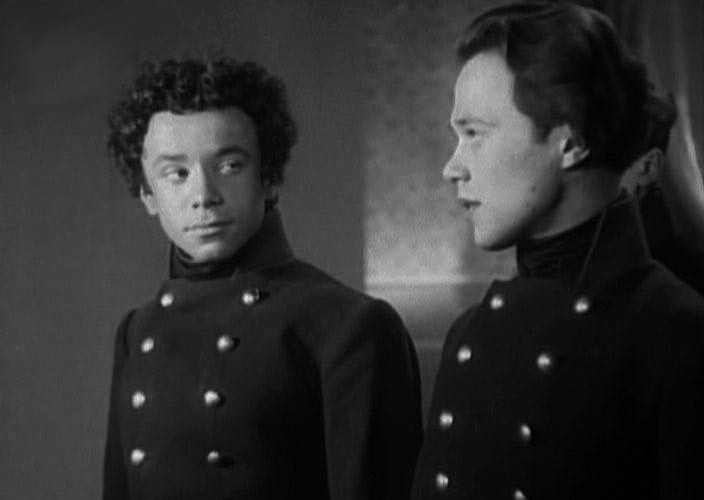
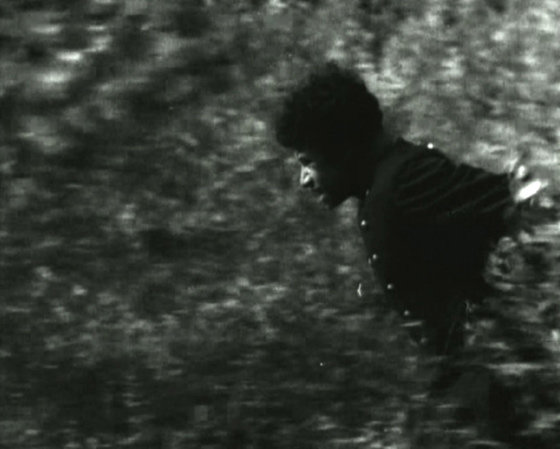
The incomprehensible racial affiliation of Pushkin is regularly mentioned in these works, and always in connection with his unbridled and passionate character. In the framework of the figurative language of black and white cinema, the poet’s dark color color unequivocally marked it as an element alien to his own world. Pushkin himself in the unfinished novel “Arap of Peter the Great” gives the following description of the ambiguous perception of the racial belonging of his ancestor: “He is for them a kind of rare beast, a creature of a special, alien, accidentally transferred to the world, who has nothing to do with him” [1] . By the century, two biographical ribbons on Pushkin were removed from the day of death, Arama Naroditsky paid special attention to the racial question in his film “The Youth of the Poet”. The authors of most reviews on this film approvingly met the image of Pushkin’s “Wild African” and boldly responded about the game of Valentin Lithuania, a self-taught actor who played the main role. Often the dark color of the poet’s skin is interpreted in the film as a sign of something “imperative”. Already in the first five minutes of the film, Pushkin is drawn into a quarrel when a classmate Sergey Komovsky suggests that he was dropping the honor of the uniform during the next love adventure. This phrase offends Pushkin, and he is chasing Komovsky throughout the building. He hopes to avoid a fight, tries to calm Pushkin and calls him a “monkey”, one of his lyceum nicknames. As a result, Komovsky runs to the teacher and claims that Pushkin rushed at him “like a panther” because of a harmless remark [2] . In another stage, Pushkin quarrels with Pushchin because of the fortress actress Natasha, which they are both in love with; The camera moves after the boy when he, upset, runs away, wandering through the bushes, like a wild lynx. In the film, such scenes are repeated several times, where Pushkin is hidden in the violent greenery of the park or, conversely, quietly appears from the thicket.
 © Lenfilm
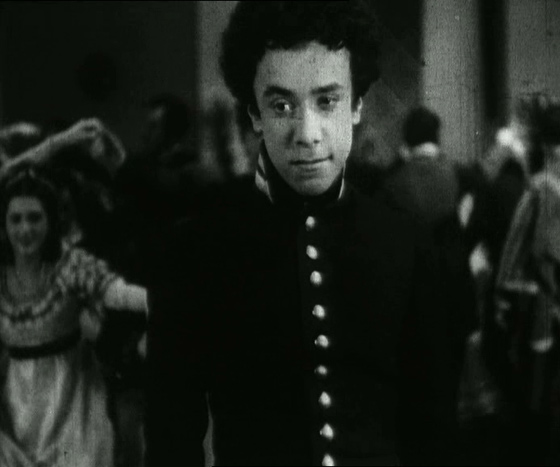
In general, Naroditsky uses the poet's darkness, contrasting him with Blagonate and Imperial Paphos. Pushkin appears an unpredictable, indomitable force in a world based on a rigid hierarchy and a clear order. At the ball, the future poet dances with an indifferent-cold princess in a white dress and long white gloves. In an earlier stage, the girl was horrified at the sight of Pushkin’s dirty uniform, and now his attempts to melt the ice and make her make her no impression on her. Throughout the scene, Pushkin’s dark face, his curly hair and the rogue smile contrast sharply with an ethnically homogeneous, uniform mass of dancers. In the end, the princess rejects Pushkin, and the camera, once again emphasizing his otherness, shows him a close -up of him alone against the background of the ongoing ball.
 © Lenfilm
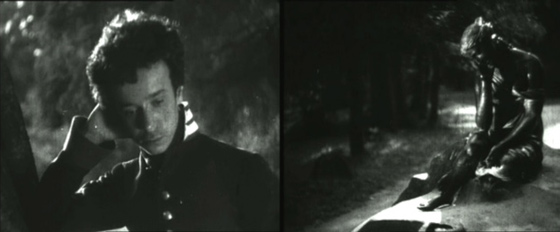
When Pushkin leaves the ball and goes alone to a walk in the park, the viewer can see the global of the harmony of feelings and forms that the poet has to be found from a hypocritical society, invariably pushing him to a cruel, almost animal rebellion. In deep thought, Pushkin stands, leaning against a tree and propping his head with his hand, then a mounting glue, and we see one of the park fountains - a bronze “girl with a jug” sitting in the same pose.
 © Lenfilm
Status immobility and the murmuring water of the fountain, their subtle interaction (reference to the Pushkin poem of 1830 “Tsarskoye Selo Statue”) become an expression of the destiny of the poet in this film [3] . In order for his fate to come true in order to become a great Russian poet, Pushkin must also put a stream of his feelings in a more strong and durable shape. As in the standard socialist plot, there is a need to find a way to reconcile the spontaneity of feelings with consciousness and discipline.
The problem of the mentor of Pushkin remains unresolved. One gets the impression that the scriptwriters of the “youth of the poet” suggested the presence of several politically conscious characters in the film: in the script, for example, there is a scene in which [a progressive teacher of ethics, rights and political philosophy] A. Kunitsyn pronounces a speech about civil debt, and another scene in which Pushkin, Pushchin and Chaadaev talk about the tragic failure of the French revolution. None of these scenes entered the film, and the roles of Kunitsyn and Chaadaev turned out to be absolutely secondary. Many critics were very lamented about these scenes, some decided to write off their absence on a rush when shooting the film - after all, the prime minister was timed to the centenary of the death of the poet. Although, perhaps, the bills were made at the request of supervisory authorities. In a review published on February 11, 1937 in the newspaper Izvestia, academicians D. Yakubovich and V. Gippius mention Kunitsyn's freedom -loving speeches as if these scenes were in the film. Perhaps Pushkinists referred to an earlier version of the film shown on the closed viewing of a narrow audience, including government officials who at the last moment decided to cut out these scenes. Perhaps the liberal pathos of these scenes lacked the revolutionary sharpness and it was decided that it was better to cut them than to let ideologically ambiguous material on the screen.
Be that as it may, as a result, a young team of passionate, but naive lyceum students in a strange way is “orphaned”. The lyceum students are bonded by the bonds of friendship, but they do not have an organizational principle of a higher order, which could later lead them to a real political action. Delvig seems to be more interested in wine than politics. More conservative classmates laugh at Kuchelbecker, when he, shaking from nervous tension, declares that power comes from the people, and not from God. Pushchin - the most advanced; He is always assembled, attentive, always helps Pushkin not catching the eye of the teachers when he goes for walks, and during a secret booze, when Pushkin reads his opposition poem to classmates, Pushchin manifests himself as a talented conspirator and calls on his comrades to remain silent and not tell anyone about it. It is also worth noting that the Slavic beauty of Pushchin is clearly contrasted with the dark color of Pushkin's skin. But, despite a few moments of sincere friendship with Pushchin, Pushkin comes to understanding himself and the world around himself. Pushkin, like all his comrades, chooses his life path.
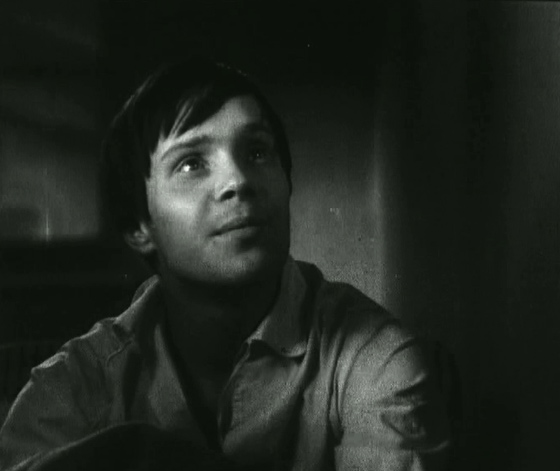 © Lenfilm
The distinctly traced intonation of the elegy, with which Pushkin is shown in the film, can be read as a hint of the tragic failure prepared for him by fate. His night walks in the park can symbolize the escape from conventions and pretense of an aristocratic society and a return to nature in the spirit of Jean-Jacques Rousseau, but they also separate it from all naivety and primitiveness, contrary to any similar associations associated with his African roots. Mainly the theme of this inner barrier is revealed by Pushkin’s love story for a peasant girl Natasha. The scene of the fountain ends, Pushkin goes on. The subjective camera (Pushkin’s gaze, making his way through a thick forest) suddenly notices young peasants dancing around a high bonfire. When the courtyard peasant drives the girls and they fly away like birds, Pushkin gloomily lowers his head. In the next scene, the story becomes personal - the young poet finds Natasha with a braided braid and singing by an open window. The image echoes one of the first frames of the film, where Pushkin closes the window to hide from the noise of the triumphal procession in honor of the victorious return of the king from Paris in 1814. In this case, the motive of the window and music is turned upside down the opposite: Pushkin rises along the ladder to climb the girl into the room. They go down together, sit on a bench and have a conversation, but again the yard appears and again breaks the erotic meeting of the future poet with the people. The serf threatens to carve a girl and strictly pronounces Pushkin for abusing his high position. The angry Pushkin screams at the serf, but until the end of the film he will not be able to overcome the class barrier and connect with Natasha. In the end, the girl will be sold, her fate is a foregone conclusion. “They would be rich, they would buy me,” she says to Pushkin and runs away in tears. Natasha comes to say goodbye to the poet, just when he reads his “ode to liberty” in Chaadaev’s house. This moment demonstrates the helplessness of the liberal mood of the lyceum circle. The girl leaves, and Pushkin has no choice but to return to his comrades and pronounce a dubious toast “For the will”.
Despite the monumentalist claims of the film, Pushkin in it is shown as an incomplete and incomplete image. It remains a barbarian and therefore retains immunity to the vices of the civilization in which he lives. But at the same time, the only thing the peasants receive from him is troubles, and his reaction to their suffering is completely passive. His poems are able to inspire comrades, in the film, the harmonious poetry is often given in installation interruption with filming trees and ponds in the park. Here we see that art is able to turn into a separate, independent power. But at the same time, in the final scene of the film, when Pushkin and his comrades, singing songs, rush on the three along a winding road (apparently, they go to St. Petersburg immediately after graduation), there is no indication of the deep historical meaning of this trip. What is its final point? The unsuccessful uprising of 1825? Or the maturation of Pushkin to the status of a national poet? Or his tragic death in 1837? Atonement in October or the anniversary itself? The film does not directly indicate from this. Only by virtue of a vague association can the viewer connect this trip to the poet and his comrades with the future uprising of the Decembrists. The viewer must decide for himself what the meaning of those fate that expect them.
Moses Levin’s film “Travel to Arzrum” is a worthy continuation of the “youth of the poet”. This film describes the events of 1829, when Pushkin accompanied the Russian army in the Caucasus during the Russo-Turkish War. “Journey to Arzrum” goes further in the image of Quir-Poet and his ambiguous position in the center of the hated world. As in the novel by I. Novikov [Pushkin in Mikhailovsky], Pushkin is obsessed with the idea of leaving Russia, from lawlessness of the secret police and shameful colonial aggression of the imperial regime. The dark color of the poet’s skin does not become an independent theme in the film, but Pushkin’s appearance (his role was played by the famous reader Dmitry Zhuravlev) unequivocally distinguishes him against the background of other characters. Pushkin is surrounded by soldiers in military uniform, he himself is dressed in a simple black jacket (scenes in the room) or in a long battered cloak on a goat fur (field shots), which resembles his own curly hair. This film is no exception - there is also the motive of the Wild Beast, in a strange way present in almost all works dedicated to the life of the poet. However, Levin Pushkin has much less “wild” than in the “youth of the poet” of Naroditsky. Unlike Lithuanian, who looks very natural in makeup, the image of Zhuravlev-Negra is so artificial that he, in a rough wig, with painted lips and eyes and worn cheeks, looks more like a transvestite.
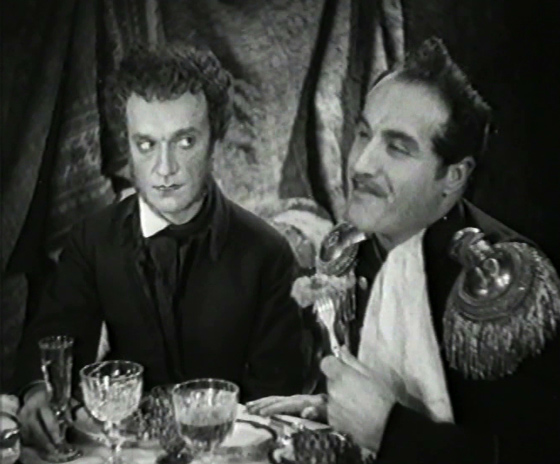 © Lenfilm
And in fact, you should pay special attention to the abundance of homoerotism in this film. Pushkin’s arrival in a military camp is accompanied by an excellent scene: naked soldiers bathe their horses in the river.
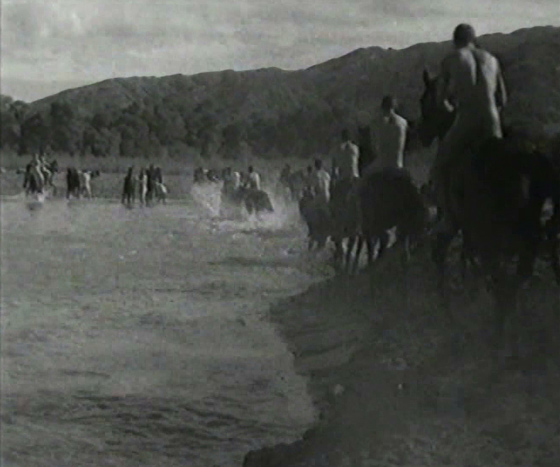 © Lenfilm
Then - a mounting gluing, and we see how General Raevsky (sympathetic to the Decembrists) leans over Pushkin lying on his fur cape, and puts his hand on his stomach. In the subsequent, parallel scene, it shows how Pushkin convinces Raevsky to see all their common friends, among whom there are several conspiracy participants who are fraught and exiled to the Caucasus. This time Raevsky is shown lying - he languidly lies in bed and smokes a long pipe hanging from his mouth. Pushkin tightly squeezes his comrade’s hand and, leaning close to him, persuades him to arrange this meeting. Генерал поначалу отказывается, и Пушкин принимается нещадно его щекотать. Мы видим лицо Пушкина сверхкрупным планом, он дико улыбается и говорит: «Ну? Well? Ты чего, голубчик?» А белая рука Раевского у него на плече оттеняет черноту и подвижность его лица.
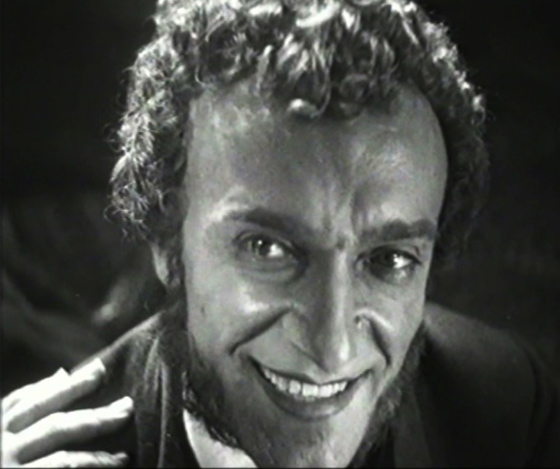 © Ленфильм
Эта встреча, организованная в нарушение устава (офицеру не положено общаться с рядовыми), становится центральным эпизодом всей картины. Мужчины сидят в палатке, курят, иногда прижимаются друг к другу, декабрист Захар Чернышев играет в это время на гитаре, а другой декабрист, Иван Бурцев, ведет скорбный рассказ о тюремном заключении. Особенно подробно он описывает момент, когда им сообщили о казни товарищей. Роль Пушкина в этой сцене — подбодрить остальных. Николай Семичев, третий заговорщик, зачитывает строки из пушкинского «Во глубине сибирских руд…» и вспоминает, каким утешением для них это стихотворение стало в тюрьме [4] . А потом все хором поют романс «Талисман», переложение одного из стихотворений, написанных Пушкиным до событий двадцать пятого года. В данном контексте слова о волшебном любовном талисмане приобретают новый смысл. Очевидно, что этот талисман — это сам Пушкин, и он не сможет уберечь своего владельца от смерти и не поможет возвратиться из дальних стран, зато он способен сохранить верность событиям 1825 года. «Милый друг! от преступленья, / От сердечных новых ран, / От измены, от забвенья / Сохранит мой талисман» [5] . Эротизм этих строк полностью соответствует той нежной дружбе, которая связывает этих мужчин друг с другом.
Таким образом, по сравнению с «Юностью поэта» в «Путешествии в Арзрум» акцент на трагический исход восстания 1825 года делается более однозначно. Пушкин и его прогрессивно мыслящие товарищи застряли в этой гнусной точке времени-пространства, где всем заправляют продажные и кровожадные генералы и доносчики. Примечательно, что только такие персонажи в фильме проявляют гетеросексуальное желание. На приеме у генерала Паскевича Пушкин с ужасом наблюдает, как царские приспешники обжираются мясом, параллельно призывая его стихом обессмертить их военную славу. Кто-то из офицеров зачитывает строфу из пушкинской поэмы «Руслан и Людмила» — вот таких «высот поэзии» они ждут от Пушкина: «Раздета сонная княжна; / Прелестна прелестью небрежной, / В одной сорочке белоснежной / Ложится почивать она» [6] . При упоминании полуголой девицы все за столом начинают гадко и похабно прихихикивать. Подобные сцены однозначно дают понять, что цель этой гомоэротичной встречи Пушкина с потерпевшими поражение декабристами отнюдь не в том, чтобы вернуть им боевой дух и восстановить их революционную потенцию. Напротив, они подверглись кастрации, и Пушкин указывает на это и требует хранить верность их коллективному поражению. Описанная выше встреча завершается пламенным чтением из «Бориса Годунова»; выбранный отрывок весьма созвучен с судьбой самих заговорщиков.
Что пользы в том, что явных казней нет,
Что на колу кровавом, всенародно
Мы не поем канонов Иисусу,
Что нас не жгут на площади, а царь
Своим жезлом не подгребает углей?
Уверены ль мы в бедной жизни нашей?
Нас каждый день опала ожидает,
Тюрьма, Сибирь, клобук иль кандалы,
А там — в глуши голодна смерть иль петля.
Знатнейшие меж нами роды — где?
Где Сицкие князья, где Шестуновы <…>?
Заточены, замучены в изгнанье.
Дай срок: тебе такая ж будет участь. [7]
В данном контексте темное, довольно страшное лицо Пушкина, когда он щекочет Раевского, можно интерпретировать как само лицо революционного загнивания, на которое он заставляет своих товарищей смотреть.
Данное прочтение подкрепляют и другие сцены фильма. Финальная часть картины посвящена истории двух декабристов, Бурцева и Чернышева, отправленных на верную смерть: они должны взорвать башню, чтобы русские войска смогли взять укрепления и войти в осажденный город. Заговорщики успешно выполняют задание, но зрителю четко дается понять, что их героический подвиг лишен всякого смысла. Вместо обещанного восстановления в чине их ждет смерть: Паскевич и агент тайной полиции Бутурлин по приказу самого царя обязаны проследить, чтобы они не вышли с поля боя живыми. Когда Чернышев погибает, Бутурлин злорадно поздравляет его с восстановлением в офицерском звании. Когда от ранений умирает Бурцев, Пушкин находится подле него. В этой трогательной, семантически нагруженной сцене Пушкин накрывает тело погибшего друга своей меховой накидкой, сняв ее только наполовину, и на мгновение он замирает и погружается в свои мысли. Эта бестиальная и в то же время нежная сцена похорон резко противопоставлена ложному благородству истинных зверей, обрекших Бурцева и Чернышева на смерть. И даже в смерти они не находят столь желанного завершения. Их смерть оплакивают, но это лишь временный, краткосрочный траур — символический потенциал их гибели полностью перечеркнут. Под барабанную дробь русские войска входят в город, матери с младенцами в ужасе прячутся от кровожадных солдат-мародеров, дети пускаются в бегство, скот разбегается, валит дым, с неба обрушиваются камни. Пушкин покидает поле боя и случайно встречает Семичева, умирающего от чумы рядом с другими солдатами, которых принесли в жертву во имя низкой и подлой цели. Поэт возвращается на поле боя и видит страшную картину разрушения, он ходит между трупами и мрачно всматривается в искаженные от ужаса лица уцелевших женщин и детей. Как и в «Юности поэта», он бессилен облегчить их страдания. Пушкин абсолютно пассивен, он не более чем очевидец [8] .
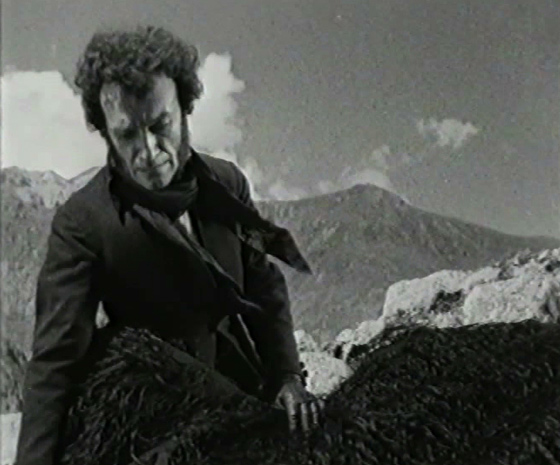 © Ленфильм
Концовка «Путешествия в Арзрум» похожа на последнюю сцену из «Юности поэта»: Пушкин в тройке едет по проселочной дороге. Песня кучера отвлекает его от мрачных мыслей, и с полуулыбкой на лице он наклоняется вперед, чтобы послушать. Эта сцена перекликается с другой, более ранней, сценой, где Пушкин видит телегу, на которой везут гроб с телом Грибоедова. Пушкин приходит в ужас от увиденного, но он смотрит на горы, прислушивается к грубому пению мужчин, везущих гроб из Тегерана, и на лице его появляется та же полуулыбка. Параллель с Грибоедовым вновь связывает Пушкина с мертвыми и по-настоящему не оплаканными телами его товарищей [9] . Левин также использует мотив бестиальной пустоты. Черная меховая накидка (шкура животного) связывает Пушкина с декабристами, но царская армия не замечает этого, она видит лишь пустоту. Когда Пушкин в конце концов отказывается писать стихи об успехах военной кампании и с отвращением отбывает из полка, Паскевич обращается к Бутурлину и говорит: «Пустой человек!»
Темы звероподобности и/или пустоты регулярно всплывают в произведениях о Пушкине, что свидетельствует об их неспособности в полной мере соответствовать требованиям историзма и создать завершенный образ поэта. Во многом эта осторожность напоминает беспокойство советских интеллектуалов 1920-х годов: они опасались, что в полое тело поэта может просочиться чуждая идеология и из него не получится сделать один из столпов советской культуры. Раннесоветская критика еще не заполняла пустоту поэта народной любовью и энергией, она чувствовала в Пушкине необъяснимое присутствие чего-то чужеродного. А в произведениях, написанных к столетию гибели, эта тревога, наоборот, проецируется на самого Пушкина. Он становится чужаком для своих же современников, и пока революция не победит, его судьба не свершится. Пустота, подготавливающая Пушкина к вечной жизни в народной памяти, совсем иного свойства: она указывает на то, что Пушкин невидим для враждебного мира. В отличие от извергов-реакционеров Пушкин не желает надевать маску ложного благородства, и поэтому для него нет места в обществе. Из-за этой пустоты его смерть воспринимается скорее как зверская расправа, нежели как акт мученичества.
В конечном итоге обе эти категории проводят границу между искусством и политикой. В отличие от романа Тынянова поэтический гений Пушкина, даже оставаясь его главной характеристикой, остается в этих произведениях за скобками. В основе этих сюжетов всегда лежит политический конфликт, а тот факт, что Пушкин — гениальный поэт, воспринимается как нечто само собой разумеющееся. Исполненная надежды улыбка из «Путешествия в Арзрум» — удачная иллюстрация того, что Жак Рансьер называет «неактуальной надеждой диссенсуса». Бестиальная пустота поэта отделяет его от единственной активной силы своей эпохи — от политиков, насаждающих свои якобы цивилизованные порядки в мире, измученном страданиями. Чтобы дистанцироваться от всего этого насилия и сохранить верность поражению 1825 года, необходимо исключить себя и таким образом позволить искусству вступить в диалектическое взаимодействие с реальностью. Таким образом, трагизм этих произведений не только отражает то обстоятельство, что время для борьбы еще не настало, но еще и вскрывает конфликт между искусством и жизнью. Более успешным (т.е. откровенно наивным) произведениям, созданным к годовщине, свойственно одновременно обозначать и сразу же стирать это различие. Так, например, в своей книге «Наследие Пушкина и коммунизм» Валерий Кирпотин воздает Пушкину почести за его достижения, для него Пушкин — это культурная основа. Но он и одновременно трагическая жертва, которая должна быть искуплена (и, таким образом, завершена) новым советским человеком.
В перечисленных выше произведениях отсутствует безграничный оптимизм Кирпотина. История Пушкина здесь — это незавершенная история мученика, стоически принимающего потрясения своей эпохи, а его поэтическое мастерство — лишь обещание Будущего. Подобно Протею, поэт пуст, и заполнить эту пустоту способен только народ, когда его мученичество завершится, а его нетленное звероподобное тело вернется к жизни и к человечности. Таким образом, исторический долг Пушкина — покорно ждать до тех пор, пока не настанет далекий день грядущей победы. В результате инверсии монументализм оборачивается пророческим предвосхищением народного освобождения, а эсхатология со временем превращается в проверку на выносливость, в бесконечное заключение в зловонном разлагающемся теле, в одном шаге от долгожданного завершения.
Перевод с английского Якова Подольного
[1] А.С. Pushkin. Полное собрание сочинений в 16 тт. (М.-Л., 1937—1959), 8.1:5.
[2] Ссора вспыхивает вновь, однако на сей раз разногласие несет политическую нагрузку: Пушкин отказывается признать божественную природу царской власти. Он вступает в драку с набожным и верноподданным Комовским, а потом снова убегает в лес. Его неистовство шокирует одноклассников: «Какой-то африканец. Savage!"
[3] Стихотворение Пушкина заканчивается так: «Чудо! не сякнет вода, изливаясь из урны разбитой; / Дева, над вечной струей, вечно печальна сидит». Pushkin. Complete set of works. 3.1:231.
[4] Исторические факты в этом фильме трактуются с определенной вольностью. Бурцев открыто не поддержал восстание и оставался в чине майора. Чернышев не погиб на Кавказе, а Семичев не сидел в тюрьме в 1827 году, когда Пушкин написал свое знаменитое послание.
[5] Пушкин. Complete set of works. 2.1:396.
[6] Там же, 4:33.
[7] Там же, 7:40. Отточием в угловых скобках показано, что в фильме из отрывка была вырезана строка «Романовы, отечества надежда».
[8] За весь фильм он совершает лишь одно настоящее действие — тщетно пытается убежать от царских войск, когда сражение подходит к концу.
[9] В оригинальном литературном сценарии последняя сцена сообщает, что в тот же день в Россию прибыл Дантес. M. Блейман и И. Зильберштейн. Путешествие в Арзрум во время похода1829 г. «Звезда», № 1,1937 г., стр. 100.