
Translated material
The European Commission will recommend EU members to have at least three gas sources
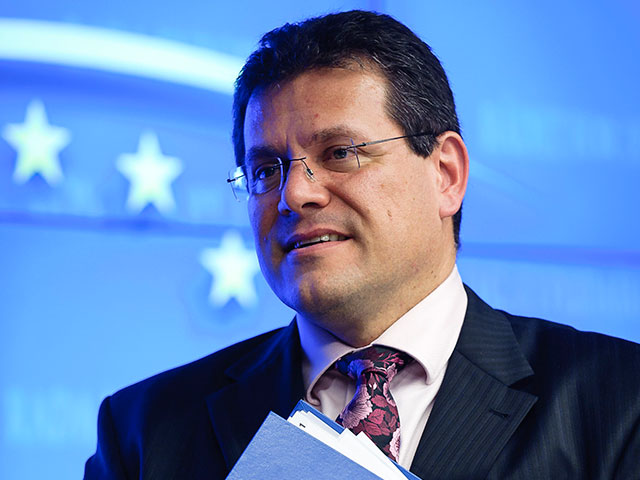
The European Commission is developing proposals that will allow participants in the European Union to exchange more frequent gas and depend less on Russian supplies. In particular, the countries of Central and Eastern Europe, which are stronger than others, depend on Gazprom, will recommend to have at least three gas sources. According to Reuters, the deputy chairman of the EC Marosh Shefchovich, responsible for the energy, after a meeting of the working group, who should outline a plan for improving the gas infrastructure in Europe, stated.
"We decided to make our goal to provide each country in the region at least three reliable gas sources. We will consider all infrastructure projects as soon as possible, which should be funded from European funds," Shefchovich told reporters.
The meeting of the working group was held in the capital of Bulgaria Sofia in support of the country that lost the South Stream project. Sofia will discuss with the European Commission the idea of inviting Russia to build an underwater part of the Southern Stream to the Distribution Center in Varna, said Bulgarian Prime Minister Boyko Borisov.
According to him, the country will need 2.2 billion euros for the construction of a distribution center that could receive gas not only from Russia, but also from Azerbaijan, from the Bulgarian deposits in the Black Sea and from LNG terminals in Greece. Bulgaria could also receive gas from storage facilities in the Czech Republic and Slovakia through the gas pipeline passing through Romania, Borisov said.
Earlier it was reported that the first step of the work of this group should be the development of an action plan for the integration of the gas market of central and southeastern Europe and the creation of gas relationships in the region.
Recall that the European Commission, which is the highest executive body of the EU, is preparing a plan for the creation of energy union, and is also going to develop alternative sources of energy resources - in particular, the Southern Gas Corridor from Azerbaijan, Turkmenistan, Georgia and other countries of the Caspian region. It contains new important points regarding interaction with the main gas supplier to Europe - Russia. We are talking about new restrictions on investing Russian companies in the European energy sector.
Firstly, the European Commissars on Energy, Trade, Industry and Competition propose to entrust during 2015 to develop a detailed scheme for general procurement of imported gas. A great supporter of this idea is the current chairman of the European Council Donald Tusk, but the main players in the European gas market are unambiguously against centralized purchases.
Secondly, four European Commissioners may be entrusted to "discuss investments of third countries, such as Russia, in the European Energy Market (infrastructure, distribution, gas supply and electricity) in the context of energy security."
This item is directly directed against Gazprom, which owns various transport and sales assets in the EU. His participation in sales could increase sharply as a result of an exchange exchange transaction with the German concern BASF.