
Translated material
Inspiration of anger
At the beginning of 1915, in Germany, along with the national anthem, the “anthem of hatred for England” sang along with the national anthem, while in England they began to prove that Beelgian is Beelgian. The intelligentsia was involved in the unprecedented chauvinistic frenzy, in which in the first months of the First World War was involved, the next material dedicated to the centenary of the Great War 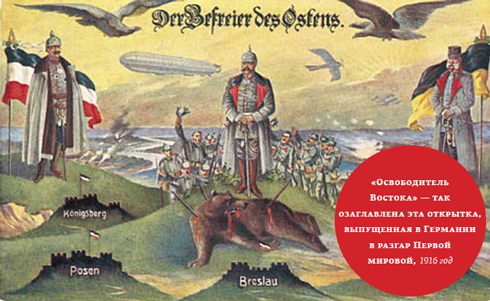
But we will hate you endless hatred.
Our hatred will never leave us,
Hatred at sea, hatred on land,
Hatred in the heads, hatred in hands,
Blacksmith's hatred, prince's hatred,
The fierce hatred of the seventy million
United in the name of love,
United in the name of hatred,
Everyone has only one enemy - England. ” This is an excerpt from the “Anthem of Hate for England”, composed by the German poet Ernst Lisauer. Korney Chukovsky wrote then that such an inspiration of anger, as in this essay, was not yet in universal literature. This is not a song, but a cramp, something convulsive, shamanic; It is difficult to translate it with a random-blundry spell-minded spirit, sometimes reaching the trance.
“The mass thinks national” in the memoirs “Yesterday's World” Stefan Zweig
* * Stefan Zweig (1881–1942) - Austrian writer, critic, author of many short stories and fictionalized biographies. He knew Lissauer well, wrote: “Kaiser was inspired and honored Lissauer with the“ Red Order of the Eagle ”. The poem was reprinted by all newspapers, the teachers read it aloud in schools, the officers recited him in front of the system of the soldier - until everyone learned this casting of hatred ... among the seventy million Germans there was soon not a single person who would not know the “hymn of hatred for England” from the first to the last line ... Ernst Lissauer gained the most loud glory that the most high -profile glory He gained a poet in this war. "
Gustav Strezeman, subsequently the Reichscanzler and the Minister of Foreign Affairs, summed up his impressions in 1921: “Not a single people had to come to God and world history in such purity <...> Our goal is to reconcile all the layers of the German people. The mass thinks nationally. This was proved by 1914. "
Wilhelm II, in his famous throne speech dedicated to the beginning of the war, proclaimed: "I do not recognize any parties, for me now there are only Germans."
The Jews of the Reich (and the Lisauer became a national poet) with glee met these words; They believed that they would finally be able to "plunge into a wide stream of national fate." As it turned out, in vain.

The unity of the elites of the German-speaking cultural elite was in a state of national euphoria, everyone was intoxicated by the war and are convinced of the correctness of the German and Austro-Hungarian empires. In the first week of the war, Sigmund Freud wanted to see the columns of German soldiers, with a victory in Paris. “All my libido belongs to Austria-Hungary,” the great psychoanalyst proclaimed. “Gradually,” wrote Stefan Zweig, “it became impossible to talk to anyone reasonably. The most peaceful, most good -natured, like obsessed, longed for blood. Friends, whom I knew as convinced individualists and even ideological anarchists ... turned into fanatical patriots, and from patriots into insatiable annexionists. Each conversation ended either with a stupid phrase, like "who does not know how to hate, he does not know how to truly love", or with rude suspicions. "
Thomas Mann saw in the war the opportunity to get away from “materiality” and “intellectual emptiness”. For him, the war then was a struggle between the German “culture” and the “utilitarian civilization” of England and France. In the 1915 essay, Frederick and Big Coalition, he wrote that democracy is “not German business”. And in 1916, already knowing about a million killed a year, he continued to glorify the war, which, in his opinion, foreshadowed the "mystical synthesis of power and spirit."
One of the leading thinkers of Germany, the beginning of the century, Leo Bek wrote: "She (war) allows us to feel that the life of the Motherland is our life." The thirty -six -year -old philosopher Martin Bubert, one of the most original philosophers of the 20th century, the “Prophet of the Jewish Renaissance”, proclaimed the war by cultural liberation. He saw in it the “sacred spring” and believed that in the end the war would unite the Germans and Jews around the general historical task - to bring culture to the Middle East. He explained to several shocked foreign pacifists that Germany was only defending, and condemned one of them (the famous Dutch writer and psychiatrist Frederick Van Eden) for “infantile attacks” on Germany. The famous philosopher German Kogen believed that “the highest ideals would be realized in this patriotic war” and that it would bring Germany a “heroic victory”.
The hatred of the peoples of those countries with which the German world fights, captured the cultural layers of Germany and Austria to such an extent that they began, for example, to deny the contribution of the great British and French to world culture. And the British and French in relation to the Great Germans showed the same attitude. In German theaters, Shakespeare's plays ceased to be staged, and in the French - the operas of Mozart. In England and in France, “evidence” appeared that the Beelgian Beathoven. The hatred of two fighting camps was mutual and amazing stupidity in force.
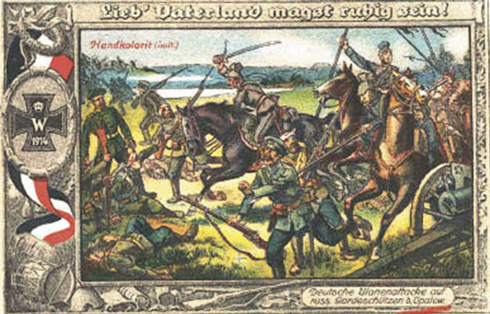
The German propaganda postcard “Peace to you, beloved homeland!”, 1914, the war as the deliverance “what is called the lunism of the masses, in such cases is only the discharge of unbearable internal stress,” said Theodor Wolf, chief editor of the liberal newspaper Berliner Tageblatt.
Historian Fridtjof Shenk wrote that the political groups were once hostile to each other enthusiastically united under the militaristic slogans; Workers and bourgeois, peasants and intellectuals went to the battlefields with songs and flowers in their hands. People perceived the war that had begun as deliverance, the beginning of the "New Age", the era of the "new civil world."
In the formation of military units, over 4 million men were called up for military service, and this did not cause any opposition from the population. On the contrary, over 180 thousand volunteers went to the front.
Photos of the flowers crowned by soldiers and women escorting them at the stations soon flashed on postcards and newspaper turns. After reports about the first victories of the German army, the patriotic enthusiasm was almost limitless and widespread. Even in the working quarters of Berlin, until recently-the main strongholds of internationalism, on the facades of the houses one could see patriotic black and white-red flags. Rumors began to spread about enemy sabotage, which led to a widespread hunt on the alleged Russian spies.
The news and paintings of those days made a very strong impression on contemporaries, and the press created a special aura for this historical moment, stylizing the military inspiration of the Germans under the “sacred anger”. As the journalist of the newspaper Tagliche Rundschau wrote, Germany experienced “the great miracle of self -renewal, discarding all the petty and alien, a kind of powerful awakening of a national character” (learn the vocabulary of our Alexander Prokhanov?).
As many eyewitnesses noted, the Germans first came to a kind of “popular unity”. “The prejudices fell, the delusions were scattered, people between whom the Himalayas seemed to lie, found compatriots in each other. <...> War is a great destruction and at the same time a great update. It destroys, and it creates it, ”exclaimed the liberal journalist Helmut von Gerlah.
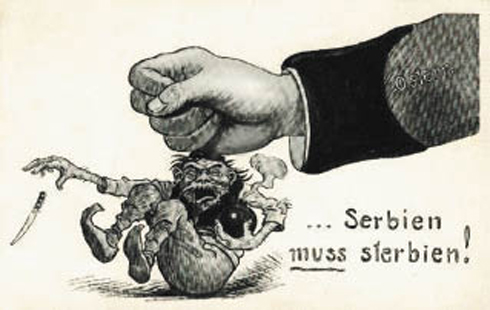
The Austrian propaganda caricature “Serbs must die!”, Created after the murder of the Archduke Franz Ferdinand, 1914 All for the front, the entrepreneurs of the Reich did not stand aside the general impulse. Among those who did not believe in the transientity of the war, was businessman Walter Ratenau, the chief shareholder of the AEG electrical giant. Ratenau immediately understood the difficulties of adapting the farm to the war, especially in the conditions of the English sea blockade. At the military ministry of Prussia, a military-raw department was created, which headed Ratenau. Not only the combat effectiveness of the empire depended on his activities, but also its survival in isolation from the main trade routes. Under the leadership of Rotenau, military-industrial societies began to supply German industry with raw materials. These institutions played a major role in the state regulation of Germany’s economy during the war years. As a result, the concentration of large businesses intensified due to the weakening of smaller campaigns. In fact, state corporations were created, but with a predominance of private capital.
For warfare, according to the German government, a “total world” and cooperation within German society, which had to be maintained by any means, was needed. Therefore, unity was accompanied by a limitation of most elements of democracy.
The ideas of Walter Ratenau about the “total economy” will subsequently appreciate and practice the Nazi Minister of Arms Albert Speer.
The sobering with the advent of an increasing number of the wounded in the rear and the publication of the lists of the dead military euphoria began to quickly decrease: “The people think quite really,” one priest stated, “the need for a heavy burden lies in public.”
In 1924, the outstanding German publicist Kurt Tukholsky, recalling that time, sarcastically notice that "the waves of intoxication that walked around the country ten years ago left behind the hanged crowds" and "there is no means to get rid of a hangover, except to get drunk again." People believed Tukholsky, did not take out anything from the experience of the war.
The fate of Hurray-patriot Lisauer and his anthem is also sad. As soon as the war ended, and the dealers again wished to trade, and politicians - to negotiate with each other, everything possible was undertaken to forget the calls for eternal hostility with England. Lissauer was put on a shame as the only culprit of the crazy hysteria, which was actually shared by everything - from small to great. In 1919, everyone who praised him defiantly turned away from him. Newspapers no longer printed his poems; When he appeared among his brothers on Peru, there was a tense silence. Subsequently, this outcast was expelled by Hitler from Germany, to which he was attached with his whole soul, and died forgotten - the tragic victim of one poem, which ascended him so high only to then destroy.
And another example. Jewish entrepreneur Ernst Levi, the last owner of the bronze shop, cast 60-centimeter letters in 1916 for the inscription in the Reichstag “German people”, was deprived of property in 1939, and in 1944 was strangled by gas in Auschwitz. It is symbolic that the letters were cast from the metal of guns captured by the French in the war of 1813-14. Such a tragic cycle.
Photo: Deutsches Historisches Museum