
Translated material
IM: How to choose a service for yourself
By 2017, two -thirds of the world's population will be signed for one or another service of instant messages
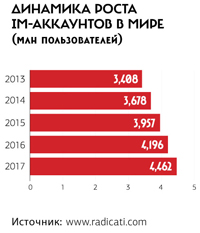
Instant Messengers, IM services are experiencing a real boom today. 3 billion 678 million registered users - so many people in the world use various IM today (however, of which 1.48 billion are accounts in China). According to forecasts, in 2017 there will be almost 4.5 billion.
Last year, Facebook paid $ 16 million for the WhatsApp messenger, the largest Internet company Rakuten-$ 900 million for Israeli Viber, the Chinese giant Alibaba invested $ 280 million in Tango.
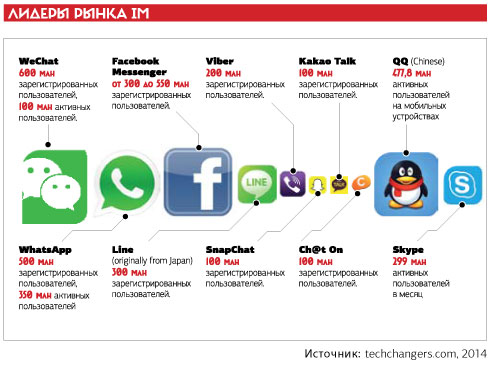
The unconditional leader today in the world market is WeChat (literally - “we chat”) - it has 600 million users, of which 100 million - use the service actively. This IM works mainly in Asia.
But WhatsApp (350 million active users) conquers the market not only in the USA, Europe, Russia, but also in Indonesia, Brazil, South Africa and India - according to the company itself, the messenger operates today in 100 countries of the world, 10 billion (SIC!) Messages are sent daily. The third most popular-Facebook Messor-from 300 to 550 million registered users.
Why IM?
 |
| Increase |

The first success of the messengers fell in the late 1990s: a number of popular applications, for example, ICQ, survived to this day and even moved from computers to smartphones. However, now they are not set the tone, and beginners are spreading in the opposite direction - from smartphones to desktops. The competition in this segment is huge, there are several dozen messengers.
The reason for growing demand is simple: a messenger is a compromise between voice or video reporting and ordinary e -mail. Each of these types of communication has its pros and cons, and instant messengers are successfully leveled and combined. And besides, they reduce the costs of traditional types of communication-calls and SMS: telephone companies lose hundreds of millions of dollars a year due to the fact that people stop using paid SMS and switch to communication in messengers.
Another distinguishing feature of the modern IM market - they can be chosen for your goals and objectives. If the safety of correspondence is critical for you - one solution, if you need communication with children - another, with your parents - the third, with business colleagues (it is closed for everyone outside) - the fourth. We need file transfer - one story, calls - another, I would like not to break into the smartphone, working at the computer - another option, etc. And to all this, the problem of their own habitat is added-someone has one messenger, but there is no other, most people prefer one technology and have not heard about another, but to persuade everyone who contacts you, to establish a particular messenger is a gystalous business.
Increase protection against a big brother , most of your contacts-if you use social networks Facebook or VKontakte-probably use their IM applications that are well hidden from outside attention. They work through a secure protocol https: //. The interception of traffic in this case is deprived of meaning, since too much time will take its decryption. But your safety is vulnerable in case of hacking an account or withdrawing your device by third parties, so they are unlikely to be considered as a really protected tool. More recently, whatsApp introduced messages of messages, a few weeks ago he had a desktop application, which, however, was seriously criticized - it is not too convenient to use. Another problem is a rigid binding to the phone number, so the application automatically leaves the profile if you entered it on another gadget, for example, on the second phone. WhatsApp and VKontakte are popular among younger Russian users. However, they most likely use other instant messengers - for example, Snapchat (100 million registered users), designed for instant exchanging pictures.

Moreover, the word “instant” has a second meaning here: Snapchat gives the recipient to view the message no more than 10 seconds, after which it will be destroyed. The time of "life" is counted from the moment the message is opened, it is set by the sender.
This makes communication not only more funny, but also much safer: you can only intercept the messages not read by the user. On the other hand, they do not remain in the archive, but these are not only text messages, but also pictures, possibly with drawings and signatures or video clips. You can have time to save the resulting picture in the form of a screenshot of the screen, but the sender will be automatically notified about this.
From the very beginning, Service of Telegram was positioned as a protected messenger. The project of the creator of VKontakte Pavel Durov, who was forced to emigrate, repeats the story of the most popular Russian social network in some ways. At first, the service like two drops of water looked like WhatsApp, but over time, in terms of capabilities and convenience, it went around its prototype. Recently, a magnificent desktop client has appeared, which will not be distracted by a smartphone if you sat down to work for a computer. Experts highly assess the prospects of Telegram, believing primarily in its creator, his ability to get investments and attract high -class specialists. Well, those who are in a good way are obsessed with safety, will evaluate its function of “secret dialogues”, which make it possible to destroy data through a period of time set by the user.
Safety is a horse and Wickr, which so far is only for iOS, Android and desktops. The messenger appeared last year. Even if your gadget gets into third hands, it will not be possible to read the correspondence. On the servers of the company, user data and traces of their activity are not stored. This, of course, is inconvenient for the forgetful ones, but here you have to choose - either an archive of correspondence or secrecy.
This model is rapidly gaining popularity, and you can already call several more similar messengers: Blink, Gryphn, Frankly, Tigertext - just choose. Their main drawback is the vague prospects against the backdrop of the recent requirements of the authorities even the most democratic states to ban encryption messengers. It is clear that such private tools will lead any lists of applicants for the ban, since not only oppositionists or incorrect spouses can use them, but, for example, terrorists.
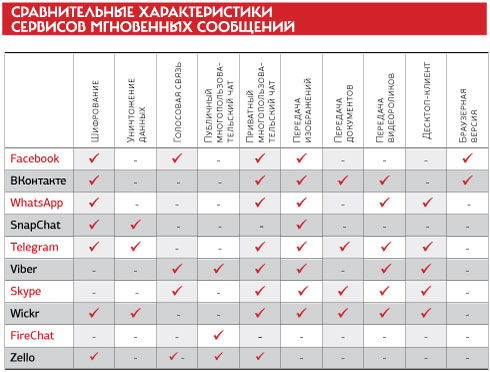
The younger generation is actively using Viber (200 million registered users) for parents and children ) - it is made for almost all, even very exotic mobile and desktop platforms.

Children and adolescents love this application, first of all, for a cheerful interface and a giant number of haracks, with the help of which, in principle, you can communicate almost without words. Viber is generally positioned not so much as a messenger, but as a voice connection application. It provides an opportunity to call via the Internet not only between Viber users, but also on ordinary phones, both mobile and stationary. The service is called Viber out; In this sense, the application is a direct competitor to the well -known Skype (299 million active users per month), which, on the contrary, will rather help to contact older parents than with children. Skype is so widespread that it has already become a common house, and when they say “let's call on Skype”, they can keep in mind not only him, but also any Internet telephony.
Both Viber and Skype are criticized for low data transfer safety both in messages and voice, although a few years ago it was believed that Skype negotiations could not be listened.
If you went to the square recently, we have become known for FireChat - the service of public chats. He has no safety. Because his task is different - it was created as a tool for participants in mass events, not necessarily a political nature, for example, for football matches. Its unique feature-it allows you to communicate even when the Internet is disconnected, creating a distributed network through Bluetooth and Wi-Fi with other users. If for mobile Internet a large number of users in one place is a problem, then for FireChat the other way around: the more they have gathered in one place, the better the network works. The first pancake of using FireChat in our real conditions - December 30 last year, when the supporters of Alexei Navalny came to the Manezhka on the day of the sentence - came out lumpy: it simply did not need - mobile networks worked stably. But the Prochrevsky trolls were filled into the chats of the opposition, who actively littered the already weak dialogue. On the same days, Zello has more users - the service of voice chats.
Each separate chat here is called the channel, it consists of short vocal messages of users in almost real time, when listening, it is terribly reminiscent of CB radio: only one of the participants always speaks. You can create your own channel or subscribe to a gigantic number of existing ones: the author, for example, was surprised to find the “official” Radio “Echo of Moscow”. Among the most popular, of course, something like "let's get married." Zello, which has the encryption of voice messages, can also be useful for mass shares for operational communication of a large number of users, especially in conditions when printing texts is inconvenient. This service was actively used with the beginning of events in the southeast of Ukraine, but here, in popular public chats of witnesses from places, trolls and fighters of the ideological front quickly replaced, turning the corresponding channels into a meaningless bike between the “quilted jackets” and “dill”. However, the channel can be made closed.
In any case, everything rests on the fact that Zello works through the Internet: if you listen to at home, it is convenient, but relying on a tool in “field” conditions is doubtful.
In short, the choice, as you can see, is rich, and it is likely to use one messenger. Often, the user needs tools for different purposes at the same time, and to drive all his contacts into one messenger is almost impossible. Therefore, it is not surprising that many use several similar applications at once.
Photo: Dado Ruvic/Reuters