
Translated material
Newspapers die
The news of the media market is ominous and funny at the same time. In January 2015 , the magazines “Mir” and “Food” were closed (applications to the “Poster”) . And then: it's time already. Reminds Trotsky’s slogan: “No food, no peace, but to dissolve the army.”
The army of journalists is also gradually dissolved. Significant reductions are in Lifenews and TASS . But they are not on the liberal roadside of the media market, but in the very center of such a propaganda mechanism in demand now. However, the cutting of staff and budgets goes throughout the market. It is clear: the times are difficult, the journalists are first driven , as Vladimir Todorov called his review in Gazeta.ru.
But the obvious explanation “Crisis in Russia”, in fact, does not exhaust the topic. The process is global: it unfolds not only in Russia and not only where the crisis is. So, according to Newspaper a Ssociation of America , in 2013 the advertising revenue of the American press reached, as it is now customary to say, a psychologically important mark - it fell below the level of 1950, when the measurement of advertising in newspapers was produced for the first time. That is, advertising revenue fell below the level from which, in fact, the industry began (market measurements are a sign of industrial maturity).
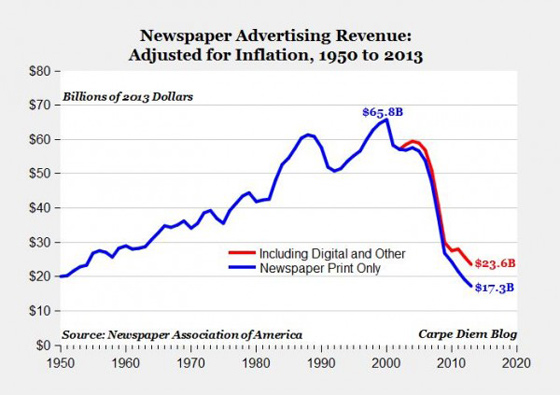
At the same time, in 1950, the population of the United States was half the current, and the economy was 1/7 part. The reduction in advertising income has been accelerating - 50% of the fall falls over the past five years. Moreover, the digital income of print media also fall, albeit a slightly slower pace. So the matter is not at all about paper.
Such a catastrophic compression of the market is not a cyclic crisis, but the end of the era. This is not about newspapers, but about journalism in general. At least about the old broadcast (“from top to bottom”) journalism. It arose at the beginning of the 17th century precisely in the format of newspapers and served the formation of classical capitalism and national states, reaching its vertex in a television format by the end of the 20th century.
This historical period ends. The social request for the production and consumption of information is changing, not to mention changes in the technological base (which, according to Marx, Innisa and Makluena, just changes social requests). Key change: the release of authorship , the availability of media for those who used to be a silent audience. That is, the conditions for this industry and for this institution simply disappear.
Bathing a green blogger
Signs of dying not so much newspapers as old journalism as an institute appear here and there. At the end of January, Barack Obama, after a traditional annual appeal to the nation, called not to journalists, but bloggers to give them an interview. The media are offended, outraged. Floggers are ridiculed with Obama (where without a selfie).

ABC gloatingly published a picture from the interviewer blog nicknamed Glozell Green , where she takes a milk bath with oatmeal. Here, they say, a new person of responsible political journalism.

CNN Called about "strange things" during the interview; For example, this very blogger of flakes gave Obama a green lipstick for the first lady (and even blurting out by mistake “for the first wife”). Naturally, a bath with flakes, green lipstick and the “first wife” entailed a giant resonance and obscured all political content, although bloggers tried to play the people's political journalists “in an adult way”. Fox even believes that Obama leads the presidency of the presidency for degradation. But the fact remains: during the largest annual ritual, the head of state did without professional priests.
The most interesting of the state structures is more often informed by journalists, but wikilicas.
Four and a half years ago I wrote on an elephant that bloggers could conduct investigations, offer analyst, report the news - in general, do all the work that journalists did. The notorious status of a journalist, supposedly giving him an admission, for example, into closed state structures, in fact often corrupts a journalist - makes him adapt to the source and be silent, and not to inform him. The most interesting of the state structures is more often informed by journalists, but wikilicas. If the information has a potential demand, then it will certainly break through, leaks, find a hole.
I wrote that a blogger, without even having a journalistic status, may well take an interview from the president; But not everyone, of course. “In this status (journalist) is superconducting. The blogger cannot take an interview with Putin. And Medvedev, by the way, can, if you're lucky. ”
In general, time has come. Bloggers have suppressed journalists already in the presidential reception, and with exactly the function for which the journalists were previously called. And after all, the resonance, in fact, turned out more. A curious detail: the audience of those three bloggers invited to Obama is 2.4 million, 3 million and 8 million only direct foloders. This is the scale of a large television channel. Distribution - YouTube and the White House website .
Media against bloggers and press services
By the way, about the White House. The media suffer not only from bloggers, but also from the press services (wider-from brands, which are now also themselves media ). The press service of the White House has long become one of the leading world political and glamorous media with the shortest access to first-class exclusive. By the way, complaints from the journalistic community are already receiving. After all, Obama Image Machine gives out content without any critical approach, which destroys the foundations of democracy, on the guard of which there was just journalism. The White House photographers shoot the best photos at the best moments and at the best angles. The heroes of these photographs are always photogenic. The reports of the White House are always positive. The “first dog” Bo always behaves well. And even vegetables on the famous beds of the first lady are always beautiful.
Bloggers have suppressed journalists already in the presidential reception.
It remains only to catch and ridicule the blunders that the press service of the White House, like any media, also admits. For example, she recently published a video on the president’s labor everyday life on her Instagram: leaving the helicopter, Obama mechanically saluted the officer with a glass of coffee, not even intercepting him in the other hand . However, this could not be a blunder; The White House could well miss this video specifically to let the "humanity". Although the military, they say, are unhappy. One way or another, all this tasty passed by the media.
The video published The White House (@whitehouse) Sep 23 2014 at 9:23 pdt
The function of a critical view of power was an important commercial and social service provided by professional media society in many countries. Due to the fact that the power is now for itself media, the media are also deprived of this monopoly. This service is transferred to the Internet for self -service. You can discuss whether the Internet will cope with it or not, but in any case the media out of any case; Unless in the composition of other commentators.
The word "never" is not applicable to the future
Strictly speaking, it is ridiculous to discuss the issue of the death of newspapers in modality "will happen - it will not happen." Statements like “newspapers will never die” issue a non -professional. All of course - even the sun will go out; Reasonably discuss the deadlines.
Five years ago, I said that the last newspapers will die out in the 30s, the main array of events will be at the joint of the 10-20s, and everything will begin to the collapse of the distribution in 2015-2016. Since the named deadlines are approaching, you can check the forecast.
As for the distribution, the process has already gone in the indicated direction - to the collapse . In the next year or two, he will collapse mass publications, in the structure of the income of which the proportion of distribution and subscriptions is great.
There is another forecast made by the famous Australian media futurist Rosson Dawson ) at the end of the same 2010. Ross created Newspaper Extination Timeline - a map with a schedule of extinction of the press by country.
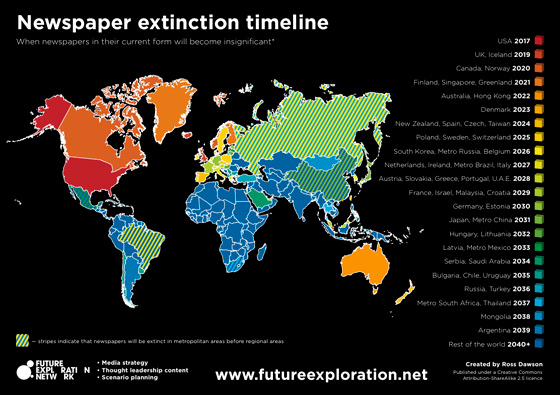
For Russia, Ross calls the 2036th, which coincides with my forecast, but for the United States-2017, which I do not agree with is too early. The fact is that Ross extrapolates into the future, first of all, the dynamics of technological and economic processes that affect the compression of the media business. While I believe that the key to calculating the deadlines for newspapers is the factor of the last newspaper generation, that is, people who managed to master the consumption of the press in adolescence. For Russia, this is, conditionally, a generation of the Moscow Olympics, that is, people born in the 80s. During their teenage socialization in the 90s, they still managed to find out on their own experience how to write and buy newspapers and magazines.
The next generation born in the 90s is the first digital generation, it was socialized into zero, already with a computer. It still sees newspapers in cafes and aircraft, but no longer really understands, as well as, most importantly, why write them out and buy. I always cite one study in Moscow universities as an example, when students answered the question of what the subscription was: “This is a non -place of nonsense.”
A similar rule of generation, in my opinion, is applicable to assessing the prospects of the press in all countries. The Internet, unlike newspapers or television, got to all corners of the world almost simultaneously. The rapid spread of communicative technologies has leveled historical conditions from the point of view of the consumption of new media. Therefore, the factor of the last newspaper generation, generation-80, can be applied to all countries. And then you need to look at various corrective circumstances that can slow down or accelerate the process of extinction of the press in different countries.
Another five years of agony - and about fifteen convulsions
Based on this, you can return to the idea of calculating the deadlines. Of course, newspapers have not died, they still live, but already bad. There will be another five years of agony and about fifteen convulsions. The press will continue to go out for some time even outside the economic expediency. In the West - thanks to private and public subsidies, in Russia - thanks to state subsidies.
The thing in the very last newspaper generation: if the Internet and the market rush a newspaper death, then the last newspaper generation moves it away as they can. In the USA and Europe, it will “inhibit” the process of dying the press through donations - both personal and through various funds. My observation experience shows that people aged about 50 years are already consuming the Washington Post content on the network, but they still write out the newspaper home for coupons and because it has always been like that. Need does not force them to count every couple of hundred, so they can afford to actually subtract their own habit, and at the same time newspapers.
Recently, in Martin Gurri’s brilliant book “The Revolt of the Public and the Crisis of Authority in the New Mille N Nium” , with which we surprisingly coincide in the development of media development, I read another example: “My 93-year-old mother continues to write out WAS h Ington Posta exclusively What loves the crossings there. I showed her sites stuffed with crosswords, but she remained adamant - she is tied to her newspaper package, and she belongs to the last generation with such a habit. ” I think newspapers still have adherents from generation younger, but the essence is clear.
Copons are another important inhibitor. In Russia, almost unknown, in the West they support the press with a successful combination of readership and advertising income. Local coupon applications to newspapers reach giant volumes. Saturday number of the same Washington Post weighs a kilogram and 80 percent consists of advertising and tamatic applications with coupons and just coupon tabs.
 The Saturday number The Washington Post is delivered in two packages branded by advertising and packed with advertising and domestic applications
It would seem that the Internet is a more convenient environment for coupons and shares, at least due to the search. So it is, the groups flourish. But we turn on the generation factor again and see the same story as with crosswords: people under 50 and more familiar to find the coupon of a local butcher or a mattress store in a familiar newspaper. Until the coastal generation replaces the coupon, coupon advertising in the newspapers will stay in this habit.
In general, a subscription that smoothly acquires the status of reader subsidies, and coupons due to the habit of the latest newspaper generation will allow the Western press to keep afloat longer than the “pure” commercial logic of the media market would prescribe. In addition, newspapers themselves are trying to develop alternative businesses like a club interactive or organizing events. And although on this path they, again, are not alone, but the brand strength and synergy of new businesses with old content skills will help some of the media output longer or even go to a new business format.
Recently, on Twitter, I wrote that soon-scatter we will check the forecast of Dawson about the United States and 2017. Ross replied that he plans to reconsider that his forecast - to push the next deadlines and move the remote ones. That is, to group the main events associated with the death of newspapers, approximately in the 1920s. This adjustment corresponds to the idea of the last newspaper generation.
Power is now for itself media, the media are also deprived of this monopoly.
Russia has its own catalysts and inhibitors of the death of newspapers. Here, the last newspaper generation will not be able to maintain the press with a ruble after collapsing a business model. For it, it will be done by the authorities for which the older generation is the main address group. The authorities will subside the newspapers to the limit of their economic survival and even for some time beyond its borders.
However, when compiling a Russian forecast, it is worth taking into account local political specifics. The horizon of essential political events is probably closer than the previously mentioned deadlines for the extinction of the press. In addition, the crisis broke out. He hit not only on the market mechanisms of the media, on which no one is particularly counting on in Russia, but also according to the budget, the alleged breadwinner of the last newspapers. Critical events began to unfold even earlier than the intended one. For example, in Moscow it has already been decided to transfer all district newspapers to electronic format . That is, in fact, close. In general, in the capital, the “social contract” of the authorities with the last newspaper generation could no longer withstand the test of Nefteedollar.
In regions where labor and production is cheaper, the authorities will still try to support newspapers for some time. In general, due to budget problems and other events, the reduction of budget feeding of the media is accelerating. It seems that the departure of the budget from the press market in terms of about the time will catch up with the “natural decline” of the media business. That is, the budget, most likely, will not be able to maintain the press much longer than the market.
What brings us all the same historical line-the beginning of the 2020s or even earlier. Although individual press subway, especially in the corporate sector and, possibly, in the “forced reading” segment (in offices or cafes), will be able to stretch out longer. And for the district, the forecast will have to worsen.