
Translated material
Around Harms and inside Pasternak
Galina Yuzefovich - about two new biographies
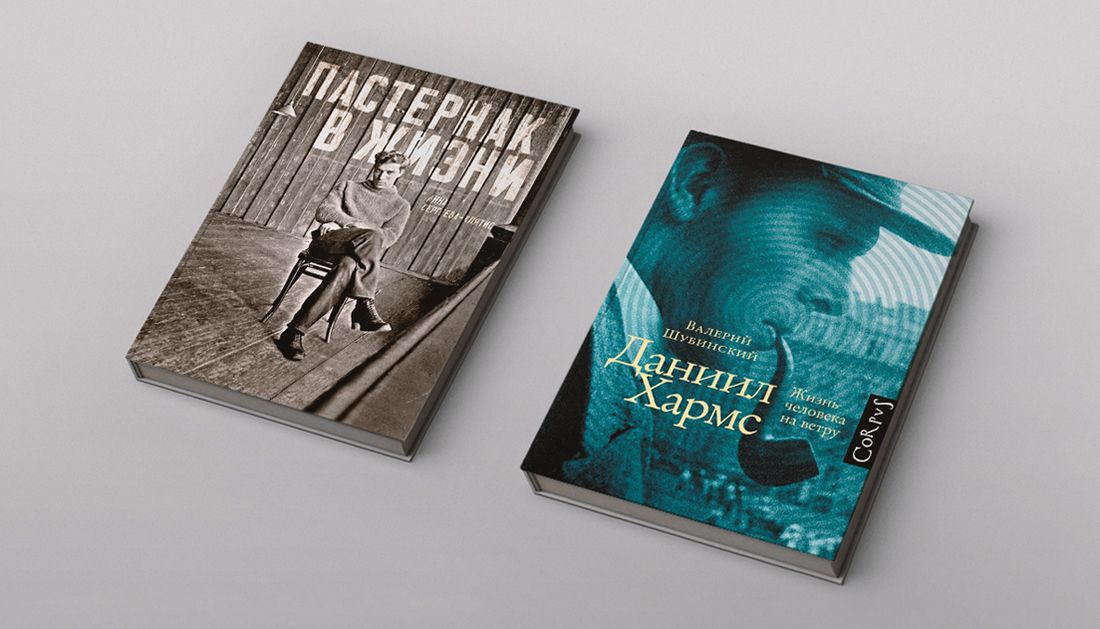
Literary critic Galina Yuzefovich tells weekly on Medusa about the most interesting and important book novelties. In the new review there are two biographies: “Daniil Harms: a person’s life in the wind” Valery Shubinsky and “Pasternak in life” by Anna Sergeeva-Klathis.
The life of poets is a fertile and inexhaustible area for research. Each generation is trying to understand the nature of their personality and creativity again, releasing more and more “poetry” works. In today's review, two similar news are presented - about Daniil Harms and Boris Pasternak.

Valery Shubinsky. Daniil Harms: Human life in the wind. M.: AST: Corpus, 2015.
Valery Shubinsky’s book “Daniil Harms: a person’s life in the wind” is a text that causes the deepest reverence: like Shubinsky, they have not been written today for a long time. In times when personal impressions and a little Wikipedic wisdom often turn out to be a sufficient base for a decent biography, Shubinsky demonstrates some kind of prohibitive thoroughness. Eight pages of bibliography (the smallest print, and these are only “main publications”, without complaints about “exhaustive completeness”), twenty pages of the nominated pointer, more than two hundred illustrations - most of them were reproduced from archival original and published for the first time. Not a book, but a monument of academic good faith.
The next impression is a somewhat exaggerated alignment and neutrality of style. In contrast to the graduate student, quoted by Mikhail Leonovich Gasparov in the “records and extracts” and believed that “the dissertation about Harms should be written a little in Harmsovsky”, Shubinsky (by the way, the famous poet himself) seems to deliberately limit himself. He refuses any stylistic kunshtuki and games: his text is emphasized and everyday dry, sometimes almost to the chancellery - minus a rare (and from that particularly pretty) irony or even more rare poetic outbreaks.
Finally, the third and main feeling that causes a “human life in the wind” is a surprise from how the main character actually occupies a little space in the book. Any once populated name (I remind you - twenty pages of a named pointer) turns into an independent story branch. Be it, who at one time, who at one time infected the philosophy of close friends of Harms-Yakov Druskin and Leonid Lipavsky, the secondary poets-“Umpers” Tufanov and Terentyev, or the future playwright Schwartz-all of them live on the pages of the book a long, rich and bright life. Any event can be traced in both directions as far as possible. As a result, the text declared as a biography turns into a kind of garden of diverging paths: Harms-Juvachev is not so much the main character as the starting point, from which dozens of winding paths scatter.
The author stipulates a similar position of the hero from the very first pages. Daniil Harms for Shubinsky is an exemplary person without a biography. In addition to the short happy period in the second half of the twenties of the twentieth century (brilliant time, Oberiu and Children's magazines “Chizh” and “Hedgehog”), he led his life to theatrical, grotesque, almost clown, and at the same time completely isolated from the outside world. The tragically did not coincide with the time in which he had a chance to live, Harms forever remained a “thing in himself” - closed, wary and not the end of a matured child. It was very difficult to understand it during his lifetime, and after it became completely impossible. As a result, according to Shubinsky, it is possible to talk about Harms in two ways - either by reducing his entire personality to creativity, or talking about people and events around him. Shubinsky makes a choice mainly in favor of the last option, and from two parts the name of his book - “Human Life” and “In the Wind” - the main one, of course, turns out to be the second.
As a result, Valery Shubinsky gets something much more than just a biography. A large, lively, warm, breathing and scary world swirls and tossed around the central figure, creating the effect of immersion. But if you hoped that thanks to this book, a mysterious person with a pipe in his teeth, in dandy golphs, caps and breeches, who once wrote “Elizabeth Bam” and “And you know that ...” will become at least a little more understandable, then ... in general, it is still better to turn to a solid biography of Harms, written six years ago for a series philologist Alexander Kobrinsky.

Anna Sergeeva-Klathis. Pasternak in life. M.: AST: Edition Elena Shubina, 2015.
The first to write such books was invented by Vikenty Veresaev, uniting all (including the most non -reliable) stories of eyewitnesses about Pushkin under one cover. After it, this trick was performed repeatedly - up to Leo Danilkin, who built up his recent biography by Yuri Gagarin on this principle. Now the turn has reached Pasternak-the Moscow philologist Anna Sergeeva-Klyatis decided to collect the consolidated choir of people ready to testify to the poet and go with him to a tour.
The Pasternak in life, which has received at the exit, is not a simple reading, at least at first. Dozens of votes arguing with each other, throughout the first hundred pages, cause a tedious feeling that you got into a crowded waiting room at the station, where everyone is pushing and screaming without listening to each other. Who was the mother of Pasternak Rosalia Isidorovna-a brilliant pianist who was removing her gift in excessive concerns for children (as her husband believed), or another child prodigy (as the then press hinted)? Was Pasternak the nanny was secretly baptized in childhood (as he himself says), or with the then order to baptize a Jewish boy without the consent of his parents, it was strongly impossible (how did his friend Sergey Bobrov very irritably assure)? What did Pasternak think about Mayakovsky - and in particular, about his suicide? Who - the poet or Zinaida Neigauz - was the initiator of the novel? And children from the first marriages of Pasternak and Neigauz - how did they survive the divorces of the parents?
However, getting used to the noise and constant shouts, you begin to notice that there is a certain structure in all this polyphony. Anna Sergeeva-Klathis, who in the introduction hypocritically promised to get as much as possible and allow his heroes to speak freely and directly, actually assumes the role of a clever puppeteer-or, if you like, an experienced dropmaster. Skillfully shocking on one storyteller in a footnote, allowing another to express his thought and with examples, insidiously exposing a fool of the third and affectionately encouraging the fourth, she achieves the marvelous coherence of the performers. Separate, recognizable voices and intonations arise in Homon, someone withdraws their own topic, and someone merges with the majority, someone's party continues from the beginning to the very final, someone comes with one or two notes.
As for the facts - including to the most hackneyed and beaten gossip, then, voiced by living human voices, they amazingly gain weight and meaning. In a word, excellent reading: the main thing is to endure the migraine on the first hundred pages.
Galina Yuzefovich
Moscow