
Translated material
The inscription on the obelisk
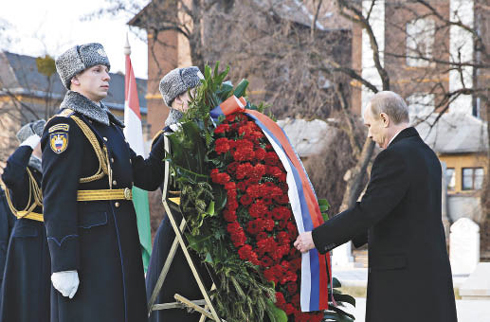
Hungary became the first country - an EU member, which Vladimir Putin visited after the disaster of Malaysian Boeing in July last year, which finally isolated Russia from Europe. He arrived to agree on the new supplies of Russian gas, and in the direction of reducing the price: against the backdrop of the current relations between Russia and the EU, this thing is almost unthinkable, a sign of a special location to Budapest. From the same row - a loan of € 10 billion, which Moscow allocates for the construction of two new power units for the only nuclear power plant in Hungary in Paksha. At the same time, the government of Viktor Orban will be disposed of at his own discretion - this is not a subsidy of Brussels when it is necessary to report for each Eurocent.
Such privileged relationships are not like many Hungarians. On the night of February 17, activists of the Dialog for Hungary party hung on the bridge over the Danube poster, on which in Venger, English and Russian it was written: “Paksh-2. - No, thanks! " Putin drove through this bridge, but did not see a banner - early in the morning the police dismantled it. Meanwhile, on the Battyani Square, opposite the parliament, someone stretched out another banner: “President Putin, welcome to Orbanistan”-a hint of authoritarian manners of the Hungarian prime minister.
There were also Putin sympathizers in Budapest. A small group of citizens in the city center held posters with the inscriptions “Russians, return” and “Welcome, President Putin, to the land of the Holy Crown of Istwan”. But all these shares, by and large, did not add anything new to the overall picture. A real scandal provoked a completely different fact.

At the Budapest Central Cemetery, where Putin visited, there is not only a memorial to Soviet soldiers who fell in battles in 1944-1945, but also restored recently at the Russian funds of the obelisk (with a red star on a spire) in memory of the soldiers who died during the suppression of the 1956 folk uprising, which the communist dictatorship qualified as a “counter-revolutionary rebellion. " It would seem that that era has sunk into oblivion. But a strange inscription appeared on the restored obelisk: "Eternal memory to the soldiers who gave their lives for the freedom of the Hungarian people during a counter -revolutionary rebellion in October 1956." How to understand this? Imre Sword - an eyewitness and a participant in that uprising, was sentenced to death, which, by a happy chance, escaped. Now he is heading the "Commission of Witnesses of 1956." “To call our uprising as a counter -revolutionary rebellion just vilely,” says the sword. “We are dealing with an attempt once again to falsify our story.”
This episode literally blew up social networks. The leitmotif of many comments: “Orban, even under the Communists, demanding the withdrawal of Soviet troops from Hungary, which made a speech during the re -burial ceremony Imre Nadia
* * The Prime Minister of the VSR in 1956, the initiator of radical reforms provoking the introduction of the forces of the Warsaw Treaty to Hungary. , whom the communist leaders buried in the nameless grave face down - it turns out that the same Orban today again calls advice to our country. ”
The maintenance of military burials in the proper state of war, as well as inscriptions on memorials, is not engaged in Hungary. But it was Hungary that could and had to convey to the authors (also, apparently, Russian) inscriptions on the memorial the idea of its absurdity and inappropriateness. And so it coincided that the scandal flared up just on the eve of Putin’s visit, creating a rather negative background to him in Hungary, completely unstable in Russia.
Photo: Mikhail Metzel/Tass