
Translated material
Neighbors are dummy
For ten months of armed confrontation in the Donbass, the adjacent Russian territory - the Rostov region - has turned into a real front -line zone. The New Times went through the trail of the unnecessary war
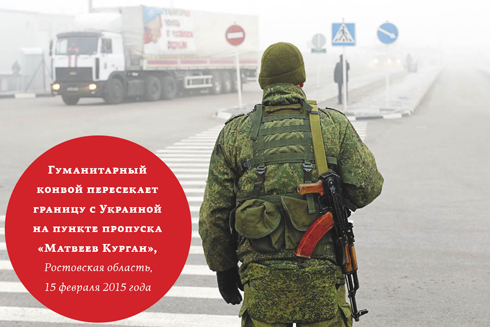
In the summer, there was no one to get from Rostov to Donbass: the buses were canceled, trains - even earlier. Luhansk taxi drivers, having delivered refugees to Rostov, took to “give a lift” to the ATO zone for the ten. By winter, regular buses went from Rostov to Donetsk, numerous “patrols” disappeared from the village roads.
“Even in the fall, here, on a turn on Matveev Kurgan, the cops stood and the documents checked,” says the driver Igor, who agreed to take the correspondent to the border with Ukraine. - They missed only the locals, well, or Khokhlov with documents - if they went to the border. Everything is strict. " There is no one at the bend, the car calmly drives the district center Matveev Kurgan 23 kilometers from the border. Outside the window, the front garden, Pyaterochka, a couple of car services flicker.
Seeing a warning about entering the border zone at the road, where there are a lot of things, the driver was agitated: “Do you have permission?” - “There is,” you have to lie to go further.
On the border
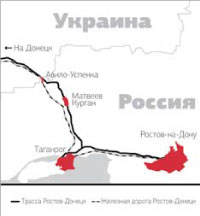 |
The village of Avilo-Uspeku in peacetime was very loved by journalists: it is divided in two by the railway, along which the border of the Russian Federation passes. It turned out that on a neighboring street, the dawn came an hour later. The Russians went to Ukraine for vodka and a snack; Ukrainians in Russia - to work.
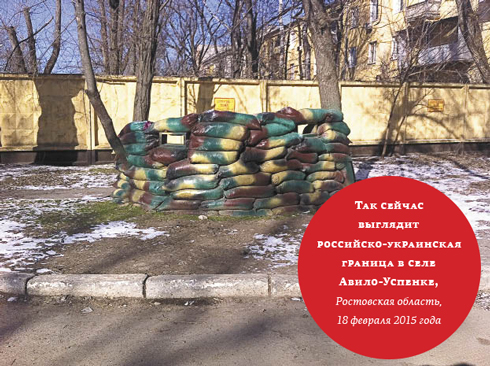
Now Avilo-Authentic is empty. Along the railway there is a concrete fence with barbed wire - this is how the border looks now. To meet a passerby here is a rarity today. The pedestrian bridge is disassembled through the paths. Due to the product, a sentry with a machine gun comes out and carefully watches how the correspondent takes pictures of the Ukrainian border pillar.
The approaches to the tiny station of Avilo-Autonzes are forced by concrete blocks, a platform fenced off with a high fence, a person in military uniform is guards. The border guard extinguishes a cigarette and hides indifferently behind the glass door of the office room. Cold.
In the waiting room on hard benches, four young fighters are sitting in earflaps, on the window folded helmets in the covers, underfoot, duffel bags clogged under the eyeballs. It is not possible to talk - a lieutenant immediately appears nearby, in winter uniforms he seems thick and clumsy. The officer nods to the correspondent to the duty station at the station - in order to avoid checking the documents, you have to interrupt the study of the Taganrog -Uspenskaya train schedule and leave the room.
The Ukrainian part of the Avilo Authority is called evemas. Only local residents with a special mark in passports can get there directly from the village. All the rest passes to the territory of Ukraine only through the border checkpoint, a kilometer from the station. “Yes, as people lived and live,” says the saleswoman in the station cafe, where local customs officers have lunch. “Ukrainians go to work for us, who else has that work.”
From March 1, it will be possible to get to the territory of a neighboring country through crossings that control the Ukrainian border guards only by passports. In the DPR and LPR, everything remains still.
The war will write off everything “You're strange,” the colleague from Taganrog surprises, answering the question of the traces of the war on this side of the border. - Yes, they are full. They go around the city in small groups of five people, in stores, at stations ... ”“ They ”are people in military uniforms, who have really been too many on the streets of the border Don cities recently.
We meet with one of them in a purple treasury “glass” in Taganrog. Oleg 26, he looks like young Sergei Efron, powder dust was eaten into his hands and face. Sniper, served under a contract in the North Caucasus, quit a couple of years ago, because it became "uninteresting."
Last summer, Oleg was found in Taganrog by friends at the Oplot sports and patriotic club and offered to “work”. He did not hit the war right away. First of all, he was taken to train recruits at one of the training grounds in the Rostov region.
“There are not enough specialists. And at first they simply were not there. These (residents of Donbass. - NT ), at first they only fought with sticks. Everything had to be taught, sometimes from scratch, - Oleg's indignant. - We go out on the assignment, local weapons received, I worked - they covered it. We are returning, I say, give me a rifle. And she is not elementary to the hast-la-on. That is, you work, and no one covers you. Mess. At one time, the whole Donbass was one professional adjustor. One! The man did not sleep for days, he was taken back and forth. "
Oleg does not want to talk about money, although he does not hide that he was paid 80 thousand rubles in a week of such “work”. But not everyone is lucky. “Yes, a lot of people“ left ”! They promised both 200 and 300 thousand a month, and the boys left with nothing, ”he says more and more annoyed. “Do you know where the whole humanitarian is going?” “Do you have to feed the army there?” “No, well, that the army is understandable. But there is nothing to eat there to the civilian population! And all the gum -conuy directs straight to the shops! ” Many refugees also told the correspondent about the same, however, the correspondent.
When asked who pays the money to the militias, Oleg laughs down, but comes to life when it comes to the supply: “Form? We buy ourselves. "Hill"
* * Type of camouflage shape. , T -shirts, shoes ... a good set, well, so that the “full minced meat” is 30 thousand is needed. From there (from the front. - NT ), I brought the "NATO" sets. Horses - not warriors, real. We push so much junk from them. NATO dryers are cool, by the way - real meat, all kinds of chocolate. And the form is good, but if you put it on fishing here ... There (at the front) you can’t wear it - they will shoot their own. ”
Oleg says that he knows nothing about the tombs that are transported to Russia and hide from journalists, in the Donbass have never seen Russian military personnel. But he personally plans to reach Kyiv himself: "We must free the cities of Novorossia from the Nazis." - “Well, now kindergartens are working in Mariupol, people are sitting in a cafe, hot bread is brought to stores. And you will come - and the city will begin to bomb. For what?" Oleg strains, as for a blow, and issues: "There are women there."
Friendly fire “May they all remain there! - Kolya, former Rostov operas, and now the head of the department in the regional headquarters of the Ministry of Internal Affairs throws in his hearts. “How many problems we had with Caucasian affairs before, there it rarely did without weapons and fingers ... And now these are falling on their heads.”
Now the main headache of the Rostov authorities and, above all, the police are the flows of armed and embittered people who leave the territories of the DPR and the LPR, disappointed in the idea of building a “new Russian world”.
It started still at the end of summer, says Kolya. The first high-profile case is the detention on September 28, 2014 young residents of Taganrog, from whom the border guards found an AK-74 machine with two stores, 4 packages of 7.62 mm caliber cartridges, 75 cartridges of 7.62 mm caliber in a machine-gun ribbon, 4 grenades, 8 Kenwood lighting missiles and a knife. During the interrogation, the detainees-the participants of the Scythian military-patriotic club-explained that they went to fight in the ranks of the militia, but did not receive the promised money and decided to take it “in nature”. These details became known thanks to Ukrainian hackers who hacked and posted documents of the Main Directorate of the Ministry of Internal Affairs in the Rostov Region in October.
“And if this weapon falls into that radical underground, which now reads the wrong books and writes all kinds of writes on the Internet? - Kolya shrugs his hands. - And it will hit! "
At the end of November, an angry visitor to the old clock in the sleeping area Rostov shot at the institution from a manual anti -tank grenade launcher - there were no casualties, the facade of the building was injured. After a couple of weeks, the media reported an incident in the very center of the city - on Budennovsky Prospekt, unknown people opened the police at Makarov pistol. However, the police, however, discloses no details of the incident.
"Do you think this is a coincidence?" - Kolya asks the rhetorical question.
On February 10, at the border crossing of Donetsk, three armed people at Kamaz from Ukraine demolished the barrier and rushed towards the federal highway M-4. They drove almost 20 kilometers. On the approaches to Kamensk-Shakhtinsky, the military put up the BTRA on the road, evacuated children from the nearest school. Everyone was sure that this was a sabotage from Ukrainian radicals. There would be few about the operation, if it weren’t for the traffic jam on the blocked highway: the riot police captured three attackers armed to the teeth in front of dozens of amazed car owners. The capture participants later told reporters that all three were drunk, and maybe under drugs. One of the participants in the breakthrough was wounded, he had to be delivered to the local hospital, where the doctors found out that he was from Vladikavkaz. It became clear that we are talking about militias, and not about terrorists.
And the freshest case: on February 19, two tipsy friends in the border Matveevo-Kurgan district quarreled, after which one cut the other. When an ambulance arrived, the attacker threw a grenade under the car. The ambulance and an ambulance received multiple fragmentation injuries, a man who quitting a grenade was also wounded, but he managed to hide.
Local media media prefer to either not tell about these incidents, as, for example, about the breakthrough of the borders on the Kamaz, or to briefly mention them in the section of the criminal chronicle. But residents of the Rostov region are increasingly thinking about the fact that there are too many uncontrollable people with weapons next to them.
Photo: Valery Matytsin/Tass, Alexey Friedman