
Translated material
Female share
In Croatia, the first lady-president in the history of the country-Kolinda Grabar-Kitarovich took office.
Her inauguration was attended by representatives of 88 states: Kolinda is well known abroad - before the elections, she occupied one of the high posts in NATO*, and in the middle of the zero years she was the head of the Croatian Foreign Ministry. But it is noteworthy, rather, another. The Balkans, including all the republics of the former Yugoslavia, for a long time were considered a conservative region, one of the last on the continent of the Bastion of Machism, where politics is considered the destiny of men. Croatian elections showed: this bastion fell. Why did Grabar-Kitarovich won and what the gender map of European policy looks like today-the New Times found out 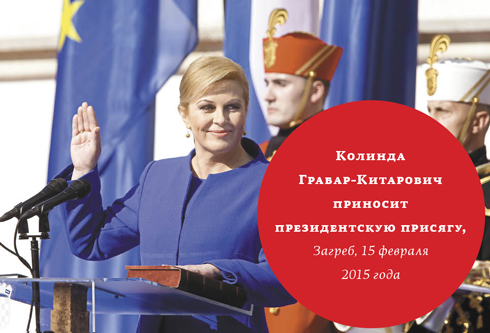
“Kolinda is a worker! She knows everything! Collect manure, milk a cow, cut a pig ... We need such a president, and not a well-educated professor-kalmar who does not know how, ”the housewife Lana Opachich assures NT correspondent. “Professor-Kalmar” is a hint of ex-president Ivo Yosipovich, who lost Colinda (it received 50.42 % of the vote) with a gap of less than 1 % in the elections of January 11. The owner of the exquisite manners, Josipovich first became famous as a composer, and only then as a politician, and to this day professes in both universities that he graduated - legal and musical.
But after all, Grabar-Kitarovich also spent most of his career at all at the pig farm-at high diplomatic posts-in Ottawa, Washington and Brussels. "So what! She is from a simple family and knows how to stay without showing off. That's why she won, ”Lana Opachich insists.
“Our president must be strong! We saw her photographs from hunting, she knows how to shoot from different types of weapons, if necessary, she will go into battle, ”the seller of the meat store Ivo Yurich tells the correspondent NT. Immediately after the inauguration in the city cafe at each table, they discussed the chic costume of the new president, which she ordered from the Croatian designer, not foreign. Many Croats also impressed the story of Grabar-Kitarovich about the grandparents who were members of the Croatian partisan detachment who fought with Italian fascists and Czechs (Serbian nationalists). She herself always emphasizes her commitment to traditional Croatian values (Catholic faith and the unity of the people) and refers compatriots to the heroic past.
“She conducted a presidential campaign in an aggressive manner: she did not allow reporters to fall asleep with populist claims like Yosipovich, and the recruitment - he himself attacked them with sensible counter -questioning - and this was an effect,” the political scientist, professor of Zagrebi University, Tikhomir Tsiper, notes in a conversation with NT .

A strong figure but the main components of Grabar-Kitarovich is still different: unlike her main competitor, who went to the polls under the flag of further integration with the European Union, she focused on the restoration of the Croatian economy, which has experienced the recession for the seventh-row for a row. The unemployment in Croatia is about 20 % (among young people - about 50), almost 900 thousand of the 4.2 million population of the country are behind the poverty line. Hundreds of thousands of Croats went to work in neighboring countries.
“Young people are leaving without exception, our average salary is 400 euros. At the same time, young people are often forced to go to the hourly rate, and an hour costs three euros, ”explains NT economist Ivan Horvatich.
“I will do everything, in my power so that Croatia becomes a rich country from which the young will not leave, where more people will be born than to die,” Grabar-Kitarovich said at one of the pre-election rallies. This phrase, according to many, helped her win.
“Kolinda ran for the presidency from the legal party of the Croatian Democratic Commonwealth (HDS), which has strong positions among the three -millionth Croatian diaspora,” explains Roman Bolkovich, Croatian political scientist. “This is mainly a Croatian working class abroad: builders in Germany and Austria, sellers in Hungary and Bosnia and Herzegovina ... It was these voices that brought Colinda as a result of victory.”
And the daily newspaper Vecernji List completely believes: in the light of the latest terrorist attacks (and attempts to commit them) in France, Belgium and Denmark Croatia, a “strong figure is necessary that can absorb the popular, anti -immigrant sentiments under the slogan of unified Europe.” It is such a figure that Kolinda Grabar-Kitarovich can become, the newspaper concludes.
* In 2011–2014, Kolinda Grabar-Kitarovich held the position of assistant Secretary General of NATO on public politics.
** ---
The weaker sex is gaining strength and influence "Mama" Merkel **
 |
Germany, in which, according to some reports, more than 300 thousand Croats have left to work, the third term in a row (since 2005) has been heading
Angel Merkel . In the elections, she, like now Grabar-Kitarovich, always won honestly-without fraud and “carousels”, with a huge support rating. When Merkel, a native of the GDR, for the first time became the head of the right -Processed CDU with West German roots, the men in the party establishment muttered: "Nothing, we give you two years, then everything will be as it was." It did not work out.
They say that Merkel has a portrait of the great Russian “feminist” on the desktop - Empress Catherine II. What the Chancellor is thinking, looking at the portrait of the Empress, no one will undertake to say. It is only known that the Germans entered the Metti nickname for Merkel - a mother, who cares, sometimes even unnecessarily. Much less known, however, another nickname of the chancellor is Das Merkel, that is, Merkel with an artist of the middle kind. As the director of the Bertelsmann Foundation analytical center Annette Hayer notes, "Merkel does not define herself as a woman, she is in a separate class-champions and champions of trezho-wires." However, the electoral support of Merkel, judging by the recent survey of the ARD television company, are still women: 63 %-for and only 24 % against (while among men-54 % versus 33 %).
Who is on the way?
 |
The main "silovik" of Great Britain
Teresa May (she holds the post of head of the Ministry of Internal Affairs. - NT ), known for her addiction to elegant shoes, is considered as a possible successor to Cameron.
In Greece, the brightest star of the left -wing “Siriza”, who won the election on January 25, is the head of the large Athens Rena (Irina), who noticed: “I am a blonde and I will be a blonde until I turn gray, and let's not argue. Blondes can also engage in foreign and defense policy. ”
If the left star has risen in Greece, then the extreme right are gaining strength in France. Their leader is Marin Le Pen, the head of the National Front, over the past ten years has become a leading political media person in Europe. The Time magazine put it in 71st place in the list of one hundred most influential figures in the world. When her father, Jean-Mari Le Pen, handed over the lead to her daughter, someone bothered if the “female factor” would hurt. It turned out, on the contrary, on May 25, 2014, the party Marine Le Pen won the Election of the European Parliament in France, gaining 25.4 % of the votes of voters
* * According to the results of the municipal elections in France, held on March 30, 2014, the National Front party, led by Marin Le Pen, became the third political force in the country, gaining 7 % of votes. . The European Parliament itself became Le Pen itself, and a proud banner appeared on the NF website: Premier Parti de France.
By the way, not only a bad political reputation, but also the spirit of “Machism” associated with it, has traditionally interfered with the growth of “National Front” - they say, this is the party only for men. Marine Le Pen is now 46 years old, from her first marriage she has three children. And in the eyes of many Frenchmen, her “failure” in his personal life became evidence of the ability to stand up for himself, and even brought closer to the common people with their daily experiences, of course, and in personal life. And of course, against the backdrop of loud divorces of Francois Hollande, and before him-Nicolas Sarkozy, Private Life Marin Le Pen, does not seem to be out of the ordinary.
Kilt and wallet the results of last year's referendum on the independence of Scotland (“for” disconnection from the UK - 45 %, against - 55 %, with a record turnout of 84.5 %), the lamps became the tongue. To which they paid much less attention: the outcome of the vote was decided by women.
 |
The shots-shots, as you know, wear a skirt-kilt. It differs from female kilt in that a large wallet hangs in front on the belt. In fact, women think more about the wallet. According to the survey, usually an accurate one in the estimates of the Yougov service, 51 % of men voted for independence, but among the Scotlands this idea was supported only by 42 %. A gap of almost ten percent! Women are more intelligently, to practical details, climbed into problems related to independence. And they asked questions to which the nationalists did not have intelligible answers. After the defeat at the referendum, the leader of the Scottish nationalists, Alex Salmond, resigned, and the woman became the new leader of their party -
Nicola Rodzhen. Norwegian lessons Scottish nationalists, making a choice in favor of Rodzhen, referred to the example of neighboring Norway. The small country of Europe, but in many respects the most prosperous in the world. And Norway is known for “positive discrimination”: more than ten years ago, the parliament adopted a law requiring equal representation of men and women everywhere, including even in private corporations - so that at least 40 % of women are in the boards. Then in Europe they were indignant: they say, nothing will work out, the worthy will not pass. Now this experience is considered successful, no one complains, there were more than enough worthy candidates among the Norwegians. And now they look at Norway more and more as a leader in new approaches to solving complex issues of social development.

In the Norwegian government of 18 ministers, half are women, including the Prime Minister and Minister of Defense (in Sweden, Germany and the Netherlands, defense departments are also headed by women. - NT ). And from this year, a new law on universal military duty came into force in the country, according to which women are subject to conscription. “We introduce a military duty not because we need more soldiers, but because we need the best, whoever they are,” the Minister of Defense explains
IMO-Mari Ericksen Sorede. In Norway, military service is "soft". Not everyone met, but you need to deserve it. In 2012, about 64 thousand people, men and female volunteers took place. Only 9.3 thousand were taken to the service.
In a recent interview, the head of the Norwegian Military Academy, Colonel Ingrid Gyerde, explained: any military work should be opened to any citizen regardless of gender, including the front service. But physically, men are usually stronger? But what if you go hand -to -hand? “In my experience, many of our girls are quite passing according to this standard,” Ingrid assures. “Already, women serve in all kinds of troops, including special forces.”
50 years later, some European colleagues associate the growth of female influence in the Western world with the feminization of men who have turned into “metroxuals” - inter -subject creatures, concerned about their own appearance and clothing more than events around them around them. The English journalist Toby Young, who writes a lot about the changing relationships of the sexes, is ironic: “Now it is difficult to imagine a metro -industrial sector who will simply grab a woman, abandon her on her shoulder and take her to his primitive hut. He is simply scared - suddenly his hairstyle spoils. "
Meanwhile, when Margaret Thatcher became the first prime minister in England, no one thought that this was a major victory of feminism. On the contrary, in the 1979 parliamentary elections, when the Iron Lady won, the smallest number of female candidates passed in the parliament. The movement for equal sex rights only gained strength.
“My mother in 1953 became one of the first women in England to take an excellent exam to become a banker,” British journalist Helen Wamak says NT. - She got married and became a housewife. And she was fired! Just because she got married! All my life I regretted that I had to make such a choice. I just hated my situation. "
According to Wamak, only now, 50 years after the start of the feminist movement, “the first generation of women has grown up, which reaps the fruits of a long struggle for equal rights with men - including in politics; Only now women are gradually beginning to perceive according to their human and business qualities, and not by the way it looks and what its forms are. ”
The review was prepared by Alexander Anichkin
Women - Heads of State and Governments: Elizabeth II Queen of Great Britain, Head of State (since 1952)
Margrt II Korolev Denmark, Head of State (since 1972)
Angel Merkel, Federal Chancellor, Germany (since 2005)
Dalya Grybauskaite, President of Lithuania (since 2009, re -elected for a second term in 2014)
Simonetta Sommaruga, President of Switzerland (since 2015)
Eva Kopach, Polish Prime Minister (since 2014)
Marie-Luzuz Kolyiro Preka, President of Malta (since 2014)
Michel Bachelet Heria, President Chile (since 2014)
Laimdota Strayuma, President of Ministers (Prime Minister) Latvia (since 2014)
Erna Solberg, Prime Minister of Norway (since 2013)
Tatyana Turana, Prime Minister of Transnistria (since 2013)
Zhelka Zviyanovich, Prime Minister of the Republic of Serbian (as part of Bosnia and Herzegovina, since 2013)
Pak Kyn Hye, President of the Republic of Korea (since 2013)
Porshia Simpson-Miller, Prime Minister of Jamaica (since 2012)
Camilla Gunell, Prime Minister of the Aland Islands, autonomy as part of Finland (since 2011)
Helle Torning-Shmitt, Prime Minister Denmark (since 2011)
Atifet Yahyaga, President Kosovo (since 2011)
Dilma Rusef, President of Brazil (since 2011)
Camla Persad-Bissessar, Prime Minister, Trinidad and Tobago (since 2010)
Sheikh Hasina Vazed, Prime Minister Bangladesh (since 2009)
Christina Fernandez de Kirschner, President of Argentina (since 2007)
Helen Johnson-Serlyph, President of Liberia (since 2006)
Photo: Antonio Bat/EPA/TASS, Luo Huanhuan/Tass, Sebastien Muylaert/Tass, Robert Perry/Tass, Deduhova.ru