
Translated material
Amnesty International: There is a deterioration in the situation
The international human rights organization Amnesty International has issued another annual report on the situation with human rights in the world. A considerable place in it is given to violation of human rights in Russia.
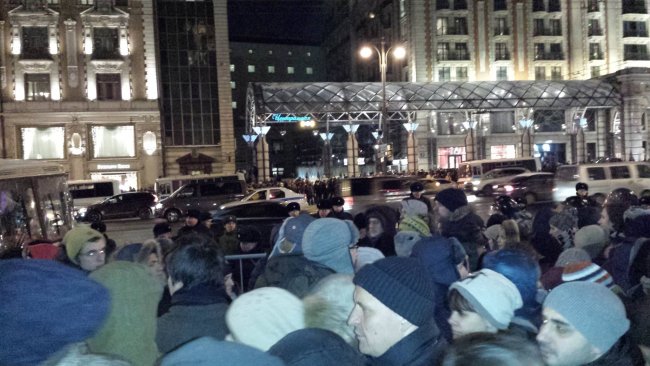
The report refers to the deterioration of the situation with freedom of speech in Russia in 2014. “Throughout the year, small spontaneous protests (no matter what peaceful character they be) are usually dispersed; Hundreds of people arrested and fined or sentenced to short arrest, ”the document says. Mass detentions were mentioned in Moscow on February 20 and 24, during the announcement of the sentence in the “Swamp case”, in March, when people went out onto the streets, opposing the military intervention of Russia in the situation in Ukraine, and on December 30, in response to the verdict of Oleg and Alexei Navalny. “On February 20 and 24, with the use of force, the police dispersed hundreds of peaceful demonstrators gathered at the court of the court in Moscow during the announcement of the sentence in the“ swamp case ”, as well as during subsequent meetings in the city center,” the organization recalls. - More than 600 people were arrested, most of them were fined. At least six people were sentenced to “administrative arrest” for terms of five to thirteen days. In the following weeks, many participants in peaceful protests were arrested. They were fined, and in some cases they were put into custody for participating in protests against Russia's military intervention in the situation in Ukraine and the annexation of Crimea. At the same time, no one interfered with the conduct of pro -government demonstrations about the events in Ukraine in the city center, where demonstrators from among the opposition were regularly forbidden to take events. ” “For several exceptions, most public protests were tightly limited, forbidden, or dispersed. In July, fines were significantly increased and criminal liability was introduced, providing for punishment in the form of imprisonment for multiple violations of the law on public meetings, ”the authors of the report said. Separately mentioned restrictions on mass events in the Crimea.
As an example of pressure on civilian activists, a story is given how in Samara “Some activists received anonymous letters with threats of reprisals after a series of single pickets of the second of March (the only form of protest, permitted without prior notice).”
It is mentioned that in March 2014, “In March, popular news network portals“ Daily Journal ”, City.ru and Kasparov.ru were blocked after placing there reports about the dispersal of several spontaneous peaceful protests in Moscow. The prosecutor's office claimed that due to the sympathetic tone, reports about these demonstrations were equivalent to the calls to participate in events “conducted in violation of the established order”. Despite repeated attempts to protest this decision, it remained valid and, as of the end of the year, the sites remained blocked. ”
The report also states the “swamp business” built on the persecution of participants in the mass event: “The authorities brought to criminal liability of persons accused in connection with the participation in the May protest of 2012 in Bolotnaya Square: 10 people sentenced to deprivation of liberty for the terms of two and a half and a half years for participation and alleged violent acts in the course of protest, which qualified as they qualified as they qualified as they qualified. "Mass unrest." Sergei Udaltsov and Leonid Razvoszhaev found guilty of organizing “riots”.
Particular attention is paid to the persecution of activists before and during the Olympics in Sochi: “On the eve of the Special Service Olympiad, the systematic campaign of persecution against NPO employees“ Ecological Watch in the North Caucasus ”(Ekovakhta), which attracted attention to the environmental damage caused by the Olympiad in Sochi6. Two of them, Evgeny Vitishko and Igor Kharchenko, were arrested by fabricated administrative charges and placed under the custody of the opening of the Olympics. Being in custody, Evgeny Vitishko was a refusal to appeal the sentence in the criminal case for exaggerated charges, which aimed to force him to silence and the NGOs in which he worked; After that, he was directly transferred to the colony to serve a three -year sentence. ”
It is said in the report and the obstacle to the freedom of expression to “individuals and groups whose views differ from the generally accepted”, in particular, representatives of the LGBT communities, who “consistently prevented peaceful meetings, including in places specially allocated for public assemblies, without preliminary notification-as a rule, in low-haired forest-floor zones.” The report also mentioned the case of activists from Nizhny Tagil Elena Klimova, who was accused of promoting non-traditional sexual relations among minors for creating the children 404 on the LGBT teenage projects on social networks.
An example of a pressure on human rights activists is an attack on the chairman of the committee against the torture of Igor Kalyapin and his colleagues who opposed Chechnya, Ramzan Kadyrov, to arrange practice and demolish the houses of militants' relatives. Amnesty International recalls that “Ramzan Kadyrov through social networks accused the head of the consolidated mobile group in Chechnya Igor Kalyapin in support of terrorists. The office of the group in Grozny was destroyed during the fire on December 14, apparently, the result of arson, and two of its employees were searched for several hours in the police without any explanation, having seized phones, cameras and computers from them. ” The case is also mentioned against the Chechen activist Ruslan Kutaev, who “complained about torture, including beating and using an electric shock, after arrest in February for fabricated accusations of heroin storage. Independent observers accurately recorded the bodily harm caused to him. Nevertheless, the investigating authorities accepted the alleged explanation of the perpetrators that the bodily injuries of Ruslan Kutaev were caused by the fall, and abandoned the further investigation of the complaint. In July, in Urus-Marta (Chechnya) he was found guilty of an unfair trial and sentenced to four years in prison, reducing the sentence by two months following the results of appeal in October. ”
The reports of journalists are also mentioned in the report: the beating of the deputy of the Pskov Regional Assembly and the publisher of the newspaper Pskov Province, Lev Schlosberg, who reported closed funerals of local troops allegedly killed in Ukraine, and the murder of journalist Timur Kuashev from Kabardino-Balkaria.
The report also refers to the special practice in Russia to transmit people who are hiding in Russia from political persecution by these states to other states; People are conveyed, as a rule, secretly, despite the fact that upon returning them will be abused. In particular, “in November, Mirzobir Khamidkariev, producer and businessman from Uzbekistan, who asked for asylum in Moscow (Russian Federation), was sentenced by the court to eight years in prison by the Tashkent court. He was accused of membership in the prohibited Islamic organization - he himself strongly rejected this accusation. It was reported that on June 9 he was abducted with the use of violence by employees of the Russian Federal Security Service (FSB) on one of the streets in the center of Moscow and transferred to employees of law enforcement agencies of Uzbekistan at the airport in Moscow; The next day he was illegally transported to Tashkent. ”
A separate place in the report is described by the situation in Crimea after Russian “restrictive laws” “in order to restrict the rights to freedom of assembly, associations and freedom of expression on its territory” began to be applied on the territory of the peninsula. “The self -proclaimed militarized“ self -defense forces ”committed numerous gross violations of human rights, including violent disappearance with impunity. The actual Prime Minister of Crimea Sergei Aksyonov said that although these militarized formations did not have official status or authority, his government was counting on them and “sometimes turned a blind eye” on their arbitrariness. Numerous reports were received about the abductions of pro -Ukrainian activists in the Crimea.
The Euromaidan activists Alexander Ryazantsev and Katerina Butko were kidnapped on March 9 after they were stopped at the checkpoint, where, as reported, the police officers and Crimean militarized “self-defense” armed with firearms and knives were on duty. Women were released on March 12. ”
The report also mentioned the case of film director Oleg Sentsov, accused of preparing terrorist attacks in the Crimea, the abduction and beating of the Crimean Tatars, "which the actual authorities did not investigate", the ban on entering the territory of Crimea, the chairman of the Medzhlis of the Crimean Tatar people, Mustafa Dzhemilev and his successor to Refat Chubarov.