
Translated material
Leo Tolstoy as a mirror
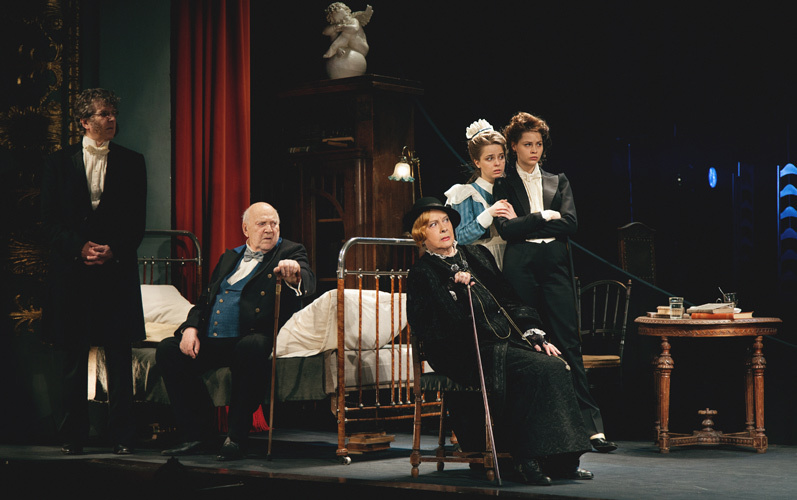
The performance of Peter Naumovich Fomenko “Fruits of the Enlightenment” was in the lighthouse of long two decades, until 2004. Today, Mindaugas Karbauskis decided to again put the Tolstoy play about the land issue on a spiritualistic session with dedication to his teacher.
The relationship of the teacher and the student were, let's say, not easy. Having left for the Moscow Art Theater “under the canopy” of Oleg Tabakov, Karbauskis seems to have avoided direct communication with his master. Critics, however, did not get tired of interpreting about the miraculous combination of Fomenko lessons with the Lithuanian theater culture. His performances were often included in the motives of death and existential choice - from the "old -world landlords" and the "story about the seven hanged" to the "draw lasts a moment" and "Buddenbrooks".
Having headed (about the request of the actors-and this is important!) Mayakovka, Karbauskis somehow immediately matured and began to deny himself lyrical attachment to his favorite plots. The very first performances showed the outlines of his new manner as a artistic director-elegant-theater, slightly distant and philosophical-melancholic. In the Moscow “choir” of the latest theatrical movements, the noble and conservative voice of Karbauskis, who advanced to preserve the “large” style, which refused to “actualize” and the transformation of the theater into a cultural center with educational sociocultural tasks, was clearly distinguished.
 © Theater named after Vl. Mayakovsky
I don’t know what, but here the fate of Peter Naumovich Fomenko recalls me, who, after the closure of the enchantingly gloomy and dangerous Sukhovo-Kobylin “death of Tarelkin” (1966) was “amazed in rights” and again returned to the Mayakovka in the peaceful and theatal appearance of the author of the “enlightenment fruits”. And although in 1984, when he put his version of Tolstoy’s play, the Soviet ship tilted and clearly showed the signs of collapse, the performance did not become either a political or philosophical pamphlet. Fomenko enjoyed the triumph of theatrical magic and acute psychological analysis. Do not forget that Karbauskis is a student of this particular wise poet of the theater, who left (or forced to leave?) Fronter's mischief of his youth for the sake of exquisite and escapated skill.
The mirror of the scene turns out to be a mirror of Russian life - and the Russian revolution, although no one uttered a word about the latter.
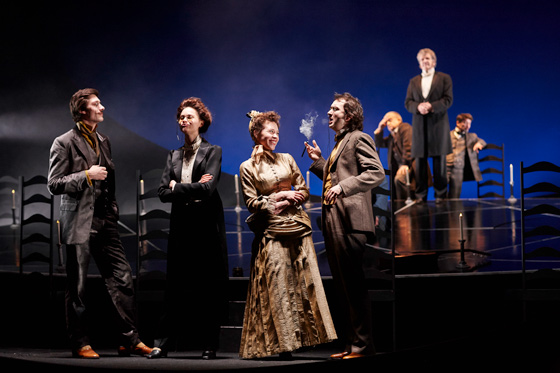
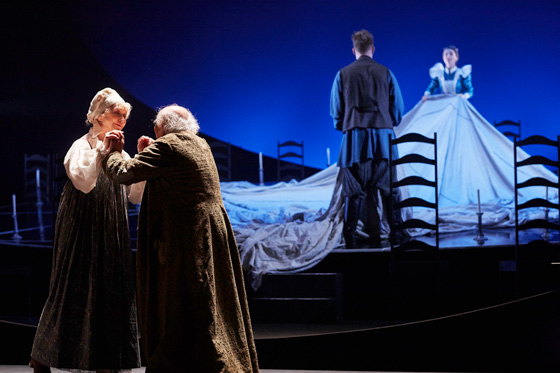
In his performance, he created a symbolic replica, the opportunity to guess between two mirrors about the past and about the future. To the Buddhist disappointment of the director, the scenographer Sergey Barkhin added the strongest figurative and symbolic tension that works in itself: two huge mirrors-binding contain a stage circle, turned into a huge table for the wandering spiritual saucers. The stage world becomes meaning and memory of itself.
Karbauskis is sure that the space will work for him. The mirror of the scene turns out to be a mirror of Russian life and the Russian revolution, although no one uttered a word about the latter.
 © Theater named after Vl. Mayakovsky
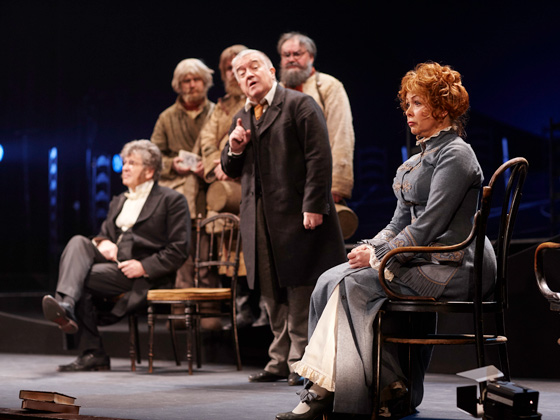
Obsessed by the passion for spiritualism, the hero of Igor Kostolevsky Zvezdinsev wakes up late, like his entire leading club lifestyle family: his wife laughing at him performed by Tatyana Augshkap and decadent children, raised in contempt for his father’s mania,-Betsi (Valeria Kulikova) and Vasily (Vladimir Guskov). From the long exposition of the first act with the morning lazy bustle in the oval frame of the rich Moscow house, there is little in memory, but three men from the Kursk province (Igor Marychev, Victor Zaporizhzhya, Sergey Udovik) bring a semblance of the theme: from another test, blind, with other morality, scholarship, a sense of dignity and beauty - they look at the gentlemen and themselves. In the mirror of the scenes, exactly saying that the theater is not a place of journalistic beings, but the memory of another, the place of meeting with another, unlike us by the world.
Perhaps the “Mirror of the Russian Revolution” Lev Nikolaevich Tolstoy wrote his play-playing play precisely about this meeting of two worlds unknown to each other, including the world of living and the world of the dead, unexpectedly “slipping” his beloved plot.
The heroes of the performance are suitable for the oval of the mirror, to fail to the ground, look into it - they will take them to the “glass”, they are freezing for a moment, amazing themselves.
 © Theater named after Vl. Mayakovsky
Svetlana Nemolyaeva-a mobile, hooligan cook-laughter with sad eyes-concerfully and patiently hides his unfortunate, captured friend, expelled for drunkenness behind the back of the sofa. A whole Russian drama was easily played in her duet with Ramses Dzhabrailov. The imposing and kindest valet Efim Baykovsky looks condescendingly and amiably at them. On a huge table, at an angle unfolded right into the hall, the “crucified” buffet Semyon (Alexey Sergeyev), the bridegroom of the charming Tatyana (Natalya Palagushkina) is already preparing for the spiritual victim. Unlike the Fomenovsky performance, both of them dream of dumping them as soon as possible from the Lord’s house, full of wild habits.
Both performances, both eras look at each other as in the mirror: 2015 is looking at 1985. In 1985, in the USSR they went in parades on the very edge of the collapse, in 2015 they again march.
(There is none of this in the play, this meaning that seemed to me is supplanted into the region of the unconscious ... Leo Tolstoy as a mirror of the Russian revolution.)