
Translated material
Cultural salmon
The phrase Barents Spektakel and the toponym Kirkens I heard for the first time-a letter came from the Norwegian embassy to attend this event, but to the question of what it is, they only said that this is a festival that the Russian-Norwegian group of curators “Girls on the bridge” (Pikene På Broen) will be Russian artists and musicians that there will be Russian artists and musicians. Journalists from Russia used to go and always returned under impression. "Look at the program on the site." Having rummaged in my memory, I remembered that familiar musicians went somewhere in Norway to play the reconstruction of the avant-garde among snow and ice floes, and then the “border musical” of the group “What to do?”, Made just on the basis of local problems, still surfaced. And this is in the case of the city of Kirkenes B8 kilometers from the border separating Norway from the Murmansk region, how it was not difficult to find out after the small Google resergi-the problems of border cooperation, the proximity of one very prosperous country and the other not such a prosperous country with strongly intersecting raw materials, as well as the problems of ever-paradoxical relations of Russian federal politics and regional levels, that is, that is, Actually, the level of real human life. There was nothing at all from the festival’s program-a show-ballet at the opening, an exhibition, a workshop for the seizure of old clothes, a fair in the square, a conference, a concert of organ music, a discussion, another concert: what exactly the organizers were collected here, it was impossible to understand from the program, it was clear that the culture, as always, was smeared with a thin layer according to some problematic local situation. Olga Zhitlin was the only familiar artist mentioned in the release - but she could not tell me anything about the festival, she was simply asked to give a video (about migrant workers in St. Petersburg) - she gave.
The case when, coming as a cultural journalist, you think that it would be better to be curatorial exhibitions and concerts that should stimulate the discussion at all.
It is important for the Norwegians that the local problems of border interaction are somehow announced in Russia (Norway is engaged in the Archangel region, the organization “Barents Secretariat” is engaged in the establishment of cultural ties in relation to cultural ties), and the festival is completely arranged as a reason to talk about these problems. Great; The only thing that turned all this into a difficult test is that in addition to entertaining problems of local life associated with tourist Russian-Norwegian ship routes to Murmansk, the prospects of oil production in the Barents Sea (which can potentially turn the Kirkenes, who had already experienced one depression in the 1990s, into a much more significant place on the map), as well as a more significant place on the map), as well as a more significant place). The export of Norwegian salmon under sanctions, it was necessary to think something about this auxiliary culture itself. The case when, coming as a cultural journalist, you think that it would be better to be curatorial exhibitions and concerts that should stimulate the discussion at all. Because long phlegmatic videos installed in empty refrigerators, about the local business of the royal crabs, which is at risk due to larger initiatives for oil production in the Barents Sea, is the embodiment of that powerless beautifulness, social democratic (striving for democratic correctness through cosmetic correction of reality) intention and neoliberal (that is, in fact, falling into a situation when it is directly instrumentalized by business and administrative interests) for implementation, for which you sometimes hate art in its current form.
 © Mikhail Salvin / Barents Spektakel 2015
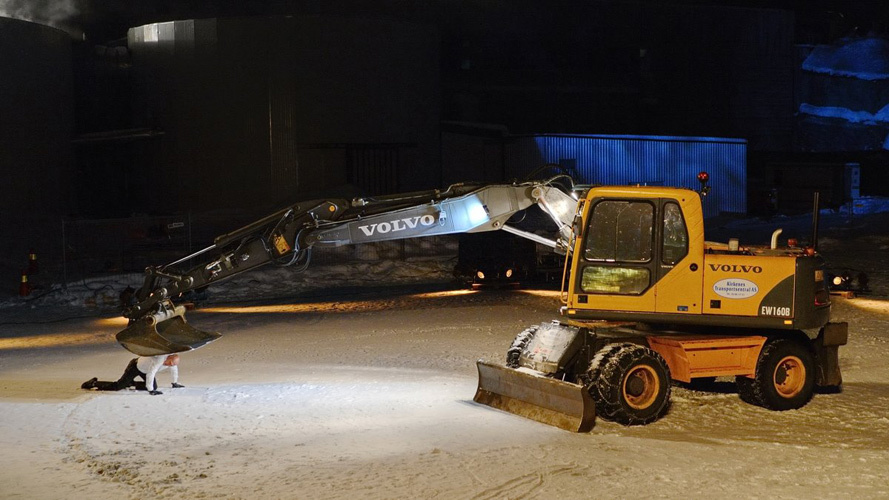
An elderly nurse of aviation ambulance, who went to bask in the hotel bar and drink a glass of wine, in terms of rubles, costed astronomical money, was holding about the same opinion. Rubbing her leg in a woolen sock, she explained to me that actually the Barents-Prospect always falls on her birthday and for her it is always a pleasant circumstance. That's just this year the opening show was a little idiotic. Indeed, it was a strange sight: on the site near the giant purification structures, the assembled Kirkenes and guests of the festival was represented by an erotic-dance duet of a tour with an excavator. For live opera singing. A lean man, dressed in an Arctic frost, dressed in one white shirt and black trousers, then hung with the power of his trained hands on a bucket of a rotating excavator, then jumped away from, as it seemed a slightly surprised car in love despair, then again, filled with obscure hopes, rushed into his hard arms. The ballet metaphorically expressed sensual relations between the brave resident of the north and technology, but looked somewhat excessively - in the sense that along the Norwegian highways exactly the same excavators work both day and night, endlessly clarifying and expanding the already ideal roads. And this is really a bewitching sight. The ballet looked like a cruel irony and a whale statement of the impossibility of truly proletarian culture in the context of a folding of moderate social democracy and the transition to moderate neoliberalism.
 © Mikhail Salvin / Barents Spektakel 2015
The Kirkenes were trampled in the creaking snow and chuckled. And the delegations from the administration of the city of Zapolyarlar (together with the village of Nickel, the village closest to Kirkens from the other side of the border; as in Nickel, there is nickel production belonging to the Norilsk Nickel concern), which arrived on the opening by the bus, seemed to like it. The head of the administration (he turned out to be the first person whom I asked about impressions) handed the business card with gold embossing and offered to go to talk if I would be in the polar. My new acquaintance, a nurse, considered that this show was "a little too much." The fireworks show last year was easier and more fun. In any case, her favorite part of the festival is actually Transborder Café . Something like a small talk show for beer, which discussed local problems with invited specialists, is the same as at the Big Kirkenes conference, but informally. Clear business, this year, conversations in both Transborder Café and at a big conference - about sanctions and how to live under them now. People from the Kaliningrad region came to TRANSBORDER CAFé to share experience. Everyone converged on the fact that in this situation only “cooperation from man to man” remains. Well, “business heals”, of course. After that, there is nowhere to go, except for the local church for an organ concert.
In the Festival program intended for cultural journalists, the Kirkenes conference was listed as one modest point between the fair and Vorkshop in the local second-hand, where trained winter pants can be bought for gigantic money. In turn, in the conference program, festival events appeared as a pleasant bonus recreation after a whole day of reports and discussions. And, it seems, the conference was more important - here larger salmon were found. While the guests of the festival studied under the supervision of volunteers from Murmansk and the downshifter artist from Norway to breed bacterial crops to produce traditional yogurt (an attempt to restore the lower neighboring relations based on bacteria like a tea mushroom; however, in my opinion, the actual definition of bacterial communism forced the artist to start), The conference was the Minister of Foreign Affairs of Norway and the governor of the Murmansk region Marina Kovtun. The one who recently became famous, forbidding Leviathan, who starred in Teriberk, for the show in cinemas, is actually all the same places near Murmansk. Meanwhile, in the Kirkenes cinema, similar to a cube from a children's designer (here all houses are similar to such cute cubes and differ only in inscriptions - “Library”, “School” or in this case “Cinema”), it was “Leviathan” in the box office. True, for the ideological innocence of the polar, nickel and Teriberki, the governor had nothing to worry about-the cinema has not been shown there since the mid-1990s, since the local DC where film installations were rented, and the Soviet film network ceased to exist.
 © Mikhail Salvin / Barents Spektakel 2015
Before we start talking about tourism, salmon export (after the counter -sanctions, Norway lost its main sales market, but reoriented export and as a result increased it by 12%) and its breeding in Russia (we have branded its dilution as a result of sanctions and collapse of the ruble, since all the Norwegian technologies and feed are now worth it), about culture and prey). Oil in the Barents Sea, on each side, the inevitable ideological mantras should have been voiced. It was a dramatic parade of parallel discourses, which were clearly broadcast here without calculating to be heard. Sad, but necessary tribute to the "federal level."
“For the first time,” the Norwegian Minister of Foreign Affairs said, which opened the conference, “since the Second World War, one state in violation of international law has encouraged the integrity of another state. We must find new challenges related to the international policy of Russia, together, like neighbors. The will to cooperate is preserved. But this country is six times more than ours, through the territory, with it we are close to the border, and there I had dined yesterday. This is the same Russia that uses military power against its neighbors. Norway does not accept these actions, we must resist this. ”
“I can’t adequately respond to the position of the minister,” Governor Marina Kovtun answered this with restraint, but I am not a foreign minister. But as a Russian woman, bearing a Ukrainian surname, in which children speak Russian and Ukrainian, for me this is a personal drama, and there are many people in Russia. Four thousand Ukrainians live in the Arctic. ”
They did not weave their mittens and did not knit - all the commercial romance turned out to be a pure fantasy.
“Amazing, border cooperation and cooperation from man to man defeated the federal Leviathan,” I thought, but I was mistaken.
“Russia did not take the Crimea, he voluntarily came to us,” the governor continued. - It is a pity that European partners do not see that fascism raises their heads in Europe. There raises the head of the swastika. For us, this is a wound to your heart if you want to know my personal attitude. And we appreciate the memory of the Norwegians about the liberation of the Eastern Finn Mark from the Nazis - we are grateful for respect for the feat of the Soviet soldier. In September, we celebrated the seventh anniversary of this event with broad joint events. The torch procession with the children and youth of the eastern Finnmark was a touching and exciting event - we really value this, believe me. ”
Perhaps this was the most ambiguous gratitude that I had heard. It seems that the common memory of the Second World War was in an extremely contradictory situation: even in the Arctic, the parties are trying to determine which one is closer to fascism. And my acquaintance of the aviation Medical Medicine, by the way, went to a tour of the Apatity in her youth to look at a knocked fascist plane. And in general, she believes that it is not good to specify military memory. But still, this intense exchange of ideological warnings was just an interlijah, after which Ruda and tourism experts came to the microphone, and they tried to forget about fascism and federal sanctions immediately.
“There are no more such relations in Europe - we must turn them into a product,” as Marina Kovtun put it. "Business heals" - again.
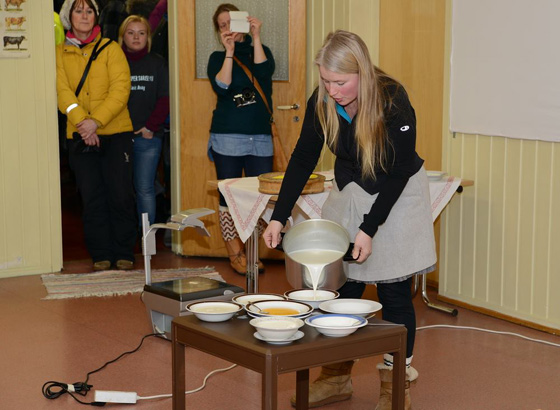 © Mikhail Salvin / Barents Spektakel 2015
For example, as in the city fair, which is held here once a month. Women from Russia come to trade woolen mittens, packs and crystal. For several years in a row, a group of German artists has established contacts with these women, even a book about this collaboration has been released. At the conference, the artist made a presentation of the project: about an attempt to return to the crafts and fair trade, which again can maintain subtle basket ties from a person to a person against the backdrop of evil federalism and global capitalism. As a contribution to the project, the artist even wove a towel with a traditional Russian ornament. But as soon as it was a little chatting with women at the fair, and it turned out that they did not weave or knit their mittens - all the fishing romance turned out to be a pure fantasy. Their goods are the very mittens that the old women had previously sold throughout Moscow and the whole of Russia. Only before they were knitted themselves, but in the last few years of home -made ones you can hardly meet - they are all made in the factory, only sold from the trays. In Moscow for 300, and in the region, 250 rubles. Murmansk women standing at the fair in Kirkenses go to Moscow for these machine mittens, and for Khrustal - to Belarus. At the bazaar in Kirkenes, mittens are ten times more expensive than in Moscow. A huge difference in the courses makes trade profitable: it is cheaper to go for mittens to Moscow than to knit them from wool yourself. It seems that for women from the Murmansk region this is the only way to earn money-and it does not go back to the old-fashioned fairs and rustic exchange, but to the forced personnel of the 1990s, when we went into the space of the world market of mittens and crystal from the stagnant but poor isolation of socialism. As the local curators say, "the iron curtain fell, and people saw that the same people were the same people." Another effect of a collapsed ruble is that the Norwegians, as a Minister of Foreign Affairs, go across the border to have lunch, purchased with trifles and refuel. The story of the mittens is just the case when art, focusing on the good and wanting to replenish the sagging social ties, turns out to be blinded by its own beautifulness, based on the exotization of traditional elements of culture - but ultimately it looks good in a festival program with local color.
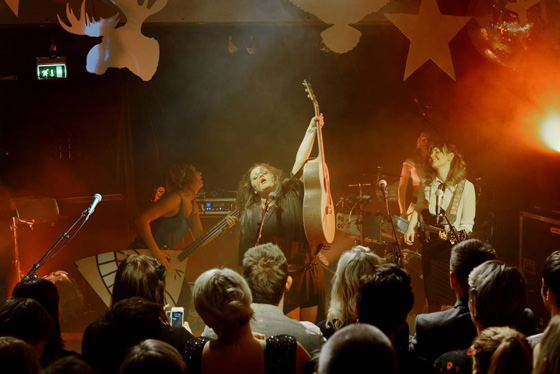 © Mikhail Salvin / Barents Spektakel 2015
There, at the conference, the Canadian spoke, who has been living in Kirkenes for a year, working on his pH . D. At the Barents Institute. In Canada, the Arctic region occupies two fifth countries, and the problems of settlement and development of the northern cities in Norway and Canada are similar. This Canadian turned out to be an architect and was engaged in urbanism of the Arctic cities-there is one: his project, which he presented at the conference, was something between the phone application for city improvements and the public art program for cities with a population of 5,000 people, where most of the time is a polar night. His application is still under development. It should unite the inhabitants of Murmansk and Kirkenes: all of them through the application will send comments that they want to correct in their cities, to the forum, and the proposals for improvement will also be discussed there. Of course, he cannot but be embarrassed that, for certain reasons for the proposal of the Murmansk residents, he will be heard with a lesser probability than the proposals of the Kirkenes. But urbanism does not give answers to this question. The issues are also raised by what effect on the life of the Arctic city of the Big Graffiti on the wall of one of the coastal cubes houses. Polls have not yet been conducted.
Back to Murmansk, like from Murmansk to Kirkenes, we were driving a driver from the village of Nickel. All the way, four hours, we only said that about a border life. About the passport of the border resident, allowing him to earn money between countries without a visa; About the stoves in the polar and nickel; About the Norilsk Nickel; about the smoke that goes directly to the villages; about violation of technology when opening new furnaces; About the ultra -modern ships of Norilsk Nickel, taking out ore along the sea; about asthma in children in villages, which has become more in the last couple of years, when they began to increase production; about the environmental concerns of the Norwegians on which there is smoke; about closed cinemas; about the desire of the Norwegians to cooperate and about bureaucratic obstacles; again about salmon; about closed fur farms and collective farms that we passed; about the battles in the Second World War on the hills through which the highway runs; about the dugouts and memorials visible here and there; About the new monastery, where we drove along the road, it was built on the donations of raw materials; About Norwegian tourists who come to hunt and ride snow -scooters; about crab safari and about steamboat routes; About the military units on the coast (we drove through the base, from where the Kursk was left for the last voyage, and the village of Sputnik, from where, now, they say, they send contractors to Ukraine ). Here they get ore, build wooden monasteries under the 17th century, here they swim along the lakes on tanks and do not go to the cinema. And about what was at concerts and exhibitions, we did not say anything expensive.