
Translated material
Elena Vigdorova: "We whistled our 1990s"
A special project “School of the 90s” , launched by Colta.ru, the educational portal “Your History” and the “Lessons of the nineties”, is dedicated to the era of the 1990s in the context of Russian history. For the most important period in the latest history of Russia, we will look at the main signs of that time and its key events through the eyes of famous teachers of history and literature.
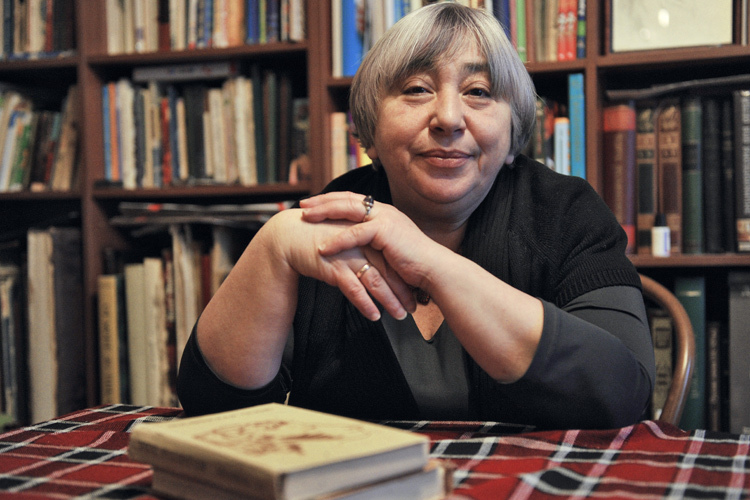
Elena Isaakovna Vigdorova has been teaching Russian literature to high school students since 1976. In 1984-2012 she worked at the preparatory courses of the RSUSU (until 1991-the Moscow Historical and Archive Institute). One of the authors of the book “Griboedov at School”.
It was stated: we are all different
Our 1990s are, in fact, the legacy of the thawing 1960s. And in schools, too, because any public climb (as, indeed, a decline) is manifested in education. Pushkin says about Alexander I: “He took Paris, he founded a lyceum” - and for him these are equivalent things on a scale of history: here is Paris, but the Lyceum. This lyceum is their then thaw. This is its measurement: such an educational institution appears, where twenty -nine boys come with the hope that the future of Russia depends on their mind, talent, and zeal. And so it happened.
But the thaw, as it should be, ended quickly. In the 1840s, Modest Korf writes his diary. Lecensists are forty years old, but a third of the release is no longer alive. Korf does not say about Pushkin, this is, they say, the story will judge. Of the others, except Gorchakov and himself, no one, it seems, does not occupy particularly high posts, nothing depends on anyone. Already in the 1840s, people know that nothing depends on their mind, talent and zeal in this country.
So rhymes the 19th century with the XX. What is the 1960s thaw in education? This is also primarily new schools - the second matting school, for example. Yes, in 1971 it was already dispersed, and it was a tiny island, and yet it showed that the school could be completely different. And in the 1990s, when the wind of freedom was already walking around and everything turned out to be in the draft, it really blew, shook school. Hope appeared.
The 1990s are the heritage of the thawing 1960s.
My daughter went to first grade in 1990 in school uniforms. But already in 1991, the form was canceled. And the feeling of freedom began for me with this - there is no form, there is no bureaucratic leveling of each and all. This was stated: we are all different.
And at once - many new schools, including paid ones. Including the insanely dear ones, where, judging by the children, which I had to teach later, all went mainly on the golden walls. Of course, I will not judge everyone, the quality of education was different everywhere, somewhere it is probably very high. A miracle for me was the Pirogov school , invented shortly before his death by father Alexander Menem . The miracle that she appeared, and the miracle that she resisted all these years. Once it was completely inexpensive, now, when the city continuously increases the rent, this is not so, but still there is an absolutely human attitude to children and parents. And teachers there, by the way, receive no more than in public schools, and children love and treat them respectfully.
Then, in the early 1990s, Anna Konstantinovna Polivanova came up with her school . There, the entire learning process was built again. From time to time I read literature from them. It was such a funny school: four graduates - by the way, of different ages - listened with interest to my lectures and recorded them in large printed letters; Sixth graders, in whom I led the lesson a couple of times, could not really sit at the desks - no one ever demanded that from them. Someone was lying on the floor, someone hung from the shop, but they were cute and friendly, did not make no noise and rude until I read the “Constantinutances” at the request of Anna Konstantinovna. I can’t say that I really liked it there, but gradually the Polivan school changed. The main thing is that many of her graduates became excellent students, and then by specialists - unsolved, free, courageous. This school turned out to be a salvation for many children, most likely, who had broken in schools with traditional ideas about discipline. Recently, I again gave several lectures at this school, and now I liked everything: children, teachers, and the works that eleventh graders wrote to me.
In 1994, a beautiful league of schools opened in Yasenev-a school for gifted children, where exams and training require such brains that any child will not go there-neither by acquaintance, no way. There are few children and many teachers. And children study in all subjects very well and with great interest. I happened to teach the children who went to the Mehmat, at the physical factory, to the biofac. They were well -read, they knew how to analyze the texts, they were all madly interesting, they were stronger than philological children.
If we talk about old strong schools, then they are simply blossomed. Surely I won’t call everyone, but certainly it can be said about the 57th and 67th (since 1993-gymnasium No. 1567.-Ed. ). In 1989, the 57th, always famous for its mathematicians, opened humanitarian classes. And they immediately began to compete with the long-known brilliant humanitarian classes of the 67th. This very productive dispute continues today.
And I must tell you that if in the 1980s mathematics were stronger in literature, maybe because the most powerful schools were mathematical, then already in the 1990s it was not so, mathematicians began to know the literature very average (only the league of schools was perhaps an exception).
When the teacher lives only by his humiliation, this speaks only of his own wretchedness.
Smart children do not meet clothes
You ask what in the 1990s it feels like a teacher who knew that he was dressed the worst and certainly worse than what they show in advertising? You know, in these very strong schools such that the teacher feels awkwardly, because he is not well dressed well, could not be. These children dreamed of entering this school and studying with these teachers. And the authority that the teachers had was excluded that they were looking at their skirt or sweater from the third desk. And if they look at, the children always look at - then they do not draw any conclusions on this basis. Here, honestly, I don’t remember the complexes about the clothes of the 57th or 67th teachers, although I talked with them closely and it was our still young years, when it was important for us what skirts and blouse we had. Nevertheless, smart children do not meet from clothes, but by the ability of the teacher to say so that they are listened to.
When the teacher lives only by his humiliation, as it really was in the 1990s in mass schools, this only speaks of his own wretchedness. That the state did not care about the school too much - it was true, it was in those years. But it was compensated by complete freedom. Not everyone could just use her. This freedom was needed only by strong teachers working in the team. She needed Zoe Aleksandrovna Blumina, Lev Iosifovich Sobolev, Nadezhda Aronovna Shapiro, Eduard Lvovich Beznosova, Irina Anatolyevna Aussem, Evgenia Semenovna Ablyuk, Konstantin Mikhailovich Polivanova. I call the best and far from all the words, but there were (and there are) wonderful historians, mathematicians, physicists, biologists, and teachers of foreign languages. And everyone expanded the world, pierced the iron curtain, taught to think and helped to stay, not get lost in these incomprehensible, through and through the beautiful 1990s. Yes, only those schools where the team gathered were shot-just like in everything: the lyceum on the Vorobyevs Mountains, the Don Gymnasium, the Milgram school, the lyceum of Yamburg, the League of Schools, the 57th, 67th, the second matches, the “intellectual”, which appeared later ... there were a lot of good schools. But where these teams have not gathered, this school konda, this school prison, this school abomination continued and aggravated by poverty.
When 84% are ready to scream “Hurray” and “Krymnash”, the snobbery of the minority will grow.
"Only because they quote Solzhenitsyn, we will not immediately put the five"
Today, these very noticeable schools of the 1990s are fashionable to blame for snobbery. But, you see, snobbery began earlier. There was intelligent snobbery, there was dissident snobbery in the 1970s. There was a desire to close in his circle and not deal with anyone else. And it was snobbery of the same kind. I will not say that justified, but very understandable. It was a protective arrogance, the unity of those who tried to hold together, because the world outside this circle was very hostile.
Snobism of the 1990s became different. Probably, we, teachers, contributed to this, showing the children how to simply determine our Mandelstam line. Like, we will read poetry, and you, strangers, worry about your Mercedes. We do not need them. And then a strange thing happened: snobbery was intensified, but we also needed the conditional “Mercedes”. And, apparently, then from the protective snobbery became more aggressive: see what we can achieve that we know how brighter and richer our life is. Add here these narrowed circles of communication, where children know each other. These went together to a linguistic school, these to a biofdom ... And now getting into the main schools becomes a matter of prestige, belonging to a circle, and someone is ready to pay and humiliate for this.
Is it good? Bad, of course. And who argues, it is necessary to fight snobbery, but this is, I would say, a family business. This family decides to give children to that school or to another. And what is more important to her: the number, teacher, circle, exam indicators or time on the road. And snobbery ... It is difficult to fight it. And now it will be even more difficult, because he again has become a protective reaction. When 84% are ready to scream “Hurray” and “Krymnash”, the snobbery of the minority will grow. This is the answer to the aggressive majority.
Children of the 1990s were not ready for rudeness, for adult aggression and ill-wishes.
The current snobs are not aristocrats, a noble sense of equality with everything that lives few of us. But just professional teachers are not snobs. Because they see children, and children are actually so naturally equal.
Although some, of course, are “more equal”. I remember very well how we worked in the admissions committee (apparently the last year of historical and archival before turning into RSUSU) in 1990. The department of structural and applied linguistics was opened, where young beautiful linguists came. Alexander Nikolaevich Barulin (linguist, creator of the faculty of theoretical and applied linguistics of the Russian State University. - Ed. ), Then not the dean, was the chairman of the commission. And before the start of work, Barulin told us: “Let's agree that only because they quote Solzhenitsyn, we will not immediately put five.” We very strictly took the exam then, because they really wanted to take the most powerful children. But when the child in the essay quoted Brodsky , we immediately did not see punctuation errors a little. And when he quoted Lotman, they also did not see.
That's what she and freedom
Do you know how the children of the 1990s were different, especially children from Moscow schools? They were already spoiled by a respectful and self -love attitude. So I took the exam: if you do not smile at them, they fell silent at all. The hard generation in its pure form. These children, who grew up in the 1990s, were not, unlike today's teenagers, ready for rudeness, for adult aggression, adult ill-wishes. And it was very pleasant.
Children of the 1990s (that is, those who went to school in the early 1990s) were smarter, sharper, more critical than children of the 1980s. They had languages, they went abroad. Moreover, all children, from poor families too. A lot of programs appeared when schools exchanged students. Schools often subsidized these trips abroad: it was believed that they were necessary, expanding the horizons.
It seemed that the humanities would always have work.
And, of course, these children were freer. The truth is freer. For example, they easily threw universities, because they did not like it-children of the 1970s and 1980s rarely occurred to them. It was a shame - it was terrible - after all, it was precisely the bright children who did so often. I learned two years, how much can it be? And then, the children of the 1990s began to work very early. Especially those who studied at the philological facilities: they immediately went to journalism, to publishing, and translated. Exactly so: they acted, studied, then, without finishing up, went to work. It’s generally easier to work than study, and they still pay money for work, by the way.
And the children of the 1990s wanted to make money. They understood that you can save, but you can earn money and preferred to earn money. Many quit studying, then returned. But with what ease they changed universities! With what ease what was being thrown back what was before! Of course, they are much freer. This is good? Fine. Is it difficult? Difficult. Does it bring trouble? Brings trouble. In general, a test of freedom ... what can I say. We could not stand it. We also professed our perestroika , whistled our 1990s. In which there were a lot of rubbish, of course, so she and freedom.
Then, against the background of the tragedy of the technical intelligentsia, it seemed that the humanities would always have work. I remember how, in 1991, immediately after the couch, one glorious boy who entered the historical and archive sat and repeated: “How much work will be! How much work! " He repeated with enthusiasm, because the KGB archives opened. “How much work will be” - and eyes shone. Then it came to naught. And the boy went into the business. And the archives closed.
The material was prepared as part of the special project “School of the 90s” , launched by Colta.ru with the support of the educational portal “Your History” and the “Lessons of the nineties”.
Recorded by Elena Rybakova