
Translated material
Longer loss
How Russian regions cope with economic troubles
** ● The official annual inflation index is about 16%in mid -February, and in the coming months it may still grow.
● Entire regions (two dozen!) Appeared, where the business works at a loss. The share of organizations that have no profit reaches 40-50%in them.
● Increasing the salaries of state employees made most of the regional budgets “social”: about 65% falls on education, healthcare, social policy and culture. And in 34 regions, this share reaches 71–77 %even higher.
● The debt of the regions, according to the Accounts Chamber, increased by 17.9% over the year, to 2.05 trillion rubles, and in 35 regions it exceeded half of the annual budget revenues.
● 300 billion rubles in the budget plan. There are not enough inter -budget loans to the regions, and they will again have to increase the debt to banks. **
The proliferation vector of the current crisis is from megacities to large industrial centers. The strongest blow came on trade, construction, and services. In a difficult situation, regional budgets. The crisis promises to be protracted, and budgets of all levels are concentrated on the support of “their own”: pensioners, state employees and state enterprises.
The first wave: there is no point in building megalopolis on Russia's catastrophic forecasts, says the famous regionalist Natalya Zubarevich: “People are very good at adapting to difficult situations.” The current Russian crisis already has a solid age: more than 2 years. At the end of 2012, industrial growth stopped, investment began to be reduced. But to the Crimea, sanctions and falling oil prices by a formal growth engine remained state investment and consumer demand, largely based on loans. Now this motor is turned off.
First, the crisis came to megacities. In Moscow and St. Petersburg, even adjusted for informal employment in the service sector, stagnation is felt stronger than in the Rostov region or Tatarstan. The financial blockade led to the suspension of foreign investment projects and reduce investment programs of Russian companies financed by foreign loans and bonds. Many foreign companies are closed or reduced by personnel, including due to antisanctions introduced against imports. Antisancations are very hit by the well -being of the inhabitants of megacities - the main consumers of imported goods. The second blow, most strictly affecting them - an almost double fall in the ruble course towards the main currencies. Moscow youth, who believed that the starting position with a payment below € 1000 per month is not for them, you will have to modify the claims.
The second wave: the regions at the next stage the crisis reached industrial centers. According to the results of 2014, industrial production decreased in 16 regions and in so many did not exceed 1%. The volume of construction fell in 38 regions, especially strongly in the Urals, in Siberia and in the Far East. The real incomes of the population in January-November decreased in 27 regions. Salaries in real terms grew a little faster than all the incomes of the population. This is due to the fact that Rosstat measures the size of the salaries only for large and medium -sized enterprises, half of which are state employees. In small business, trade, shadow sector, salaries stopped earlier than in the economy close to the state. In January, according to preliminary estimates, income fell by 0.8 %, and salaries - by 8 % in relation to January 2014. If we take into account that Rosstat most likely somewhat underestimates the pace of inflation, the fall of income is even stronger.
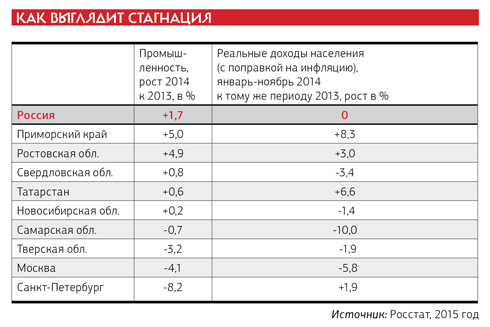
In the coming months, the anti -crisis policy in the coming months will be aimed mainly at the prevention of social unrest caused by economic problems. When Russian Railways canceled local trains and it became clear that the people were ready to block the Trans -Siberian Railway, Putin ordered the trains to return. At whose expense this will happen and how to reduce the costs of passenger daughters of Russian Railways, deducting monopolies annually considerable and all growing amounts - the government does not risk this task. The problem is transferred to regional budgets.

Another indicative example is an explosion of discontent at the Tver carriageway. Due to the folding of the Russian Railways investment program and a monopoly of imported contracts concluded at the end of January, the plant had for 2015 confirmed orders for 25 wagons at a capacity of 1200. Orders were reduced gradually, and back in 2014, the Tver, the Tver, reduced personnel from 7900 to 6300. The plant used to supply the traditional products, and began to modernize their Russian competitors later. In January, Transmashholding, which includes a TVZ, announced that another 1967 employees have been leaving since February. When gigantic on the rally was announced to the rally on the Tver scale of 5-10 thousand people, the federal center drew attention to the situation: a meeting of representatives of specialized departments, Russian Railways, Tver and the owners of the plant on the provision of orders was held in the government. The Ministry of Industry and Trade was also stirred. The company promised support in exchange for modernization (orders from law enforcement agencies and Russian Post - up to 100 wagons), some of the Transmashholding orders are transferred from the Mytishchi plant. The workers managed to persuade not to rally, the number of dismissed is supposed to reduce to 800.
This experience of Tver, of course, was appreciated in other regions. In turn, the model of solving crisis problems that the government will act will also become obvious: in manual mode to resolve the situation where the delay is fraught with a mass surge in discontent. But changes in the general rules of the game as a means to spur growth during the crisis do not have to wait. Although a radical decrease in power and administrative pressure on business, a decrease in the cost of monopolies (electricity, railway transportation) would revive business activity even in conditions of falling demand.

Survival in the 2000s has experienced a quick and confident economic growth. Now the country "is where to fall." The household skills have not lost survival skills at the expense of “household plots”, Zubarevich notes, and they will survive the stop of the flagships of industry. The problem is only in the price level. The official annual inflation index is about 16 %in mid -February, and in the coming months it may still grow. Sensitive demand is significantly reduced. But the current crisis is neither cyclic nor, as in 2008-2009, an echo of global. Stagnation may well be many years old. Without a radical improvement in business conditions, the ten-year stagnation threatened Russia and regardless of the fall in oil price, ruble and sanctions: the smallest generation of born in the 1990s joins the labor market, and the numerous cohort of the 1950-1960s retires.
The state clearly showed who in such a situation it will support first of all. These are the military, officials, state employees, pensioners - the support of the political regime. The reduction in employment and slowed down payments will have to survive these socio-economic groups (in December 2014, pensions in real terms with the adjustment for inflation were 2.6 % lower than a year earlier). But these groups can at least count on some kind of indexation of payments (even with a 10 percent sequestra, the expenses of the federal budget for the army were not reduced and funded in a priority), but salaries in the private business will not grow in the near future. Here employees have different concern: to avoid abbreviations. In many sectors, unemployment can become protracted.
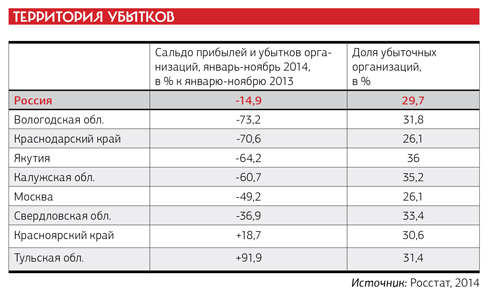
Budget holes are the main part of the revenues of regional budgets are provided by personal income tax and income tax. The growth of income has stopped - in a third of the regions they are already falling, in 2015 the decrease will continue. Profit also fall. In January - November 2014, the profit received by all organizations decreased by 14.9 % against the same months of 2013, and in many regions a decline in profit took on a landslide nature ( see table ).

Even entire regions (two dozen!) Appeared, where the business works at a loss. The share of organizations that have no profit reaches 40-50 %in them. The list of such regions includes Arkhangelsk, Kaliningrad, Novgorod, Ivanovo, Kemerovo, Magadan regions, Jewish AO, Adygea, Kalmykia, Dagestan, Ingushetia, KCR, North Ossetia, Altai, Tuva, Khakassia, Trans -Baikal and Kamchatka Territory. In almost two dozen regions, the profit falls so quickly that they have every chance of becoming unprofitable this year.
Despite the fifteen percent reduction in profit, the receipt of income tax in regional budgets in January - November 2014 increased by 12.4 % (and personal income tax - by 7 %). But this does not even compensate for the 13 percent income tax collection in 2013. And most importantly, the fall in the profit of enterprises working on the domestic market has sharply accelerated in December - January, and these months have not yet been reflected in statistics. For most regions, personal income tax was the main budget filler, and in 2015 it will most likely not be growing, Standard & Poor's predicts.
The severity of budget problems, weakened in 2014 due to the growth of income tax and the actual suspension of the action of presidential decrees, demanding an accelerated increase in state employee salaries, will intensify again in the coming months. An increase in the salaries of state employees made most of the regional budgets “social”: according to Zubarevich’s calculations, about 65 % falls on education, healthcare, social policy and culture. And in 34 regions, this share reaches 71–77 %even higher. Among them are not completely sitting on the subsidies of the federal budget of Ingushetia, Chechnya, Tuva, Altai, Dagestan, and such developed regions as the Sverdlovsk, Chelyabinsk and Irkutsk region, the Perm Territory.
In 2014, according to Iminfin.ru subordinate to the Ministry of Finance, 18 regions reduced expenses even in nominal terms. In 32 regions, the nominal increase in expenses did not exceed 5%. Revenues in nominal terms fell in 11 regions, and in 32 increased by less than 5%. The total deficit decreased from 8% to 5.4% of its own income (excluding transfers). According to EEG calculations, a deficiency of regional and local budgets, which grew to 1% of GDP in 2013, in 2014 fell to 0.6% of GDP. Nevertheless, the debt of the regions, according to the Accounts Chamber, increased by 17.9%over the year, to 2.05 trillion rubles, and in 35 regions it exceeded half of the annual budget revenues.
All this means that the possibilities of increasing expenses, trying to pull the economy out of the crisis, will not have this year: they have to pay for already taken loans. However, both in the regional and federal budget there is a huge reserve of savings - for this it is necessary to reduce meaningless expenses. This year, in real terms, most likely, income tax and personal income tax will fall. So 300 billion rubles in the budget plan. The regions are not enough inter -budget loans, and they will again have to increase the debt to banks. The real measures that could help the regions liberate the entrepreneurial initiative are well known: the maximum demonopolization of regional economies (for example, in the field of cleaning and improvement of cities), a decrease in corruption and administrative pressure. But the chances of the implementation of such measures are negligible.