
Translated material
What was treated with an "icy man"
Scientists studying the mummy of the ancient inhabitant of Europe compiled a complete catalog of his tattoos. It turned out that the ejected from toothache, atherosclerosis and kidney stones* 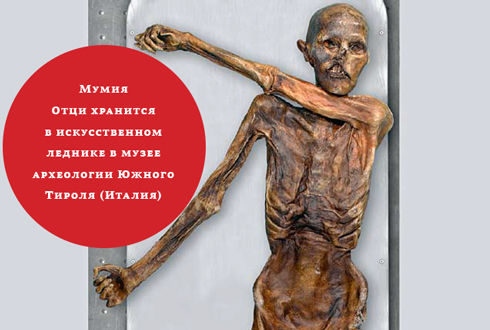
Helmut was the first to notice a dark spot in the snow and thought that it was a bunch of garbage - half an hour ago he was indignant at the fragments of the bottle of champagne found at the mountain peak. But his wife realized faster what it was.
"Look, this is a man!" - screamed Erica.
Stunned, they stood above the body, half -watering under the snow and ice, and looked at the hairless skull, buried in the snow, arms and shoulders covered with dark skin, back with protruding ribs.
Alien
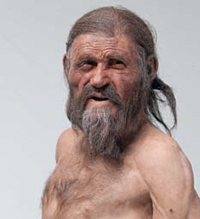 |
| Reconstructing the appearance of the “ice man” using genetic analysis, scientists found out that he had brown eyes |
Shocked spouses took several pictures, and then went down, remembering the location of the find. Downstairs, in a mountain hotel, calming down and drinking beer, Helmut asked the owner of Marcus Pirpamer, whether anyone in these mountains disappeared in recent years. After all, in fact, there was nothing particularly surprising in the find. Many climbers die, falling into glacial cracks. Gradually, the glacier melts, and the body buried in it is outside. But Marcus’s answer was negative, and then Helmut said: “We found a body that wiped out of ice.”
The Austrian gendarmerie took up the inspection of the place of the find and delivery of the body. Initially, it was assumed that the body found belongs to the Italian professor of music, who disappeared in these places in 1938. However, a few hours after the helicopter delivered the body, the police received a call from Italian colleagues: no, the grave of the professor has already been found. So, the body belonged to someone else, and it is unlikely that a professor of music would carry a strange copper ax with him in the mountains.
No one has yet understood that the find of two German climbers is a real treasure for science, a window in the ancient world and a world sensation.
Archaeologist Konrad Spindler from the University of Innsbruck, the first scientist who saw the body of the “ice man”, determined that his age is at least four thousand years. He made this conclusion, examining the copper ax found next to the mummy: the technique in which it was manufactured is characteristic of that era. However, later, the data of the radiocarbon analysis of bones showed that Otzi-such a name was received at the place of find-the Valley of Otztal (German. Ötztal) in the Austrian tyrol-lived in the Alps in about 3350-3100 BC, that is, more than five thousand years ago, when the secret of melting copper was opened in Europe and there was a copper-stone eyelid.
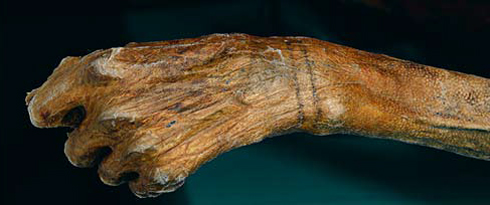
The most ancient tattoos in the world: in order to apply them, it was necessary to rub the charcoal into thin cuts on the skin
Drawings on the body are one of the most ancient mummies in the world and the oldest - in Europe, but it is not only at age. Earlier, more ancient finds fell into the hands of scientists. For example, the age of a mummified head found in the Andes is about 6 thousand years. The uniqueness of the “icy man” is that this “wet” mummy - the presence of moisture has retained the cells and tissue almost not damaged, so that scientists were able to get a huge amount of data. In addition, many objects were found along with the body: in addition to a unique copper ax, the remains of leather clothes and shoes, birch bark containers with dried plants (later scientists came to the conclusion that it was a kind of first -aid kit), onions and arrows. But the most amazing was the discovery of tattoos on the skin of the Otzi.
Drawings on the body were seen back in 1991. However, until recently, scientists were not sure that they managed to see them all. The skin of the mummy darkened from time to time, and various studies gave different results of the count - from 47 to 59. One of the latest achievements in more than twenty years of research - a full catalog of all tattoos on the body of the Ice Mummy.
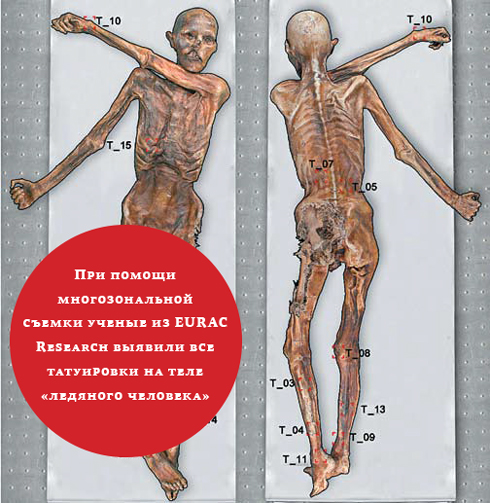
A group of scientists under the leadership of Marco Samadadli from a private research organization, the European Academy of Bolzano (Eurac Research) decided to look at the skin of an “ice man” using multi -zone survey technology - this method of non -destructive research is actively used by art historians. Using multi -zone shooting, you can get images in both visible and ultraviolet and infrared ranges.
Scientists first had to “warm up” the mummy a little, which is stored in an artificial glacier in the Museum of Archeology of South Tyrol (Italy). Then, when there were no traces of ice left on the skin, they carried out the whole body using the filter system and the modified Nikon D800 camera, capable of seeing seven spectral ranges - from ultraviolet (300 nanometers) to infrared radiation (1000 nanometers). The shooting lasted two hours and was carried out at a temperature of 4 degrees above zero. The speed mode of operation was needed to prevent damage to the mummy, which is stored at a temperature of minus 9 degrees.
Then a significantly longer stage of software processing of the obtained images came. Each pixel pictures were obtained in seven versions for each range - thanks to this, scientists were able to distinguish tattoos that were invisible to the naked eye. In the end, it was possible to count the 61 tattoo on the body of a 45-year-old man.

The Chinese in doubt these are probably the most ancient works of "bodily art" are very different from modern tattoos. All of them have the shape of crosses or parallel lines collected in groups of 2–4. Some of the lines reach a length of four centimeters. The color of the tattoo is black: in contrast to modern methods for applying tattoos for which the needle and ink is used, tattoos on the body of the “ice man” were applied by rubbing charcoal into thin incisions.
Tattoos were combined into 19 groups throughout the body, including groups of lines on the right and left of the spine, on the left caviar, on the right foot, on the inner and outer side of the ankle joint, as well as on the chest at the level of the lower right rib (this last was the most fresh of the open ones). Two lines crossed the left wrist, and a cross was found on the inside of the right knee and next to the left Achilles tendon.
Scientists note that most of the tattoos were in places in a normal situation inaccessible to the eye, that is, they were not intended to transmit information about their owner to other people, therefore, the aesthetic or symbolic significance of the tattoo could be excluded.
On the other hand, many of the tattoos were grouped in the spine or next to the joints, that is, in those places where their owner could experience pain due to age-related degeneration or diseases. This means that tattoos could have a medical value. “Many believe that the drawings were applied for therapeutic purposes, since most tattoos are located very close to those places that could get sick,” says the co -author of Albert Zinc from Eurac Research.
One of the tattoos - on the chest of the mummy - fell out of this row, thereby the hypothesis about the medical sense of the drawings on the body turned out to be vulnerable. But recent studies showed: the “ice man” could suffer from stones in the gall bladder, which can cause pain in the chest.
Scientists emphasize that many of the tattoos are grouped along the lines of acupuncture “meridians”, which means an acupuncture that is traditionally considered a Chinese invention can have a much longer history than it has been considered so far.
A bouquet of diseases to date, scientists have already received a gigantic volume of data about the Otzi itself and its era. In particular, several years ago, the researchers sequenced it with the genome and found that he had the blood of the 1st group, and also found a lactose intolerance gene characteristic of modern descendants of nomadic peoples. In addition, the decoding of the Otzi genome made it possible to establish that its closest “relatives” are modern residents of Sardinia and a number of other territories off the coast of the Tyrrin Sea.
Later, scientists analyzed in the genome a number of fragments that were not characteristic of a person, and found that these are genetic traces of bacteria that cause gum disease.
In addition, it turned out that the arteries of the Otzi were affected by atherosclerosis, he had healing fractures of the ribs, which looked like a cyst on his finger, and his nails testified that the immune system was subjected to many attacks and was in severe stress.
Scientists, however, believe that Otzi did not die his death. As the analysis of blood cells and threads of fibrin around one of the wounds in the left shoulder showed, the “ice man” died a few hours after he received a dangerous wound caused by an arrow.
* In preparation of this publication, the following materials were used: the article “Complete Mapping of the Tattoos of the 5300-Year-Land Tyrolean Iceman” from the Journal of Cultural Scientific Journal
Heritage (January 2015) and the book of Brenda Fowler “Ice Man” (Brenda Fowler. Iceman. New York, Random House, 2000).
Photo: Marco Samadelli-Gregor Staschitz/Eurac, WordPress.com