
Translated material
Save regenerative cells
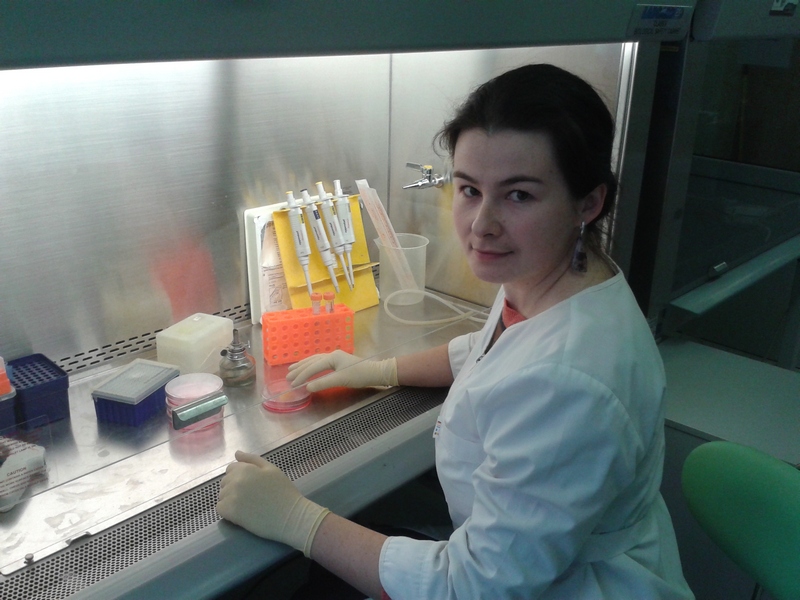
The Moscow government awarded annual prizes to a young scientist. Among the laureates was the candidate of medical sciences, senior researcher at the research laboratory of gene and cellular technologies of the Faculty of Fundamental Medicine of Moscow State University named after MV Lomonosov Anastasia Efimenko . The theme of its work: “The influence of risk factors on the stem and progenitor human cells and the processes of reparation and regeneration in the body.” We publish an interview with a scientist.
Please tell us about your study. What problems does it help to solve?
For a long time in our medicine, a paradigm has affected, based on traditional approaches to therapy and surgery. Pharmacological drugs, treatment methods and surgery techniques were rapidly improved. But in the last two decades, a fundamentally new, completely innovative area has been formed - regenerative medicine aimed at completely restoring the structure and function of damaged tissues and organs.
That is, relatively speaking, there will be no more scars on the body?
The formation of scars is a compensatory reaction of the body. Regenerative medicine is aimed at leaving this term in the past, its task is to achieve a completely new full -fledged skin in a damaged place. In our conversation, the skin is just an example. We are talking about entire organs and parts of the human body. Take, for example, the liver. Today, in the case of its severe damage or removal, individual functions of this organ can be replaced or corrected by some drugs. And tomorrow it will be possible to create in its place a completely new functional organ. This is especially true for military medicine, disaster medicine, various degenerative diseases, all kinds of developmental malformations, when some organs are simply absent at the time of the birth of a person.
Sounds somewhat fantastic ...
This is only at first glance. One of the areas that is actively developing within the framework of regenerative medicine is cell therapy. That is, the use of not chemicals or individual molecules, but whole living cells secreted from human tissues. This, first of all, is about stem cells that are designed to start working in case of damage to the tissue, recreating it again and replacing the lost areas. The adults of stem cells in most tissues are extremely small, and they are most often not enough to restore the functionality of damaged tissues and entire organs. And the task of regenerative medicine is to either stimulate their own stem cells in tissues, or increase a sufficient amount of stem cells in the laboratory and use them to create new organs and tissues for subsequent transplantation to the patient.
Today there are already such technologies, they are being developed by a huge number of research groups and commercial companies. The fact is that stem cells are the basis for the formation of all tissues of our body from the early stage of the emergence of life. But from the biomaterial of donors, we release mainly the predecessor cells of specialized cells - progenitor. They are able to activate under the influence of various stimuli, give rise to new specialized cells instead of lost and regenerate regeneration processes, restoring the structure and functions of damaged tissues and organs. They are already “brought up” and predisposed towards turning into a particular type of cells, but they are not yet.
So, what problem is your project aimed at solving?
A person does not live in perfect conditions. External factors act on him, he is sick, ages. All this affects stem cells and predecessor cells. My work is devoted to the study of the influence of these risk factors on the properties of stem and predecessor cells of the adult organism, as well as on the identification of targets to correct the functioning of these cells associated with aging and chronic diseases.
How important is the difference between own and donor cells?
Cell therapy uses both sources of cells: both its own (autological) human cells, and donor cells (allogeneous). So far, the fundamental advantages of one of these approaches over the other have not been proven. But when we use donor cells, we immediately encounter problems characteristic of any transplantology - immunological rejection, increasing the risk of infections, the system of selection of donors, ethical considerations. If their own cells are used, then many of these problems disappear by definition. But another difficulty arises: the patient’s own cells at the age of, as a rule, a number of chronic diseases, do not give the effect that was demonstrated in experimental studies. And this is the reason for the insufficient effectiveness of many approaches of cell therapy in clinical trials, when the result is not as expected as expected. It is unnecessary to explain what the price of such errors is.
The task of my work is to identify the most effective approaches to preventing or correcting the negative impact of risk factors on the therapeutic properties of regenerative cells. At the same time, I paid special attention to both the use of general playing methods of exposure to cells and the search for targets for point correction.
What is already able to regenerative medicine.
Today, there are already certain achievements that have found their use in the clinic, there are several registered foreign drugs based on stem and progenitor cells - for the regeneration of bone and cartilage, the restoration of the skin. Impressive clinical results were achieved when using the patient’s own cells to recreate hollow organs, for example, trachea, bladder, urethra and some others. A significant amount of positive results was obtained in the field of stimulation of the growth of blood vessels and neurogenesis using methods of regenerative medicine, which is especially important for the treatment of ischemic and neurodegenerative diseases. I am now talking mainly about the successes of foreign colleagues, but similar works are underway in our country. Many cell drugs are located at different stages of preclinical and clinical trials. I’ll make a reservation right away: there are no clear recipes or technologies here. This is a relatively young, but very actively developing science. Huge hopes are entrusted to it, and we cannot allow a situation in which practice will significantly ahead of the theory.
How did you come to science?
Probably, the first attempts to find yourself in research were made in school years. I was very lucky with the teachers, I studied at the University Lyceum in Petrozavodsk, where research activities were stimulated and encouraged in every possible way. Later, she performed at various scientific conferences, seminars, participated in the program “Step to the Future”. And the foundations of the scientific worldview were laid precisely then. And since it was interesting to me from childhood exactly how a person was arranged, I entered Moscow University at the Faculty of Fundamental Medicine, where one of the basic principles is the occupation of future doctors of scientific research.
It is important to note that we are not talking about applied developments, but about fundamental science, which also studies the mechanisms of the same regeneration, but it does not give any practical exit, although without its results there can be no fundamentally new treatment method, this science is not in honor ... and is, of course, not enough. Only the state can finance it. Any business, any funds are focused on a practical result. Moreover, they need guarantees, and fundamental science cannot give guarantees, if only for the simple reason that it does not know how it works, she studies it. Therefore, system state support for such studies should be built. It is desirable without unbearable bureaucracy and reporting, which are able to destroy any undertakings. On the other hand, in our country it is necessary to more actively develop the mechanisms for introducing specific results of fundamental research into practice, including these methods should be widely available to young researchers who are thinking about commercializing their scientific developments.
We will continue the publication of materials about the winners of the award.