
Translated material
Royal old age
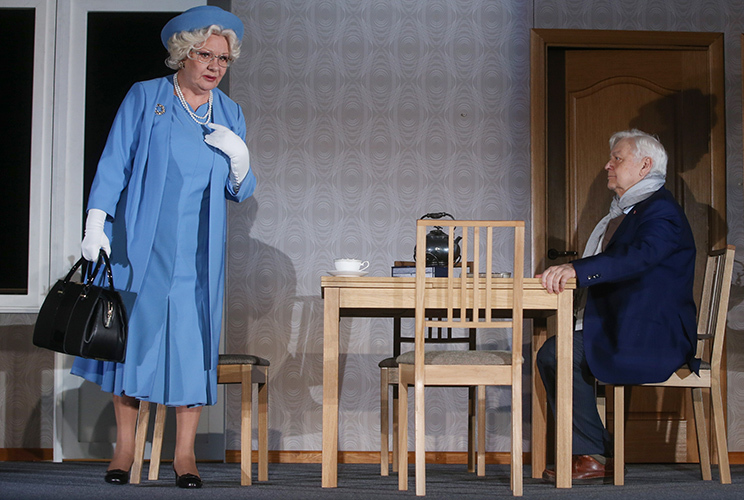
The play “The anniversary of the jeweler” of the British actress and playwright Nikola Makoliff (translation by Olga Warsaver and Tatyana Tulchinskaya) was written for two age -related beneficiaries - so that the hall laughs a lot, cries and touched. Konstantin Bogomolov, who put her to the coming in August 2015 Oleg Tabakov, acted decisively: he forced the artists to speak in everyday votes, and he transferred all the feelings to the credits, which from time to time appear on four screens. These screens descending from above replace the curtain and guide the audience emotions. "Start. The beginning of the end. The beginning of the end begins ” - the inscriptions in the gate flash.
The director continues the reception he found a couple of years ago in the performances of Stavanger (Liepaisky Drama Theater) and “My dad - Agamemnon” (Maly Theater of Vilnius), where the actors were calm, and their mythical passions were reflected in the credits. Only now he goes further: earlier the credits were only mixed, now they are forced to tremble.
The nurse makes the old man an injection of morphine: on the table no syringes, no ampoules, no one clamps Vienna and does not roll his eyes blissfully - the actors calmly sit opposite each other. “Morphine enters the bloodstream. Morphine hugs with blood. Blood carries morphine through a decrepit body, like melt snow, ”the credits say under a quiet violin chord. The hall is at a halter, as if an injection was made to the audience.
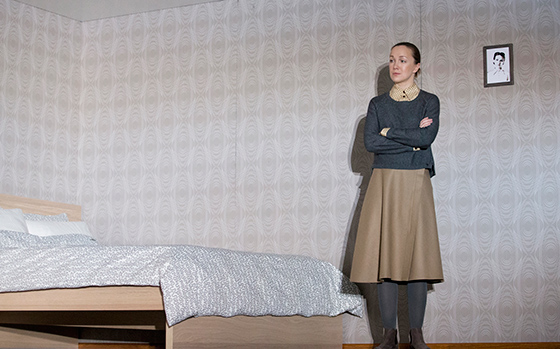
Another scene: at the table, the wife talks with a nurse, the patient sleeps nearby. But at the beginning of the dialogue, the bed is empty - Daria Moroz takes out a blanket rolled up, puts it on the bed, giving the form of a sleeping one. Sits down to the table and lowers his voice a little. Spectators stop coughing and dropping programs - after all, the old man is sleeping.
These theatrical seams, specially twisted out, and deliberately conditional room, invented by the faithful co -author of Bogomolova Larisa Lomakina, where the blackness of the Kulis is outside the window, and the Moscowaya Portal is guessed behind the front door, emphasize the gap between actors and characters. That is, the structure of the performance itself protects the artists from "complete death seriously." Actually, there is something to protect from. The 89-year-old hero Oleg Tabakov-the ruined jeweler Maurice Hodger-is dying of cancer. “The terminal stage,” the doctor says, promising him for several weeks. But Maurice is not enough, he needs to live for two months and meet his ninety - on this day he waits for tea to the queen. He tells the story of his visit to the Buckingham Palace the newly hired Catie's nurse (Daria Moroz): sixty years ago he was asked to fix something in the British crown on the eve of the coronation. He was twenty -nine, the future queen of twenty -six, she complained that the crown presses - almost the same as the need to rise on the throne; I offered to drink tea and dance. It is difficult to understand whether it was in reality; Helen, the wife of the jeweler, claims that no, but Maurice’s family life has cracked since then-he could not forget that dance and that girl: saying goodbye to him, she promised to pay a return visit exactly sixty years later, on the day of his 90th birthday.
The hall is at a halter, as if an injection was made to the audience.
On the stage - three, plus on the sides and busy shooting Artem and Vladimir Panchik (close -ups of heroes are broadcast on the screen), plus work scenes, plus the assistant director Mikhail Rakhlin, as a doctor, a diagnosis informing the hero.
“Memory is brain cells. Cancer multiplies cells. Cancer multiplies memory. Memory is a tumor ” - the credits on the screen alternate with nostalgic personnel: a shining girl takes off the crown and gives the young man. They dance under Anniversary Song Andy Williams. Smiling, she promises to visit him after 60 years. With her smile, a frame gives mantis on the screen every time Maurice recalls her, and the usual image alternates with a negative, on which the gentle face of the actress Maria Fomina turns into a grinning backbone. “Memory laughs - the tumor laughs,” the credits comment.
The subtle physiologist, the mantis once again proves that you can explore the feelings of characters and conduct with viewer emotions, without forcing the artists to tear passions into shreds. Natalya Tenyakova pronounces a text abounding in household details, a tongue twister - almost like a close -up in documentary cinema. She is extremely organically echoed by Daria Frost. Oleg Tabakov also simply and quickly pronounces the text, sometimes teasing (“And we are indulging with morphine”), allowing ourselves a significant pause in only one phrase. “And I saw the time to mutilated his legs,” Maurice recalls his father, pulling his boots.
It is very difficult to get rid of this phrase. And it is also difficult to forget Oleg Tabakov’s gaze - he always looks past the camera, inside himself, but his gathered, attentive eyes crash into memory.
 © Elena Nikitchenko/TASS
Actually, this is all that you can tell about the actors. The director left them nothing but royal correctness, composure and natural intonations. He did not even stand on ceremony with the play: in the text of Nikola Macoliff, a lonely, ugly nurse reports that she was engaged in the theater studio, and offers his wife that on the day the anniversary would appear to Maurice, dressed in the queen. She seems to do so - the touching conversation of Maurice and the Queen, who remembered him sixty years, follows. But as soon as she leaves, they call the door again - the now dressed up queen Katie explains Helen that the street was banned by the motorcade and it was impossible to go to the house. While women think about who came to the house, Maurice blissfully dies on the couch.
There is none of this in the play. An hour with a small actors create such a dense illusion that then the queen easily enters the stage. And there is no gap: Tenyakova really becomes the queen - with that smile and manner of holding, which no one else has in the world. And then the performance suddenly turns out to be a love story of the ridiculous chatterbox Helen, who managed to turn into a queen - for the sake of a nasty old husband who was always in love with another.
In the dark, while the hall is drowning in the tragic Sarabande Handel, and the credits are replaced on black screens (“Death comes and silence comes. The table is silent. The curtains are silent ...”), you can reflect on the indigenous issues of being. Cry. Remember the stories about great performances with the great old people: it seems like “Further - Silence” with Plyatt and Ranevskaya or “Solo for Watch with Battle” with Androvskaya, Yanshin, Prudkin and Stanitsyn. I thought that big actors really are not afraid of death. That is, they are not afraid of anything at all. In addition to, of course, the public is failure.