
Translated material
How a rhino visited a bird
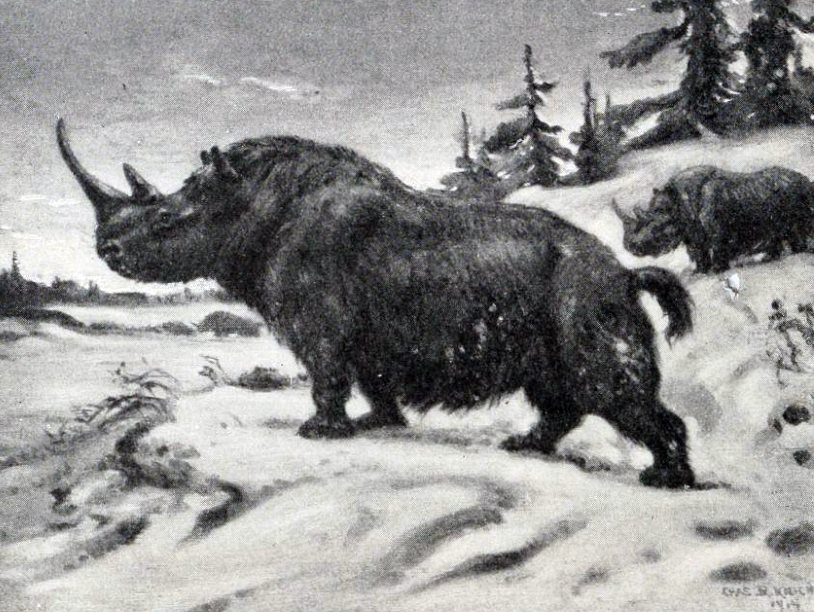
At the end of February, a message came from Yakutia that in the Abysky district on the banks of the Semyulya River, hunter and entrepreneur Alexander Banderov and his friend Semyon Ivanov discovered the woolly rhino surviving in the eternal permafrost. Hunters contacted scientists from the Department for the Study of the Mammoth Fauna of the Academy of Sciences of the Republic of Sakha (Yakutia) and transferred the find to them. Presumably, the young rhino died at the age of one and a half years. Now Sasha (he received such a name in honor of the discoverer) is being examined by scientists who expect that they can highlight a sample of DNA from well -preserved tissues of the rhino. The previously frozen body of a woolly rhino was found in 2007 on Kolyma. And in the 20th century, two mummified bodies were discovered in the Vilyui and Verkhoyansk regions of Yakutia.
A new wonderful find is a good reason to recall the amazing fate of the woolly rhino, which, after that after he died, “managed” to be a bird for some time.
To begin with, we briefly recall the intravital story of this species. A woolly rhino ( Coelodonta antiquitatis ) lived in the cold steppes of Eurasia from the times of the last glaciation. An adult animal was from 3 to 3.8 meters in length, up to 2 meters in height. His weight is estimated at 1800 - 2700 kilograms. The woolly rhino had two horns, the length of the front horn could exceed a meter, and the weight reached 15 kilograms, the frontal horn was smaller. The study of DNA samples showed that the closest relative of the woolly rhino is the Sumatran rhino ( Dicerorhinus sumatrensis ). When the climatic conditions on Earth have changed and the walking environment of the woolly rhino has disappeared, the view died out. It is believed that the last woolly rhinos lived approximately 10 thousand years ago.
The horn of a woolly rhino became the cause of its amazing adventures that happened after extinction. The fossil remains of these animals have been known for a long time. The famous traveler and naturalist Peter Simon Pallas (1741 - 1811) gathered several copies of the remains of the rhino and gave it the Latin name Rhinoceros Lenensis "Rhino Lensky". Studying the fragments of the body that came to him, Pallas wrote: “Such an abundant hairy cover that was preserved on the leg and the mentioned head was never observed, as I recall, the rhinos, who were brought to Europe in our time. And that is why, shouldn't it should not be considered contrary to the judgments of others that our Lensky rhino was born in a more moderate climate of Central Asia. I can say that it differs from the rhinos of the forests of North India, as well as from those [rhinos], which generates the hot Africa, more woolly skin, just like other living creatures born in a hot climate, they usually have to differ from those who live in temperate latitudes, more naked skin ”(quoted according to Kalandadze, Shapovalov, Shopovalov, Tesakovalov “To the issues of the nomenclature of the woolly rhino Coelodonta antiquitatus (Blumenbach, 1799)” 2009).
A little later, the German scientist Johann Blumenbach (1752 - 1840) described the extinct rhino under a different name Rhinoceros antiquitatis “Ancient rhino”. Now the name Coelodonta antiquitatis is used, meaning "Poloz -toothed". The teeth of a woolly rhino really had a large inner cavity, unlike the teeth of now living rhinos.
The mummified head, brush and foot of a woolly rhino from illustration to the work of P. S. Pallas (reproduced from the work of A.V. Shapovalov, E.M. Tesakova “To the history of paleontological literature in Russia”).
However, it so happened that only the horns of woolly rhinos were found in the ground. And this caused hypotheses that may now seem unexpected. The fact is that the horn of a woolly rhino also had an unusual sign. If modern species have a horn in the cross section of the rounds, then in a woolly rhino he was flat, recalling someone's giant claws. The first about huge birds, whose claws lie in the ground, began to speak the peoples of the North, stumbled upon petrified horns.
The horn of the woolly rhino and the horn of the white rhino (Ceratorium Simum)
Perhaps the finds became only a confirmation of the northeast of mythological representations that had already been available among some peoples. The fact is that in their legends there was a common motive - birds commanding thunder , the common and in other regions of the world. The most famous thunder-birds from the folklore of the American Indians, but the peoples of Russia told stories about them. In the traditions of the Evens, the hero fought with a two -headed eagle with four wings, four claws and iron feathers. When the eagle waved his wings, fire flashed when he clapped, thunder thundered. Evenks of the Ilumpia district represented a thunderstorm as an iron bird with fiery eyes. The Askimos-Onupiats living in the Bering Strait area depicted giant eagles who hunt whales: dive on them from above and grab their claws.
Thunder birds grab whales and boats. Bone carving (Fitzhugh, Kaplan 1982) .
However, the legends of gigantic birds did not prevent the benefits of the found “claws”. As reported by Alexander Middendorf (1815–1896), who traveled in 1842 - 1845 in Eastern Siberia, Yukagirs were cut out of the horns of the plate, which were fixed on bows, increasing their elasticity, and consequently, long -range.
Some scientists of the first half of the 19th century also shared the opinion that the finds are not horns, but claws. Matvey Gedenshturm (1780/1781–1845), which studied the Novosibirsk Islands and the mainland coast between the mouths of the Yana and Kolyma rivers in 1808 - 1810, wrote about the finds of skulls and horns of rhinos: “Sometimes, together with their heads, they find a substance more like a nail from the claws than to a horn ... vague on the shore ... The Arctic Sea Yukagirs try to look for these claws. Of the fresh, they make a lining bone to the bow, which is supposed to be under the wooden arc to multiply its elasticity. Buryats and Tungus use bull horns for this; The closest to the Sea of Okhotsk is a whale mustache. But the nail Yukagir onion surpasses all those elasticity, and the arrow, launched from it up, is lost completely out of sight. Yukagirs call the heads and claws of these birds, and there are many fairy tales between them about this wonderful poultry: either they occupied their miracles from “1001 nights”, or the writer of Arab fairy tales was borrowed from them with a description of their bird Rock. Some of the heads of these heads considered them nasor, and the claws of this beast with a horn of this beast. The narrowness of the horn was attributed to the action of frost, allegedly flattened by natural roundness. But the head length disproportionate with the width makes it doubtful of the prison. The rhino horn is conical, not flat and triangular; Its color is not yellow-green, and it has no knees. ”
It is possible that the opinions of scientists were also influenced by legends, not not the northern peoples, but a story about the vultures from the Herodot History. Talking about the Scythian lands, Herodotus reported: “Above Issedonov, according to their own stories, there are one -eyed people and stereo Golden Grifs. The Scythians convey this from the words of Issedonov, and we, others, learn from the Scythians and call them Slyfish with arimas: “Arima” at the Scythians means a unit, and “SA”-the eye. In all these countries, winter is so harsh that there are an unbearable cold there for eight months ”(translation of G. A. Stratanovsky). Note, Herodotus does not describe the appearance of the vultures. From his text it is generally impossible to understand whether it is people, ground animals or birds. The way ideas about the vultures that steres gold were gradually formed in the ancient literature is a separate interesting story. But we will return to the horns of woolly rhinos.
In 1822, the "transformation" of the rhino ended. The German scientist Gotthilf Heinrich von Schubert (1780–1860) on the basis of “claws” described the type of Gryphus antiquitatis “Ancient Griff”. It should be recognized that Schubert's assumption was not supported by many contemporaries who nevertheless considered these finds as horns of an extinct rhino. Professor of Moscow University Johann Gottgelph Fisher (1771–1853) criticized the assumption of an extinct huge vulture in the article “On Gryphus Antiquitatis of German Naturalists” (1836). In the end, the bird of the woolly rhino was safely forgotten, and he regained the status of a mammal.
And the horns of woolly rhinos continued to cause the interest of scientists. There were many disputes about whether they became flat after the death of animals or, as was ultimately established, were the same initially. It was possible to open the layers of a annual growth of horns. In 1970, Vadim Evgenievich Garutt and his colleagues, having examined a large number of horns, drew attention to the characteristic scuffs of the front horns. As a result, they came to the conclusion that woolly rhinos raked the snow with a horn to get grass from under it.