
Translated material
The look of an outsider
A special project “School of the 90s” , launched by Colta.ru, the educational portal “Your History” and the “Lessons of the nineties”, is dedicated to the era of the 1990s in the context of Russian history.
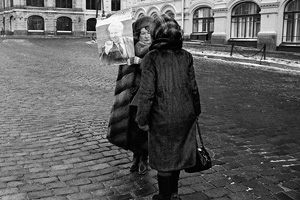
The Dutch photographer and documentary director Leo Erken from 1988 to 2000 filmed the events taking place in the territory of the former Soviet Union.
From the author
“You are an outsider, so you take these photos. We are inside these events and therefore are not able to observe them from the outside. We are too involved in them. ”
Some time ago, Svea Gustavs, a designer and publisher from Amsterdam, born in the GDR and having German citizenship, uttered these magical words, which led to the book Street Street . We sat nearby, opened boxes with my photos and studied my archive, as historians study.
For more than twelve years I have traveled to the countries of Eastern Europe and the former Soviet Union, making reports on various events. I shot on camera, trying to understand what was unfolding before my eyes.
First, I went to Belgrade in 1987 to visit my friend. I was a student of the Academy of Arts, and the big world attracted me. I had a plan to travel around the whole world. At that time, my only experience in communicating with Eastern Europe was a trip to Berlin in 1983, in school years. What could I know then? I just continued my travels and was a witness to the story itself. As soon as the closed boundaries opened before, events and revolutions began to attract curious people like me. I became part of the journalistic and photo community, which, after each trip, made new plans. There was always a reason for this. When working with local translators and “fixers” (patience is a great dignity), a lot of time and effort took place to get to this or that place and get the opportunity to observe people.
Once I heard the wise words of the famous cellist that during the performance should not be felt how much you rehearsed. The most difficult musical passage should sound so easily as if nothing is easier. I always remembered this when I had to shoot in difficult circumstances. My life credo: “Be an observer, ask questions, take the situation as it is, do not interfere, but look, listen and react.”
At this time, the revolution took place in the media. In my profession, digital equipment and the Internet changed everything. The craft of a professional photographer has ceased to be exclusive. Anyone can photograph and publish photos on the Internet. It's great. Photo journalists are always at the forefront. We go ahead. We were among the first to create websites, and, using new means, we distributed our materials around the world. But then there was a catch-when at print publications, things became bad due to the fall in the profit from advertising, budgetary reductions primarily affected photojournalists.
Even in the early 90s, when I published hundreds of photos a year, it was difficult to live on this earnings. Today it is generally impossible. Newspapers and magazines almost do not publish materials that require a long photojournalist observation. Photo journalists, such as me, are in demand in the world of art and are supported by private funds.
I received grants, and this gave me the opportunity to continue working for some time, then I decided to go in other directions. I began to work in non -cheese photo projects, make documentaries and teach at the Academy of Arts.
Everything in the book Street Street is a story, 15 years ago I took the last photos in Russia. For a long time I was thinking about what will be the benefit of such a book. For three years, we presented her sketches at the book fair in Leipzig and tracked the reaction of people. It was there that we realized who will be our readers. This book is for those people about whom it is for those who have experienced these events or their parents and friends. These people have different stories and opinions. And me? I was and remain an outsider, I was watching there.
The electronic version of Leo Erken Street Street is being prepared for the publication
The material was prepared as part of the special project “School of the 90s” , launched by Colta.ru with the support of the educational portal “Your History” and the “Lessons of the nineties”.