
Translated material
Riff Raf
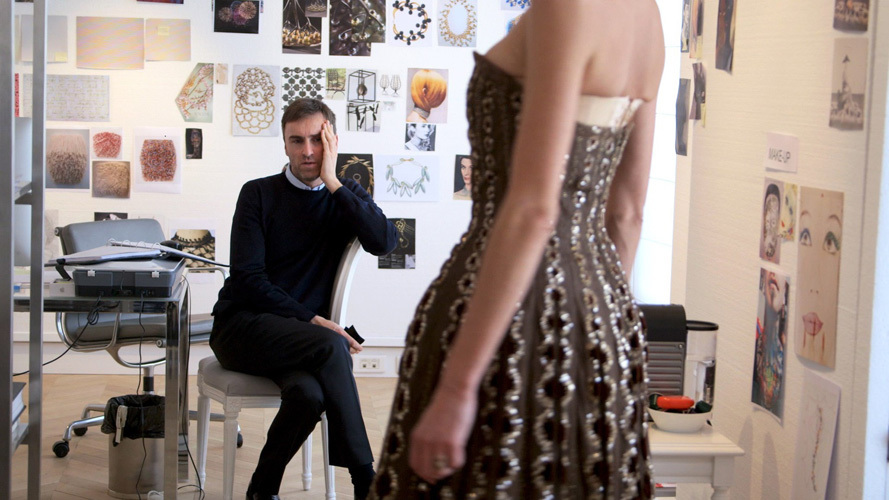
A middle-aged man sits on the roof of the Parisian mansion and, almost crying, mutters something incoherently. The man's name is Raf Simons, after a few minutes his first Haute show in his life should begin Couture for Dior home. Nerves, tears and other snots are not what you expect to see in the film with a deceptively glamorous name “Dior and I”, but this nervous texture is not the only thing that Frederick Chang differs from typical fashion-baires.
Documents about the world of fashion rarely reach people who are specially not interested in fashion. Most often, these films create a personality cult from the industry, especially if this personality is a designer itself. The deceased stars are honored with conditional ZhZL, while it is customary to place contemporaries in circumstances that competently emphasize the advantages of their figure: a spectacular series of filming, shows, interviews and searches for inspiration. The names of such paintings often contain the name of the protagonist: “The Secrets of Lagerfeld”, “In Search of Halston”, “Valentino: The Last Emperor”, “Mark Jacobs and Louis Wütton”, “Diana Vriland: Eyes must travel”. Some are fulfilled not without fiction-as, for example, “The History of a Men” about the British designer of men's costumes Oswalde Boatenge (a film, almost like “adolescence”, shot 12 years) or “age for the style of not a hindrance”, telling about elderly New York fashionistas, stars of the Advanced Blog Style . In general, this genre is rather a television, such films rarely get to cinemas. There are exceptions, for example, “Notes on Clothes and Cities” by Vim Venders, but this is rather an elegic statement about the poetics of Yoji Yamamoto than a strict document.
 © CIM Productions
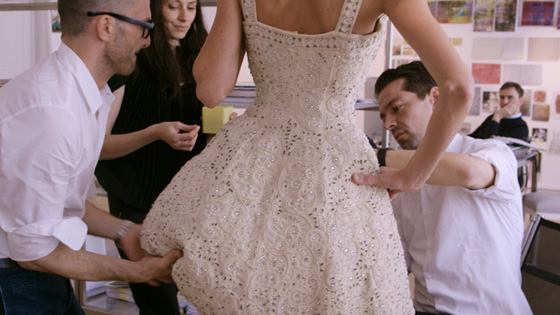
Director Frederick Chang (in the past-the co-author of the mentioned film about the designer of Valentino and the other, about the fashion editor Diana Vriland) in his independent work “Dior and I” shows the complex world of the couture studio Dior . Moreover, he looks at his device not from the side, without losing his mouth from admiration, but is diverse in detail in the multi -stage process of high -fashion production - and, more importantly, gives the word to each of its participants. And this is very exciting - simple tailors rarely rarely become the heroes of the films (if you can, of course, call simple those who have been working more than 40 years in Dior : these aunts have experienced more than one couturier who led them). In addition, not just the production process is shown here - but a chronicle of a kind of debut of the Belgian designer Raf Simons (recall - this is his first collection of Haute Couture ). And everything should not be for 6 months, as is usually accepted, but in 8 weeks.
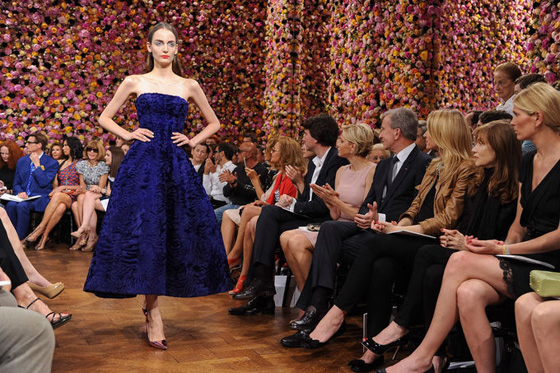
The chronicle of the creation of the collection in places turns into a real production drama: here the designer is introduced to the new team, he studies the archives of Dior, asks to print the paintings of his beloved artist Sterling Ruby on the fabric, chooses fresh flowers that wants to close the “dirty” walls of the Parisian mansion, where the defile will take place. The result is staggering even on the screen: one of the first guests of the show - the chief of the American Vogue Anna Wintourh declares Rafu: “I look, you did not have problems with the budget.” Material issues, usually remaining in the story of fashion behind the scenes, in “Dior and I” arise repeatedly - and the head of the couture studio openly says to the camera: “If a person buys 350 thousand euros from us a year, I cannot refuse him anything, we live with this money.”
 © CIM Productions
The main advantage of Chang’s film is just in this directness. It cleans the fashionable industry of glossy shine and removes the retouching from faces, materials, interiors - and communicative processes. He brings to the forefront of the difficulty of translation, rhetorical gaps (and any boss A large house should be good, on a team of fifty people, a speaker) and pauses of misunderstanding in dialogs.
Perhaps even stronger than he himself would like, the main character of the film - Raf Simons is revealed. By the time the Belgian arrived in Dior , there was already a solid reputation and the label of a narrow specialist of the same style. Former furniture designer, he took up fashion in the mid-90s, for a long time only dressed men and was popular mainly among lovers of expensive StreetWear 'a. After 10 years, Simons headed the prestigious brand JIL Sander , where, in essence, he came up with minimalism. In 2012, after the shameful scandal and subsequent dismissal of John Galliano, Raf was invited to do Dior (it is interesting that, despite many years of experience with men's clothing, only a women's line).
 © CIM Productions
Not everyone likes his new vision of “women from Dior ”. Fashion critics are divided into those who honor it as a seer who creates new standards of femininity, and those who believe that the last three years Dior are a chronicle of the depression of an artist who is strangled by a non -stop race for increasing sales. Frederick Cheng with the conclusions about Simons is in no hurry, instead, performing the operation even more stringent - but also effective. He literally rhymes Rafa with Dior, breaking the shooting of work on the collection of chronic shots voiced by the orders of the diaries of Dior himself. Of course, the myth of the Belgian minimalist, of course, can’t stand clashes with the myth of one of the main fashion revolutionaries: the worked out image cracks at the seams, the mask slides, finding an ordinary person under him. Is he to the dior (the similar vulnerability of which gradually begins to be traced in naive diary records)? Yes, to the same extent as each of us is notorious, exhausted by the eternal “no matter what happens” a person.