
Translated material
Our main screening
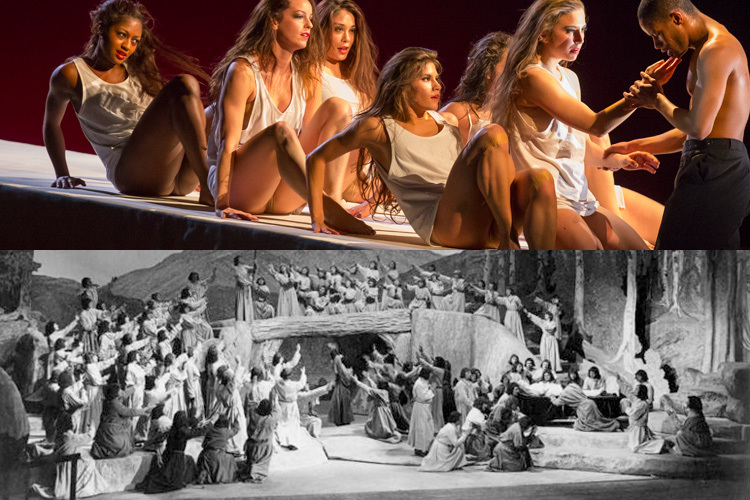
Do you love classics the way the Russians love it? You, singing Italians and ironic British! You, insightful Gall, and you, gloomy German! Are you able to understand all the immense breadth and the whole depth of this love. When I suffered them, the future of Russia suddenly flashed before my eyes. I personally saw her new lands - the blooming Crimean, blazing the lights in Donbabwe and Luganda. I heard the heady smells of the "Russian spring." I seemed to have visited the rallies of Anti-Maidan and on the processes over the directors.
Where is the anti -Maidan, and where is the love of classic ballets, realistic theatrical productions and costume operas? Where is the intelligentsian defense of the poet Pushkin from his interpreter Pupkin, and where is the trial against Tangayzer in Novosibirsk? They are nearby.
Passionate, selfless, hysterical love for classics is not a love for a beautiful in Russia. This is a love for something frozen, safe and cementing the whole society-from kindergarten to creative universities and from laundry to the Ministry of Culture.
What is the laundry! Even such a powerful institution as the Russian Orthodox Church arose to protect the classics. Take, for example, the chairman of her synodal information department of Vladimir Legoyd, who categorically did not approve the performance of Timofei Kulyabin “Tangaizer”, which, according to the good old tradition, he did not see, but about which one grandmother sung. The opinion of Legoyda can actually be considered the official point of view of the Russian Orthodox Church, and if her hierarchs were excited exclusively in the production of religious symbols (of course, imaginary scolding, but not about that), my indignant mind could still accommodate this. But Mr. Legoada is indignant about the "artistic aspects of" Tangiar ". “ Experts who have already met this work noted that the play itself is an insult to Wagner. Everything is distorted and the classic has only a distant relationship. (...) The church is sometimes accused of struggling with art. The church does not fight art, but tries to protect it. Today we are in a situation where we need to protect the classics, including Wagner , ”the chairman of the Synodal Information Department told the public.
The evidence of the accusation of the process against the Tangazer, the culturologist (!) Maria Nikolaevna Busik-Trophimuk, echoes Legoyde with impressive ardor and even more impressive grammatical mistakes: “ If Wagner were alive and if his successors were or were known, he would be an international scandal. Yes, and Kulyabin would not dare to “swing”, so to speak, on our Richard Wagner! Just not Camelfo! ".
Imagine a Catholic conservative, which defended Bokkaccio, a Protestant fanatic who writes a lawsuit in court regarding the incorrect interpretation of Schiller. Not only for any normal country, for any church is nonsense. For us, this is almost the norm.
And if the process over the Tangaiser is indeed a clerical attack on secular values, then I will call you an entire army of such “clericals”, infinitely far from any denomination. The churchmen were still humble, the National Socialists were still marginal, the law on insulting the feelings of believers has not yet been adopted, and bloody battles were already going on for the classics. Taxi drivers, musicologists and numerous teachers of numerous creative universities were already ready to redeem the director who, in the conditional theater, B. somehow put the operator of composer G., and in parallel with the case of Tangayzer, activists wrote a letter to Putin with the demand to immediately prohibit the Opera of Leo Dodin: she also does not correspond to something there!
What is happening in Russia can be called a total conservative revolution, which happened in parallel in the most different segments of society.
This sacralization of art forms and the transformation of classics into icons, which must be prayed according to strictly established rules, with all the desire, cannot be placed in the usual scheme of the secular state VS. Religious obscurants. There is a symptom of some other disease that you will not immediately find the name.
What, in fact, is a strange society in which nostalgia for the Soviet past is adjacent to the strengthening of the role of the Orthodox Church, the Orthodox Church stands to defend the German composer not noticed in the Orthodoxy of the Orthodoxy, and yesterday's Wahhabits are the main soldiers of the Russian jihad?
Its ideology only seems whole and monolithic. In fact, there is no ideology. Neither religion, nor the ideals of socialism, neither intelligible nationalism, nor even imperial idea can apply to it. But the overall vector of movement is still obvious.
What is happening in Russia can be called a total conservative revolution, which happened in parallel in the most different segments of society. Its manifestations seem to be sometimes mutually exclusive, but this is always the victory of the conservative trend over the modernization. He defeats inside the Church itself (after all, there is also his liberal wing and his renovationists), he moved to a fierce offensive in the field of culture, he obviously prevailed inside the power structures: any modern, smart and detecting modernization of a person, that is, anyone who wants to work Sergey Kapkov will sooner or later squeezed out, departed, sent to his own. Desire. Sometimes the guards mistakenly run into someone else's department (from the church to the theater, for example), and with satisfaction finds that there are a dime there without them.
On each specific sector of the front, the battle can still be won: the Tannhaiser was defended! But in general, the outcome of the war - and what is happening can be called a civil war, just still do not shoot on the streets, although sometimes they are shot - I'm afraid, has already been decided. The society in the early 90s made a sharp modernization jerk, and now everyone who did not fit into its steep and sometimes dangerous turns, now they take revenge under different slogans and pretexts.
Russia is unlikely to turn into a clerical power, it is unlikely that the ideology of Nazism can finally triumph in it, and it is already difficult to return it to a socialist past, to put it mildly. What will happen? But then it will be - sticky, viscous mess from retrograde ideas of a variety of shades and stripes. The gradual, but steady transformation of the country into a conservative province. The creeping revolution of grayness, sometimes not having a clear ideology, but almost always having general aesthetic preferences. It is with their help that it is easiest to express a common, spilled in the air, a request for conservative (eternal) values.
You can resent about Lenin, to despise Nicholas II, not to read Jesus Christ the son of God, but Pushkin, Pushkin with Tchaikovsky, Gogol and Lev Nikolayevich Tolstoy, cannot but worship. We, cordial, will not give them to the reproach for modern interpreters. Not only monarchists, Stalinists, Orthodox and homegrown culturalists will agree with this. Then the liberals will pull up. “ Wagner, like a completely brutal German, if I met this director, I would have killed him, I am responsible for my words!” This, having previously scolded Vladimir Putin, said about the Kulyabin on Echo of Moscow, a furious wrestler with the bloody regime Mikhail Weller. Legoyda with Trofimuk bead nervously praying aside.
It is not surprising that aesthetic battles have long been in Russia outside the aesthetic sphere, and the classic has become a pillar and the statement of the current regime. Hysterical love for her is almost always love not for, but against Tchaikovsky against Chernyakov, to Gogol against Serebrennikov. The boundaries of love are shifted, but aggression remains unchanged. At first they loved Chekhov against the nyakroshus, then the Nyakroshus himself against any new directing. From this, in essence, one step to love for the homeland against the rest of the world.
That is why aesthetic preferences for me personally have long become a litmus piece of paper. Correct political views do not save from aesthetic savagery, but interest in modern art is almost always a guarantee that a person wants to see the world changing. Anyone who understands, or at least seeks to understand the modern theater (or music - no matter) cannot be hatred for classics. He simply searches in a textbook work of a pre -person of today's problems. And if they ask me what the specific social benefits of contemporary art, I will answer simply: it helps society to learn to live in the present, and not in a well -defined and ossified past.