
Translated material
Carbar worm
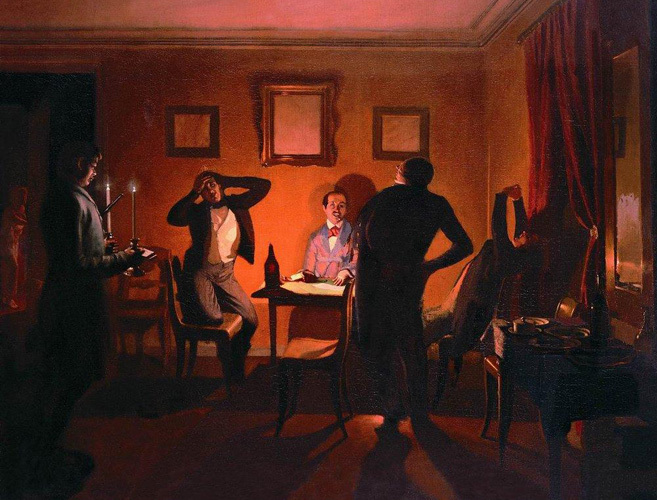
The Tretyakov Gallery hosts the anniversary exhibition of Pavel Fedotov (1815-1852) . Our regular authors of Alexander Novozhenov and Gleb Napenko talk about the artist.
The logic of nonsense
Within a few days of his active insanity, before being captured and placed in the millstone of the psychiatric system of Nikolaev Russia of the 1850s , Pavel Fedotov managed to commit several actions that convinced everyone of his undoubted madness. Forced to usually calculate every penny and more than anything, afraid of debts in the world, he, in the words of his acquaintances who saw him in different parts of St. Petersburg, suddenly began to “litter with money”. Throughout his life he did not decide on marriage, he made two proposals to the girls from familiar families within one day (both were accepted). Then he went to the tomb to remove the measurement and order his coffin. And already being in the hospital, he, according to the testimonies of his friends, began to rave to turn the Vasilyevsky Island into new Athens, the ideal world of art, furnished with statues and marble palaces.
In the cascade of outputs, which in the presentation of contemporaries sound absurd like Gogol's “notes of a madman”, stresses were resolved, which determined the entire former, “normal” life of Fedotov. The system of these stresses is set for the history of Russian art for the artist of the modernist type - a place on the border, which used to abruptly separated art from life, on the edge of academic norms. Immersed in everyday reality, the artist is simultaneously forced to distance himself from her with all his might - to be a “real artist”. The new type of cultural professional, the existence of which is not guaranteed by an aristocratic rent, the support of the Academy, the protection of the king and the great princes, or the arbitrariness of the serf, but almost entirely depends on the success of the bourgeois buyer.
Fantasizing about turning the Vasilyevsky Island with its zucchini, merchant houses, barracks and street, who served as material for his art, into a parody reserve of classicism, as if leaving the hills of the academy, whose building reigned on the front embankment of the island, as if Fedotov was repented in love for “low household”, making A delusional jerk back, in the bosom of art, that is, in the bosom of the Academy - which he never belonged and which was not a product of which was not. His life on the Vasilyevsky Island, which first passed in the barracks, and then in the rented rooms on the far lines, did not go inside the academy, but rather spun on its backyards and around it - like buildings and as institutions. The democratic conditions for the admission of freedoms allowed him to attend field classes in parallel with the military service. His idol and patron at this very academy was not anyone, but Karl Bryullov, who blessed Fedotova-lodant to abandon the military service and become a professional, but precisely because Fedotov’s gaze, according to Bryullov, was deprived of academic shorts. And his main public success happened precisely at the Academic Exhibition of 1849: it became almost the most visited by the academic exposition for the first half of the 19th century, but precisely because the “matchmaking of the Major”, “Fresh Cavalier” and “The Voining Bride” differed sharply from the emasculated academic context. It is not surprising that biographers do not comment on the fantasy of academic Eden on Vasilievsky, bringing as a fact of madness, not fit into the logic of the artist’s development.
Immersed in everyday reality, the artist is simultaneously forced to distance himself from her with all his might - to be a “real artist”.
The nonsense about the classic oasis acquires the meaning in contrast to the insane determination of marrying, waking up in Fedotov in the days of insanity. He did not have a state and who had reached professional recognition late, he had to drive the thoughts of marriage all his life, remaining, in his own words, "a lonely on the end of my days." A easily recognizable modernist position of the flaer - an observer of lives gliding past him - as in the drawing “Vasilyevsky Embankment in the winter”, on which from left to right and right to the left, that is, “in front of the eyes”, but “past the eyes”, go, are driving, driving, dragging. Two hand offers made simultaneously (not so insane, if we consider the second spare option in case of refusal) lead in the direction opposite from art with its statues and palaces - to everyday life.
Finally, ordering a coffin to himself, Fedotov leaves for himself the third opportunity, on the other side of the choice “art or life”, through attraction to death, finally taking off all the insoluble elections, of which the existence of a person of his time and his occupations. “Wormy Camor” is a cozy Fedot euphemism for death as a shelter from insoluble contradictions.
Or/or
To resign and devote yourself to the art completely, to remain in the regiment and engage in art in their free time, to marry and come to terms with family cares and poverty or remain free, but lonely (“an artist who married his talent”; “The first morning of a deceived young”; “And now brides here, brides!”; Finally, to exhibit or not to exhibit (“No, they won’t understand!”). And if you stay in the service and get married? Then - as if as a punishment for fulfilling desires - you will have to die, leaving a pregnant wife (“widow”!) And a mustachioed portrait on a chest of drawers. They often write that the picture is inspired by the fate of the widowed sister of Fedotov, who was left without a livelihood. But in the portrait on the chest of drawers it is easy to recognize the artist himself. He, as always, is ironic over himself, but also triumphs, avoiding the fate of his alter ego - who made the wrong choice of the officer.
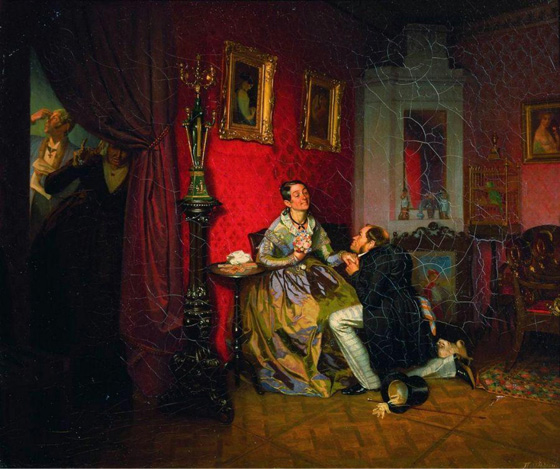 Pavel Fedotov. The pushing bride. 1847
What is usually interpreted as a social satire on public morals is reduced to sorting out a limited set of options, continuously scrolling in the artist himself, in his paintings, pencil sketches, and sipias. Fedotov endlessly draws in albums, now and then including dialogues as a character: drawing, as is characteristic of this medium, works just as fundamentally rehearsal technology, the survivation of personal obsession.
A closed space of options always exists under the sign of death, which is equal to the predetermination of all infinitely calculated capabilities. The same in the card game - she, whether in the barracks or in civilian rooms, in Fedotov iconography goes continuous leitmotif: the cards have already been handed over, it remains to be considered trump cards and think that others have in their hands, talking about “chastity” or, otherwise, “about women” - two names for the sexual issue of Fedotov’s youthful diary.
In the claustrophobic space, in which the artist along with his characters is locked, the end of romanticism is visible with his irrational fragmentation of the world, the openness of the subject of the unlikely and boundless ocean of opportunities, a spacious distance between the audience/author and the exalted. Romanticism arose from the Great French Revolution, which has still opened unthinkable social and historical prospects, but arose precisely as the result of its failure and the subsequent political reaction: the newly open was taken beyond the scope of the cash public, and the limitlessness of being could only live in the “natural”, mystical, exotic or crazy - in any case related to the foreign world. So it was Caspar David Friedrich or Russian romantic Varnek with their canonically romantic paintings and self-portraits against the backdrop of these windows. The romantic artist, excluded from the academic and court social institutions, first realized the shatterity of his position in society, but was concerned not so much by him as his correlation with the other world of the world of freedom, which was placed in the promising portal of the window.
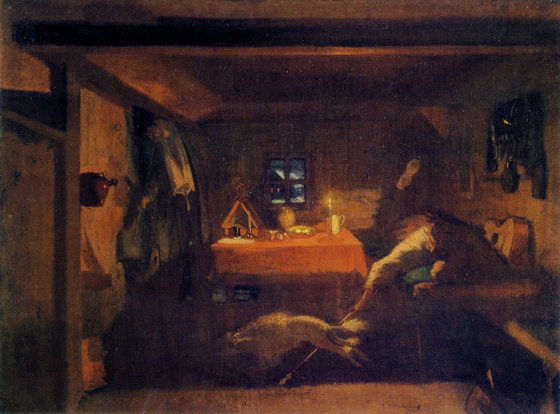 Pavel Fedotov. Anchor, still anchor. 1852
Fedotov’s nowhere, except in one of the latter, while his most claustrophic paintings - “Ancor, still anchor”, there are no windows in the interior. In this only window, it is not a field and not the sky, but the hut, on the contrary, is exactly the same as the one in which the officer, exhausted by longing, makes his poodle jump over and over again. Realism in Russian painting begins precisely in the “rooms” of the philistines, poor noblemen, merchants and barracks Fedotov, where the artist, along with his heroes, will be locked inside the limited set of social capabilities provided by the mean Nikolaev time. The prospect as a view of the window, like freedom of look and as an exalted relationship of a substitute with art, is lost. The canvases of the contemporary of Fedotov, the founder of French realism, Gustav Kurba, in which he in a similar way depicting his meetings with his own characters, critics accused the imperfection of the prospect.
Fedot realism explores the strict determination of options accessible to people in reality. Social options (to resign / serve, marry / remain free, follow the vocation / equip life), but also bodily - in the sense in which the position of the human body, which is on the street, is determined by the temperature of the air (a sheet of sketches “chilled and chilled”), and in the room - there are not many options - you can stand, sit or lie “like people” as people Sit and sit (in front of the elders) ”). In a sheet with a servant chairs, accompanied by the signature “I ask you to sit”, it is shown how social restrictions coincide with bodily. And in the “players” and in preparatory drawings to them, Fedotov explores the moment of leaving the card game, when the participants leave their places on the chairs around the table, at which they sat for many hours, and stretching out new positions - leaving one social ritual and preparing to move to another.
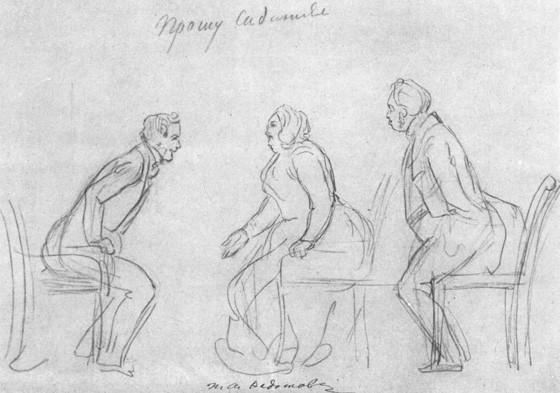 Pavel Fedotov. I ask you to sit down (how people sit down (before the elders)). 1846
Fedotov’s compositional laws of academic painting are not read as internal laws immanent art, for example, the rules of beauty, but as a way to talk about the laws of reality that determine the life of the artist and his work. Fedotov jokes over the romantic idea of the artistic genius in the series “Birth of a genius”, where a baby, whose birth is overshadowed by a new Bethlehem star, is immediately abandoned into the stuffy life of the parental house, where the survivors and doctors scurry. So in delirium, before he was seized and handed over to the hospital, Fedotov assured that he was Christ: another, final, identification with God, who, until his death, was doomed to exist in the ordinary of the world.
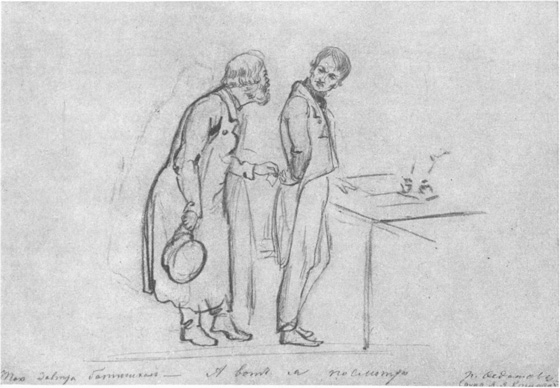 Pavel Fedotov. Bribe taker
The predetermination of socio-motor variants and their study became the subject of art precisely at the time of class mixing of the late 1830s - early 1850s . Opala of the nobility after the Decembrists uprising, the impoverishment of one part of it, the oburiors of the other, the submission of the privileged classes of the bureaucratic apparatus led to the fact that the estate division was more and more blurred, superimposed at this moment a new class division. A mixture of estates and the birth of the bourgeoisie as a fundamental element of our time ( Modernity ) is described by Timothy Clark in his book “Manet. Artist of modern life. " The trajectory of Fedotov, a military man, a military son, who received the opportunity to visit as a volunteer, democratic drawing classes of the academy, along with aristocratic sons and pupils, takes place inside this historical framework. The torment of the choice of which the professional who had now fell from estate and academic guarantees was doomed to something fundamentally new to the former non-alternative slavery of the fortified artist, whom the owner sent to the academy for teaching, and to the free funny of an aristocrat lover, and to the fate of a successful agricultural and retirement, was doomed Already in advance was bought by the imperial art support system. And the question of marriage, as he appears in the iconography of Fedotov, was the same new issue as the new professionalism: he could not afford to choose whether to get married or not, the wayward aristocrat of the Catherine -sample could afford not to suffer from marriage dilemmas, living without regard to morality and law. Marriage as a social choice and as a topic for public commenting appears at the moment when a bourgeois context appears: that is, when the officer ceases to disdain marriage to the merchant daughter for the amendment of affairs (“Major’s matchmaking”) and when society can publicly discuss this plot at the exhibition at the academy, the new situation still remains ethically controversial, but is already becoming socially acceptable.
Objects of property
The world of Fedotov characters is a world of intersecting interests that are realized in objects. One character is no longer just a type, but a whole plot, if he has something that he possesses (“a young man with a sandwich”). If there are two characters on the sheet, then they already have something to share. Each picture or sketch of Fedotov is arranged as a dense coupling of interests, a peak moment in the relationship “subject - object - another subject”. This is either a fight for an object, or the moment of possession, loss, seizure, but never a descriptive image of the intermediate phases of existence of characters and their states, as it happens in later genres, for example, at Perov, Yaroshenko or Makovsky. The whole structure of Relations in Fedotov is articulated in the depicted event, and the space in which the event unfolds is not just an atmosphere or environment, but rather a drawing where each element of relations between characters and objects is rationally articulated. The fact that the couplings between the subjects through the object make up an independent plot in addition to the moralizing and social characteristics of the characters, meets the fundamental structure of bourgeois relations, where ideally no personal characteristics is an inalienable and everything becomes the subject of exchange. The Order of St. Stanislav, a sign of service to the Fatherland, in theory, outside the logic of the exchange of property, is compared with a holey boot in a “fresh cavalier” - and with the stomach of a pregnant cook. Part of the body, property and the subject of symbolic pride become equal members of one equation (in which what is hidden in the stomach of the cook is a well -known unknown). For example, female attractiveness - also ceases to be just a paint that characterizes the type, but becomes a separated object of exchange: in the figure “poor girl of beauty - mortal braid” the beauty of the young seam, seduced by the pod, is alienated in the naked mannequin lying near it, and in “the first in the first in deceived young” it turns out that parts of the body (teeth, hair) can be taken over the same time, the same way. Like furniture.
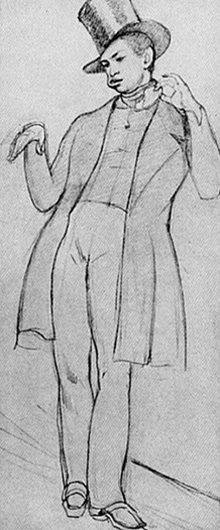 Pavel Fedotov. A young man with a sandwich. 1849
The bourgeois logic helps to fragment the body, forcing Fedotov in a new way to rethink the academic casts of hands and noses, designed to gather in an ideal image, but suddenly acquiring an independent meaning, turning into fetishes-commodity, sexual, artistic, as in the Belvederers ("drunkenness of academicians"), where the place of antique casts occupies a half-pusher. Here inevitably there are analogies with the metonymic objects of Gogol, his noses and overcoats that inhabit Petersburg and act instead of living people. These Gogol’s things are baits for desire, as in Nevsky Prospekt, where the hero in the crowd, in which the mustache and dresses crowded, is romantically fascinated by a girl who is a prostitute. So Fedotov’s things are invested by desire, almost as partial objects of the body: extreme examples of this - pregnancy in the “widow” and “fresh cavalier”, a piece of bread in “Breakfast of the aristocrat” and “a young man with a sandwich”. Fedotov’s attribute, becoming from a simple characteristic of the character with what he passionately seeks to possess, or what he painfully loses, ceases to be just an attribute. Throwing things thrown to the floor are not just a rocky aristocratic mess, but most often former objects of appropriation or struggle: a wrapper from a card deck, a bottle, a sheet with the inscription "oysters" - the scum of the faded and switched interest. The reason for this exaggerated desire for things is that the existence of a person in the Fedot world is not guaranteed by anything but these things themselves. Ultimately, you can lose everything, for example, having lost in cards, as in "players". And if a romantic or aristocratic hero had something else to rely on, then Fedotov’s heroes are doomed to eternal vanity in finding their place in life.
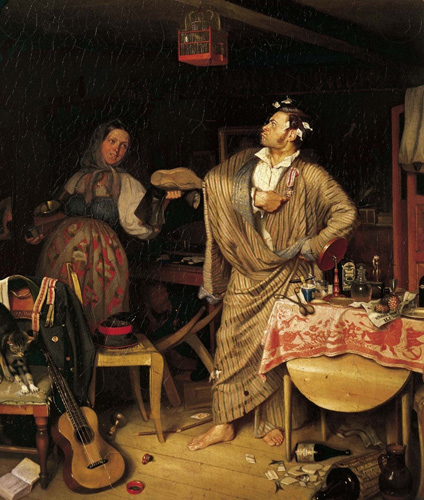 Pavel Fedotov. Fresh gentleman. 1846
The cycle of objects for which a continuous fraudulent struggle is being conducted arises in a situation where nothing belongs to anyone rightfully. Первая, батальная, фаза творчества Федотова связана с казарменным миром, которому он очевидно симпатизирует. Биваки, переходы егерями реки вброд, коммунальный быт полка — по выражению одного из исследователей, это мир, который делится на два уровня отношений: «товарищества» и «начальства». Это мир, также наполненный объектами (вспомнить хотя бы взлетающие вверх шапки во «Встрече в лагере лейб-гвардии Финляндского полка великого князя Михаила Павловича 8 июля 1837 года»), но объектами казенными, за которые не ведется конкуренция, — и кирасы всего полка стоят стройным рядом на одной полке. Каждый обладает одинаковым набором вещей, делить однополчанам между собой нечего, а товарищество возникает на нижнем этаже военной субординации, когда закон, регулирующий все аспекты жизни, привычен и потому как бы стерт, а полковая жизнь, хотя и однообразная и омрачаемая по временам начальством, сохраняет в себе очарование товарищества равных и праздной беззаботности, оборотная сторона которой — скука. Одновременно казарма — институция, перенимающая в условиях нового общественного устройства логику старой феодальной модели, структурированной не через отношения обмена, а через отношения силы, впрочем, остающейся у Федотова в состоянии всегда потенциальном: батальных сцен он никогда не писал, его сюжеты — мирный солдатский быт на биваках, учебные маневры и торжественные встречи с великими князьями либо церемонии вроде освящения знамен. Становясь профессиональным художником и лишаясь военного заработка и казенного жилища, Федотов выходит в мир обмена, где такого регулирующего и уравнивающего закона уже нет, как нет и понятного способа устройства своего существования. Здесь все хитрят, чтобы получить то, что им не принадлежит. Передел состояний, имуществ, репутаций, решение финансовых затруднений через брак: все герои Федотова постоянно попадают в ситуацию выбора вследствие неопределенности своего положения.
Место концентрации всех дележей собственности и пересечений интересов — «Магазин». Тут покупатели обманывают продавцов, а продавцы — покупателей, «полубарыня» тащит отрез ткани в саквояж, молодая жена выпрашивает деньги у старого богатого мужа, ребенок клянчит игрушки у матери, которая тем временем сует записку молодому офицеру, — это хоровод претензий и хитростей, обязательным звеном которых служат желанные объекты. Герои не смотрят в глаза друг другу, все взгляды направлены на вещи — это замкнутая система, в которой просто не остается места окну с пейзажем для отвлеченного романтического смотрения вдаль. В дневнике Федотова имеется запись о том, как он стащил в канцелярском магазине несколько стальных перьев — в чем ничуть не раскаивался, пеняя на то, что продавец намеренно задрал цены.
Такова функция объекта у Федотова: вещь работает замковым камнем в конструкции.
Само искусство становится объектом обмена — реалистический жанр возникает именно как кабинетная картина, которая существует не для украшения гостиной, а для пробуждения ума: новый типаж, современный покупатель, интересующийся техническими, научными новинками и активно участвующий в общественном обсуждении, вешает ее у себя в кабинете над столом. Этой задаче отвечает формат картин Федотова, которые вписаны одновременно в два регистра циркуляции — денежный и вербальный. Помимо индивидуального потребления (живописная картина Федотова — это всегда великолепно отделанная драгоценность) они работали как триггер для провокации дискуссий, будь то на академической выставке или в салонах московских интеллектуалов. Запускаемый ими обмен мнениями связан именно с той сцепкой интересов, где обнаруживают себя персонажи: мало описывать нравы или типажи, нужно сделать так, чтобы двусмысленность запутанного положения открывалась зрителю постепенно, по мере разглядывания и комментирования. При этом литературные комментарии самого Федотова, которыми он снабжал свои картины (и даже опубликовал эти тексты в «Москвитянине» ), отличаются куда большей дидактичностью, чем сами его холсты. Желание быть понятым одним конкретным способом определяет метод его работы и формальные особенности его жанров. Дотошное стремление достичь конкретного светового эффекта, конкретной фактуры («ничего не буду делать, пока не научусь писать красное дерево» — это о «Вдовушке») не было простым перфекционизмом трудолюбия. Известно, что Федотов мог месяцами дорабатывать свои вещи, но общая диспозиция акторов — неодушевленных вещей и персонажей — оставалась в том виде, в каком она была схвачена на раннем этапе, которому часто предшествовало текстовое описание будущей картины. Каждая вещь-деталь незаменима изначально — это показывает известный анекдот с цензором Мусиным-Пушкиным, который требовал убрать орден с халата кавалера, указывая на недопустимость профанации государственной награды. Но убрать орден означало полностью разрушить смысл картины: точно так же нельзя убрать горб у жениха в «Разборчивой невесте», живот у вдовушки, кусок хлеба у аристократа — такова функция объекта у Федотова: вещь работает замковым камнем в конструкции. Вся дальнейшая обработка картин относилась исключительно к резкости зрения. Федотов не мог допустить нечеткости образа, поскольку стремился к абсолютной однозначности той роли, которую вещь играет в ситуации. По сути, каждому предмету назначена цена, будь то люстра в доме купца, штофные обои в «Разборчивой невесте» или комод красного дерева и опечатанная бронза во «Вдовушке». Универсальность атрибута цены позволяет вещам и героям участвовать в объединяющей их замкнутой цепи обменов, где нет места независимому от этой замкнутости измерению.
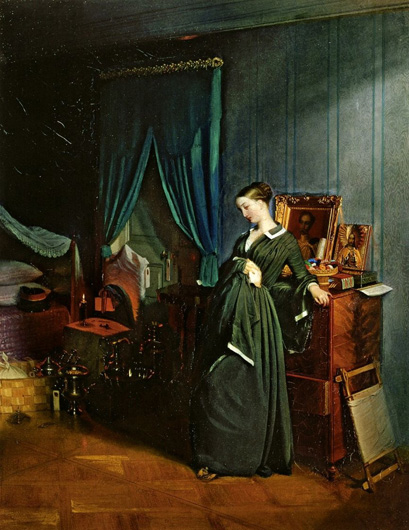 Павел Федотов. Вдовушка. 1851-1852
Но помимо вещей, имеющих цену, встречается еще один класс сюжетообразующих объектов: они, в силу своих свойств, либо еще не вошли в круг обмена, либо уже выпали из него, но их присутствие структурирует всю ситуацию (как раньше — окно в романтической картине). Объекты, выпавшие из обмена, часто выставлены на середину сцены, как мертвый младенец в «Художнике, женившемся в надежде на свой талант» или труп собачки Фидельки, но могут присутствовать и почти незаметно, как портрет умершего офицера во «Вдовушке». Объекты же, пока не вошедшие в оборот, присутствуют как скрытые. Такой объект, по контрасту с поблескивающей поверхностью опечатанной бронзы, которую скоро заберут кредиторы, прячется внутри стыдливо задрапированного живота вдовушки и также — внутри живота кухарки в «Свежем кавалере». Кавалер выставляет напоказ Станислава, она же тычет в дыру на сапоге, подразумевая при этом больше несуществующую пустоту внутри своего тела, и одновременно «под столом заднего плана виден пробуждающийся, вероятно, оставшийся на поле битвы тоже кавалер…Талия кухарки не дает права хозяину иметь гостей лучшего тона». Хвастуну удалось получить кое-что, но кухарка получила кое-что похитрее. Мертвецы и еще не родившиеся младенцы — телесные объекты, возникшие не по расчету: они становятся рискованной помехой в рациональной бесперебойности сделки и обмена.
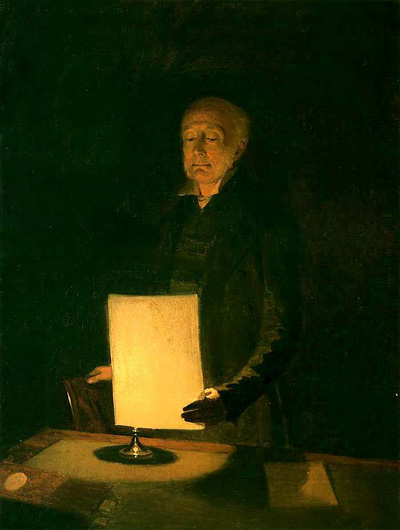 Павел Федотов. Портрет Егора Гавриловича Флуга. 1848
Освободиться от объектов окончательно — как это происходит в «Игроках», где центральный персонаж показывает пустые ладони, — означает выйти из игры, но также выйти за пределы человеческого мира интересов. Наброски к «Игрокам», которые выглядят как самостоятельная графическая серия, напоминают мир призраков, где отражения путаются с тенями, а над головами играющих зияют пустые рамы. Сходным образом устроен портрет Флуга, выполненный по посмертной зарисовке его лица: старик держит пустой лист бумаги, подсвеченный с тыльной стороны свечой. Сюжет обнуляется, и воображаемый мир картины пропускает в себя пустоту поверхности реального холста. Этот пустой холст — словно единственная подоснова реальности Федотова, из которой вычли все объекты, — обнаруживает в пустых рамах «Игроков» невозможность иного измерения по ту сторону игры и обмена. «Игроки» — одна из немногих картин, которая держится не на отношениях с объектами, а на системе взглядов. В мире Федотова поднять взгляд на того, кто напротив, можно только тогда, когда ничего больше не осталось в руках.
* * *
Об «Игроках» — как и о фантасмагориях Гоголя — часто говорят как о предвосхищении модернизма. Но логикой модернизма отмечено все федотовское творчество: и его профессиональный статус, и позиция медиатора между территориями искусства и жизни, и, наконец, возникновение общей универсалии обмениваемых друг на друга объектов-означающих: объектов частичных и метонимических, товаров, знаков и денег, слов и образов. Холст становится в конечном счете пространством письма, то есть игры этими объектами, а не окном в иной мир. И стремление прорваться по ту сторону этого письма возможно только через фигуры умолчания: беременные животы (указание на пространство перед рождением), портреты мертвецов (указание на пространство после жизни) или, наконец, ничего не значащую пустую и плоскую основу картины, картины-товара и картины — грифельной доски для записей и зарисовок: одна такая всегда стояла в комнате Федотова.