
Translated material
"The olship is a powerful and pressing thing"
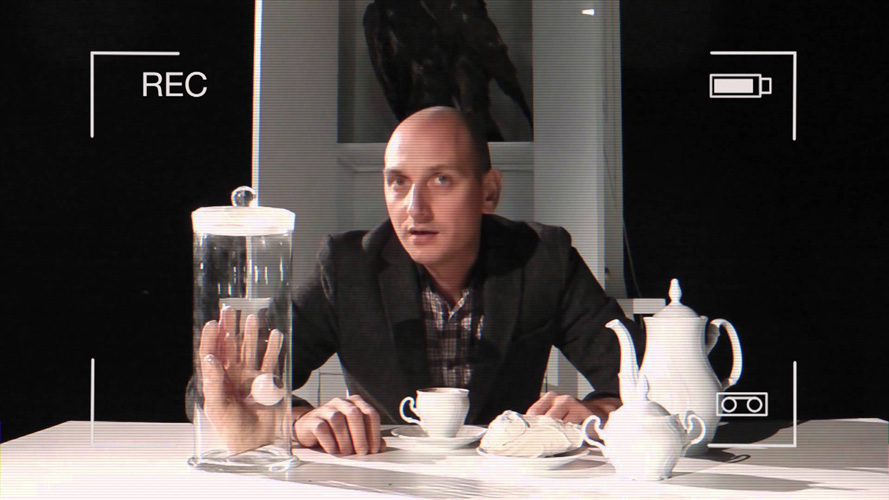
The metropolitan theater of nations continues the season of Russian classics by the premiere of Gogol's “Marriage” with Ksenia Sobchak as a matchmaker Fekla Ivanovna. Dmitry Renansky talked with the director and artist of the performance by Philip Grigoryan.
- “Marriage” was your idea or the proposal of the Theater of Nations?
- We were negotiating about the staging of a new performance, and all the names that I proposed did not fit for one reason or another. Since the current season takes place in the theater of nations under the auspices of Russian classics, I began to think about Ostrovsky, with whom I had long wanted to work. I do not want to repeat common places about the “Russian Shakespeare”, but this is really an outstanding drama, the ideal material for the big stage.
- And what about the beards? How to work today with this Zamoskvoretsky discourse?
- In this sense, I had no special problems with Ostrovsky. But just with “marriage” not everything is so clear. A couple of years ago, I was already preparing for the production of this play - at the suggestion of Eduard Boyakov. The main question that tormented us with the playwright Denis Retrov, with whom we worked on “marriage”, directly touched the beard. What to do with the plot -forming opposition of merchants and nobles? We did not find the answer to this question at that time: the hand was flinching to rewrite Gogol, and the actualization mechanism was never felt. I had to refuse the production. A certain amount of time has passed since then-and when the Hudor of the Theater of Nations, Yevgeny Mironov, suggested that I put it precisely “marriage”, I already had something like a solution.
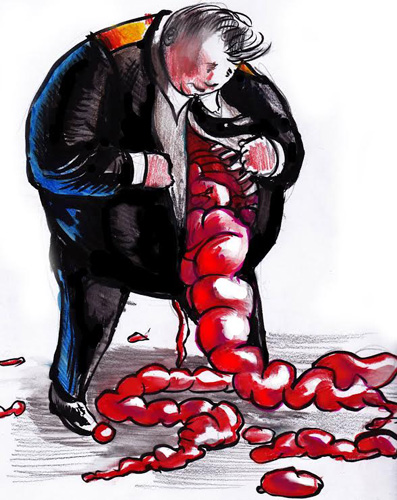 © from the personal archive of Philip Grigoryan sketches for the play "Marriage"
-A few years ago, you already experimented with the actualization of Russian classics, releasing “Woe from Wit” in the Perm Theater-Theater ...
- Yes, but the dramaturgy of Griboedov perfectly falls on the realities of today - literally every phrase “grief from the mind” can be done directly about the life around us. Gogol cannot be discovered with such a key: he is not a realist. He speaks of large, deep human problems, but at the same time brings everything to shameful little things and brings this contradiction to the caricature, to the grotesque. "Marriage" generally looks like the forerunner of the absurd drama. Gogol seems to be masked by the play under the vaudeville, but constantly works with existential problems. Supproe is such a comic version of Hamlet. Only, unlike the Shakespearean hero, Podpolesin does not have a lexical apparatus that would help to somehow verbalize the problem. And where Hamlet decides the issue “to be or not to be”, subclesin simply mumbles.
We did not “go to the marriage” “marriage”, but took her towards the animation.
- The latest stage story of Gogol’s play can be determined, in fact, by the competition of two traditions: the first inherits the Efros call “to the error” , the second interprets the Gogol text exclusively as convenient material for the self -propelled “Chesa” - in recent years, however, it has become extremely fashionable to combine these seemingly multidirectional vectors. What is your "marriage"?
- Well, if we take into account that we did not try to “be mistaken”, then, apparently, it turned out just the self -propelled “scatter” - in the end, we had a fantastic composition of the actors for this. Our solution requires an ensemble game, but at the same time we need to exist in some extreme degree of caricature. Yaichnitsa executor (Oleg Komarov) - double of Vladimir Harkonen from Dune Frank Herbert: mannered security official, patrician, sadist. The retired Captain Anuchkin (Anton Eskin), who dreams that the bride knew French, is a military corpse rolled into a zinc coffin, a romantic corpse obsessed with a high idea: there is something from Platonovsky Kopenkin from the Chevengur, which dedicated all his victories to the Luxembourg Rose. Gogol Zhevakin, if you remember, tries to marry for the seventeenth time - and in his old age finally understands why a person needs a family, but he realizes it too late: actor Sergei Pinegin brought him either a divers or an astronaut - both in an allegorical and in a completely literal sense of the word. On the one hand, a slightly “flying” man, on the other, is a tragic hero of the Soviet cosmos, a futuristic project that remained in the distant past ... The exit turned out to be such a hellish commedia dell ' arte - we did not “marriage” “marriage”, but took it towards the animation.
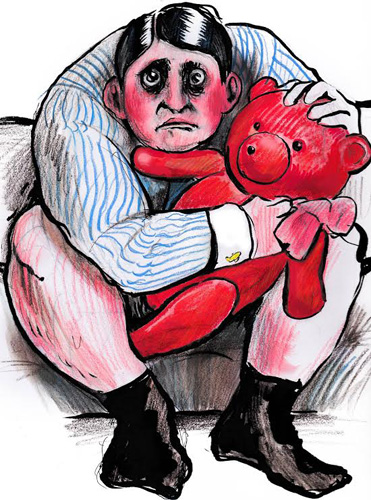 © from the personal archive of Philip Grigoryan sketches for the play "Marriage"
- In the role of a matchmaker Fekla Ivanovna, you are busy with no less than Ksenia Sobchak. You needed it, so to speak, Just for Fun -or does such a paradoxical engagement have some kind of conceptual background?
-Composing a performance, a fair part of time, you stupidly, like a computer, sorting out a variety of schemes until the soul responds to something specific. This is exactly what happened with Ksenia. She was constantly nearby, like one of her favorite animated characters: I was always her fan, procrastinating, I love to watch her interview on "rain". I was always delighted with the ability of Ksenia to be free and telling the truth in situations where no one says it, and also the ability to fall, rise, study and seize more and more territories - I think, you understand what I mean. At some point, I thought about Ksenia in relation to “marriage”-and forgot how a dream. And then Evgeny Mironov called me with the question if I want, they say, to try to “marry” Ksenia and Maxim Vitorgan. - Ed. ). I once immediately saw in Vitorgan the Podsklesin that I needed: a big child, a phlegmatic with a hidden pain, a large courageous person-and at the same time such a navel! When we first met, I did not expect that they would respond so vividly: going to a meeting, for some reason I thought that Ksenia would eventually “jump off”, and Max would remain. As a result, it turned out that both play in the play.
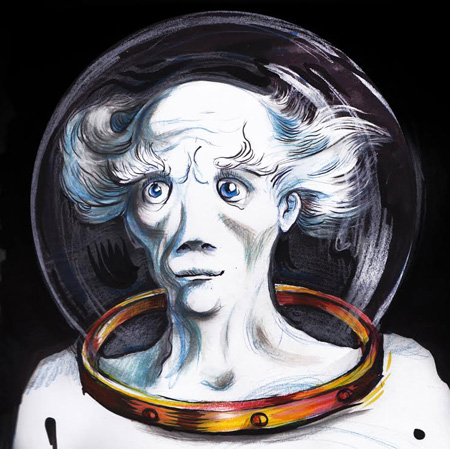 © from the personal archive of Philip Grigoryan sketches for the play "Marriage"
-The advertising image of the performance refers the advanced viewer to the field and the living, and the more mass audience to the screensaver of “House-2 ” . Fekla Ivanovna Sobchak in your "marriage" plays the usual role of the country's main television?
- I deliberately do not play this game, I do not say directly who it is at all. It is rather a generalized image - flesh from the flesh of the modern world, a function, a mechanism, which, in essence, does not care who to marry with whom. She is neither good nor bad, although she is seen subcles for death, which came to his soul. Fekla behaves like a social network for dating-if you remember, at some point she says Agafier: well, you don’t want one, so take the other-what difference does it make, you want it, you want to be thinner, we have thinner, we have a groom for every taste.
-Do you work with Sobchak as with a kind of radi-mide or are you still trying to integrate it along with other artists in a common ensemble?
-In a sense, yes. But this situation was unacceptable for both of us. And the biggest revelation for me was the moment when Ksenia finally began to play. During the rehearsals, she did, I must say, a great job. There is one very indicative scene in the play, in which Fekla comes to Agafier Tikhonovna-with us she owns some kind of small catering, something like a shawarma where a tired matchmaker sits up to a snack. Ksenia spent many hours on this scene to learn to eat and speak at the same time ...
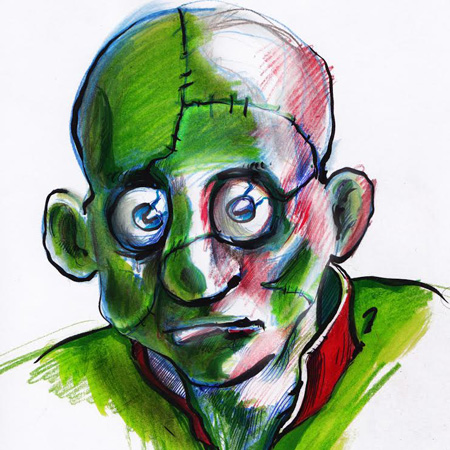 © from the personal archive of Philip Grigoryan sketches for the play "Marriage"
-What is more in this extravagant casting camp-risk or confidence in the cash success?
“I think it's still risk.” The yarn is a powerful and pressing thing. The performance turned out to be by no means uniting the hall: having the arrogance to invite Ksenia Sobchak to go to the dramatic scene, we must be prepared for the fact that in response a large number of people unexpectedly and suddenly become experts in the field of theater.