
Translated material
Two Hague
Interview with the President of the Russian Federation to the authors of the film “Crimea. Way to homeland "from the point of view of international law
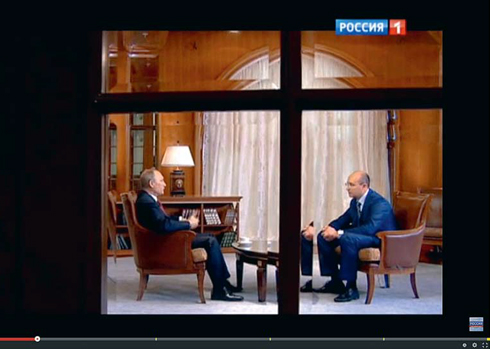
Vladimir Putin talks about how he directed the operation to capture Crimea. According to the authors of the film, this interview was given in hot pursuit in April 2014. Screenshot from the film "Crimea. The path to his homeland » Picture, demonstrated on March 15, 2015 on the State Federal Channel, lasting almost 2.5 hours, claims to be documentary. However, the tape consists mainly of staging "reconstruction of events" and synchrons of various individuals against the backdrop of a beautiful nature.
The most important thing in the film is the detailed interview with the current President of Russia Vladimir Putin, who took about a third of the screen time. The guarantor of the Constitution, albeit in streamlined expressions, but in sufficient detail, tells how he personally led the seizure of the peninsula.
The film is rather artistic in nature, therefore, the confessions sounded by their status cannot be equated with indications in the procedural sense. Nevertheless, in the picture Vladimir Putin is positioned as an acting official, the Supreme Commander -in -Chief - that the hero himself repeatedly emphasizes - so that his statements cannot but take into account all the interested parties.
In his interview, the President stated that he acted within the framework of the legal field: “I did not need to take advantage of the permission of the Federation Council on the introduction of our troops into Ukraine, because I did not scream my soul, because under the relevant international treaty at our military base in Crimea we had the right to have 20,000 people and even a little more. Even with the amount that we added, what I was talking about now, we did not even gain 20,000 ... Since we did not exceed the number of personnel of our base in Crimea, strictly speaking, we did not even violate anything. And they did not enter additional contingents there. ”
There is a share of truth in this statement. Indeed, in the spring of 2014, agreements on the status and conditions of the stay of the Black Sea Fleet of the Russian Federation on the territory of Ukraine of May 28, 1997, which were extended in 2010, “Kharkov agreements” until 2042, were in force between Ukraine and the Russian Federation. In accordance with these agreements, a certain number of Russian military could be placed in the Crimea: sailors and marine infantry and equipment (more than a hundred armored vehicles, some artillery systems, etc.), and, of course, the fleet.
But Putin said: “In order to block and disarm 20,000 people (Ukrainian military), you need a certain set of personnel and not only in quantity, but also in quality,” this passage is repeated in the film twice. The president gently explains that under his leadership, Russian troops had to disarm the military units of the Ukrainian army or “convince” them not to intervene.
To do this, he "instructed the Ministry of Defense under the guise of strengthening the protection of our military facilities in Crimea to transfer the special forces of the main intelligence department and the forces of the marine corps, paratroopers." “At some point” the Bastion complex (a ground complex for the destruction of sea vessels) and another technique not provided for by agreements was delivered to the Crimea. After Ukrainian volley installations appeared from the Kherson region, "we were forced to put our systems, which ... under the first salvo ... would be destroyed (Ukrainian attitudes)."
The president also told how the special forces of the GRU during the capture of Ukrainian military units isolated the Ukrainian military from special communications, "and we controlled and felt open negotiations (Ukrainian military)." As the voice says behind the scenes, when the Ukrainian ships were captured without special operations. “We made a fortress from the Crimea from the sea and land,” the president summarizes.
Of course, 1997 agreements on the status and conditions of the Black Sea Fleet have never provided for the creation of a Russian fortress from part of the Ukrainian territory.
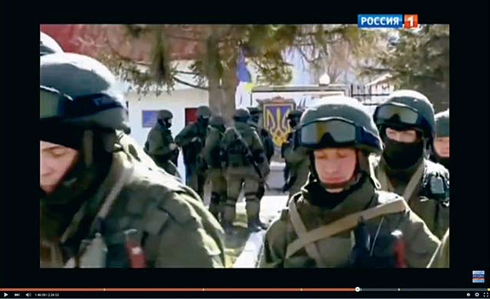
"Polite people" near the Ukrainian part in the village. Perevalnaya, not far from Simferopol, March 3, 2014. Screenshot from the film
The country - the aggressor in the operation were involved “at the first stage - the special forces of the GRU, the Airborne Forces, the infantry, then other units ... The Foreign Ministry, the“ legal services ”, and“ those who deal with domestic policy issues ”were involved. In addition to everything, Putin spoke about the direct connection of the Russian command and armed groups (Cossacks), other informal armed groups (the so -called “Crimean militia”) and their direct leadership. He speaks high enough about their high military spirit, discipline and responsibility.
This position of the president directly refutes the official position of the Russian Foreign Ministry, the main thesis of which is: Crimean events developed “without external influence”. And in March 2014, the actions of Russia in the new presentation of the Supreme Commander directly fall under the definition of aggression, approved by a resolution of 3314 (XXIH) of the UN General Assembly of December 14, 1974.
Namely, according to Art. 3:
-
n. “A”: the invasion or attack of the armed forces of the state on the territory of another state or any military occupation, no matter what temporary it is, the result of such an invasion or attack, or any annexation using the force of the territory of another state or part of it is the participation of the GRU, Airborne Forces, etc. in the “peaceful will of the inhabitants of Crimea”;
n. “C”: blockade of ports or shores of the state with the armed forces of another state - the Bastion complex and blocking the withdrawal of Ukrainian ships from the Sevastopol Bay;
n. “D”: the attack by the state’s armed forces on the ground, sea or air forces, or the sea and aircraft of another state - the subsequent seizure of Ukrainian vessels and military units;
n. “G”: a sending by the state or on behalf of the state of armed gangs, groups, irregular forces or mercenaries that carry out acts of the application of armed force against another state that are so serious that it is equivalent to the above acts, or its significant participation in them is the sending of the “Cossacks” and the leadership of the “Crimean militia”.
Thus, the events in Crimea in the presentation of the President of Russia of March 15, 2015 are falling under four of the seven points of the UN General Asamble resolution No. 3314.
Meanwhile, the presence of any (at least one) of these signs - regardless of the declaration of war - evidence of aggression. That is, according to the same resolution, evidence of an international crime.
“The mosquito of the nose will not flow” in the film tells not only about military operations. “The buildings of key authorities, on which stability and legality in the Crimea depended, were taken under protection. It took special forces only 30 minutes to carry out this operation on the night of February 27. ” The President of the Russian Federation explains this by the fact that “we had to ensure the work of the representative body - the Crimea parliament. In order for this parliament to get together and carry out the actions provided by law, people should feel safe. The parliament - “people gathered, voted and elected the new chairman of the Government of the Crimea, Aksenov Sergey Valerievich, and President Yanukovych, acting at that time, approved him. From the point of view of Ukrainian law, everything is observed. With the legal component - there the mosquito of the nose will not flood, ”the guarantor concludes in his characteristic manner.
The last statement, from the point of view of jurisprudence, is very doubtful. There is not a single state in the world except the Russian Federation that would share this position. Viktor Yanukovych was already outside Ukraine and was evading the performance of his presidential duties, for which he was suspended by the legally elected parliament-the Verkhovna Rada of Ukraine, which Putin for some reason refuses legitimacy. In addition, according to the legislation of Ukraine and the Crimean Constitution (Article 37), Crimea did not require the presidential approval of the candidacy of the new government chairman approved by the Peninsula parliament - only its coordination. I.O. The President of Ukraine at that time was Alexander Turchinov - this is with him this approval and had to be carried out. The degree of freedom of the will of the deputies of the Crimean Rada in the presence of the Russian military who “guarded” them is also called into question by many. Almost no one outside the Russian Federation is in doubt the illegality of the procedure for the appointment of a referendum on accession to Russia.
Articles of Crimean events are devoted to many international documents. Thus, the resolution of the UN General Assembly dated March 27, 2014 No. 68/262 “Territorial integrity of Ukraine” lists the main international treaties whose norms were violated by the Russian Federation: Article 2 of the UN Charter, which provides for the obligations of all states to refrain in their international relations from the threat of power or its application against the territorial integrity or political independence of any state and resolve their own and resolve their own and resolve their own international disputes by peaceful means; Resolution 2625 (XXV) of October 24, 1970, in which the UN approved a declaration of the principles of international law regarding friendly relations and cooperation between states in accordance with the UN Charter; The norm that the territory of the state should not be the object of acquisition by another state as a result of a threat of force or its application and that any attempt aimed at partial or complete violation of national unity and territorial integrity of the state or country, or their political independence, is incompatible with the goals and principles of the UN Charter; The final act of the conference on security and cooperation in Europe, signed in Helsinki on August 1, 1975 (under this act, Russia violated all the principles of international relations); The memorandum of security guarantees in connection with the accession of Ukraine to the agreement on non -proliferation of nuclear weapons (Budapest memorandum) of December 5, 1994, according to which Russia acted as one of the guarantors of the territorial integrity of Ukraine; An agreement on friendship, cooperation and partnership between Ukraine and the Russian Federation of May 31, 1997 and the Alma-Ata declaration of December 21, 1991.
In addition, other international treaties were violated by the Russian Federation, in particular: the fundamental act on the relations of Russia -NATO 1997; Partnership and cooperation between the Russian Federation and the EU 1994; The charter of the Council of Europe - the transfer of all violated contracts would take more than one page.
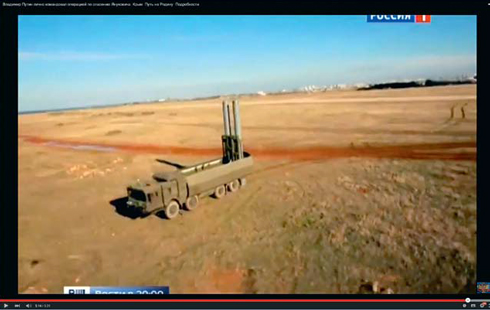
Coastal Coastal Mobile Complex "Bastion", designed to destroy ships. Screenshot from the film
The position of Europe is the most complete conclusion on this issue is the resolution of the European Parliament of March 13, 2014 (2014/2627 (RSP)). According to this document, Russia's invasion of Crimea is an act of aggression and violation, first of all, sovereignty and territorial integrity of Ukraine. The European Parliament states that pro -Russian militants and Russian soldiers captured key buildings in the capital of Crimea, Simferopol, as well as other strategic goals in Crimea - including at least three airports. Most of the Ukrainian military units on the peninsula were surrounded, but refused to lay down weapons; Since the beginning of the crisis, a significant number of additional Russian troops have been deployed in Ukraine.
The European parliament recognizes the arguments represented by the Russian leadership to support this aggression, completely unfounded and not related to the realities in the field, since there was not a single evidence that the life and health of Russian citizens or Russian -speaking citizens of Ukraine were hazardous. In addition, the European Parliament states that on March 6, 2014, the self-proclaimed and illegitimate authorities of Crimea decided to ask Russia to include Crimea in the Russian Federation and appointed a referendum on the issue of Crimea from Ukraine on March 16, 2014, thereby violating the Constitution of Ukraine and Crimea.
Thus, the Crimean “referendum” is nothing more than a political performance, without any legal consequences.
At a meeting of the UN Security Council on March 15, 2014, 13 members of the Council supported the position of the European Parliament, China was refraining. The resolution was not adopted by the UN Security Council only because Russia as a permanent member of this body on the basis of Art. 27 of the UN Charter, has a “veto right”. In the future, the European Union and almost two dozen leading states have confirmed their commitment to this position through the deployment of restrictive measures (sanctions), which are still valid.
So about the mosquito and his nose, the president of the Russian Federation, to put it mildly, is mistaken.
The prospect for the Hague to be Vladimir Putin by the president of a non-nuclear power, who is a permanent member of the UN Security Council, and any other country, his interview on the state television channel would be drawn to two Hague. In this Dutch city, almost across the road, there are two ships - the International Criminal Court and the International Court of the UN, which consider international offenses of people and states. And if Russia had some kind of “other” country, the prosecutor of the International Criminal Court would have already begun an investigation involved in the crisis: Ukraine is now slowly collecting evidence for the future, only theoretically probable process-to the International Court of the UN to bring the Russian side liable. The conflict could be resolved within the framework of international law, but the Russian Federation did not ratify the Roman statute of the International Criminal Court, and the actions of its citizens do not fall under its jurisdiction. The Russian Federation also excluded itself from the jurisdiction of the UN International Court (the exclusion was made for a very limited circle of cases associated with the seizure of aircraft, nuclear materials, as well as some rare cases of human rights violations).
But it cannot be excluded that in the future it will be possible to create a special International Tribunal AD HOC (this allows the VII head of the UN Charter “Actions in relation to the threat to the world, violation of the world and acts of aggression”, but this requires a decision of the Security Council, whose members, as we recall, have the “right veto”); He will deal with a detailed analysis and assessment of the activities of the Russian Federation and its officials.
As an example of the already held court of international criminals, one can cite the international tribunal for judicial persecution of persons, responsible for serious violations of international humanitarian law committed on the territory of the former Yugoslavia since 1991 (UN Security Council resolution No. 827 of 05.25.1993). It was created in 1993 by decision of the UN Security Council and is still working (the estimated end date is 2017). In its activities, the tribunal is guided by a doctrine of joint criminal actions, when each member of the criminal group brings individually specially determined responsibility for the crimes committed. At the same time, the tribunal considers the crimes of all participants in the process: Serbs, Croats, Bosnian Albanians and Maccentons. The processes go both over the former presidents and the former guards. In total - 155 accused. Some of them, for example, Slobodan Miloshevich (the past president of Yugoslavia, then Serbia) - died in prison, without waiting for the end of the process, some, like love bear (chief of counterintelligence of the headquarters of the army of the Republic of Serbian) - were sentenced to life imprisonment. Basically, the accused received various prison terms from 5 to 40 or more years of imprisonment. At the same time, some, like Milan Milutinovich (another former president of Serbia), were justified.
Photo: Sergei Ilnitsky/EPA, Donat Sorokin/ITAR-TASS, VAS CZERWINSK/ROOL/ReUTERS, YouTube.com