
Translated material
Sad city
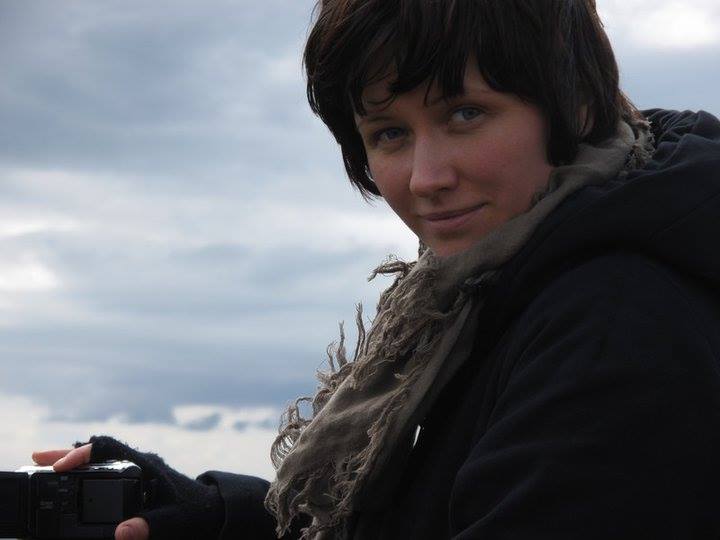
The Copenhagen Museum in recent years has been occupied by ecologists. In order for children to get an idea of nature, learn to grow vegetables, in the museum courtyard last year they planted trees and broke the beds. Pupils of nine schools and residents of two settlements for young people with special needs germinated and planted flowers, peas, beans, zucchini, salad. The project was called Grow Flow . Bright bird houses built by members of the Happy City Birds group can be seen not only in the museum yard, but in many areas of Copenhagen.
The exhibition "City Nature" is located in several museum halls on the ground floor. These are two parallel stories - about the history of the green movement in Copenhagen and about amazing modern environmental initiatives.
In the first hall there is a shield with graffiti made in memory of the 114-year-old chestnut from the Westerbro area. The tree was cut down during the construction of the metro in 2011. Under the chestnut, the life of five generations of Copenhageners passed, he saw the transformation of a slum into a bohemian area, grew above the houses, had 817 friends on Facebook. The Copenhagens staged a farewell party - they danced on the street, read poetry, baked toasts. The stories and interviews related to the tree were released in the form of the book "Oda chestnut", pieces of wood were turned into an art object, the chestnut seeds were sprouted and planted in the nearest yards.
The story of the chestnut from Westerbro interested me because I came across a cut of 200-year-old chestnut in Bergen. Nobody escorted the Bergen giant with parties and poems, he was killed at night so that the inhabitants did not manage to organize a protest. A hut was placed in a beautiful square, awarded the article "Shitty Architecture", and the lawn was completely covered with a boardwalk. The only thing the townspeople could do was arrange a farewell rally. But the tree cannot be returned .
In the museum hall "Return to the roots?" You can wear headphones and watch films made by various eco-unit- Pragshave, Byhaven2200, Brændnældebed , and also learn about the slow-food-a movement that considers unreasonable transportation and packaging of vegetables and fruits in plastic. Activists of Slow Food want to grow and purchase local food-for example, joining the consumer cooperative Kuffahavns fuffarefællessskab food Co-OP .
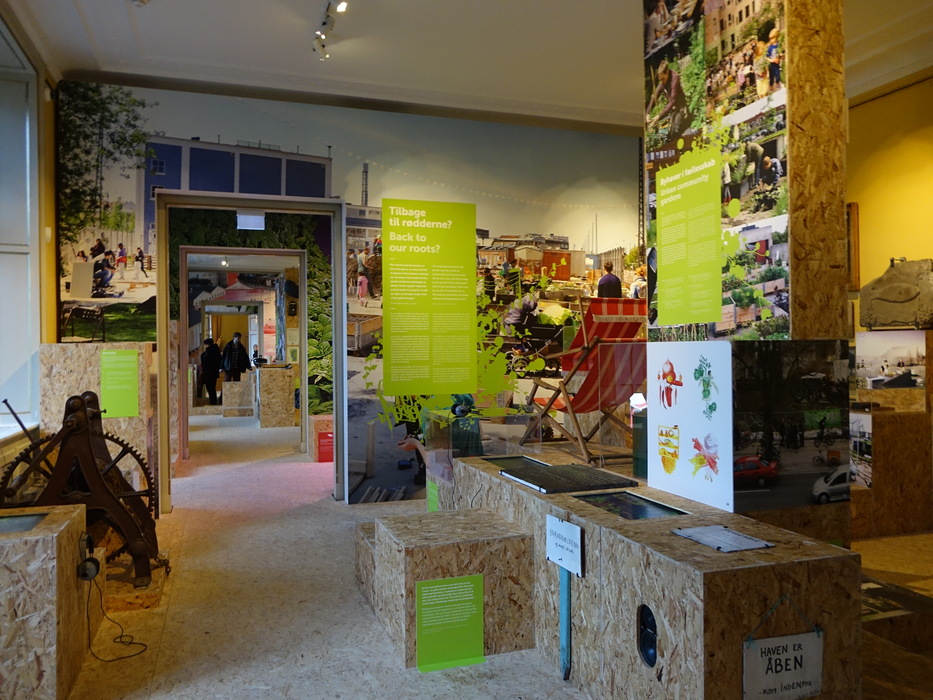
In April 2010, the Copenhagen food cooperative , uniting more than 3,500 workers and 10 stores, outlined the purpose of its existence: "Available eco -products for all." The food cooperative believes that plants should be grown using organic methods, without exhaustion and chemical pollution of soil and water, with care for animal health, on a stable and stable basis, as well as “local” as much as possible. By reducing the distance from the farm to the consumer, the effects of traffic on the environment decreases, freshness, taste, and nutritional value of products are preserved. Support for a local manufacturer saves it from ruin and allows you to maintain local farm traditions.
Vegetables and fruits should be grown taking into account the season; You can use greenhouses, but it is unreasonable to heat them. Copenhagen food cooperative supports fair, conscientious and direct trade, showing solidarity, avoiding the negative social and economic consequences of the ruin of farmers. The cooperative collaborates with environmentally friendly industries and takes care of reducing CO2 emissions, reducing the amount of waste, using eco -materials everywhere where it is possible. Participants in the cooperative try to disseminate knowledge of food and ecology, want to inspire people to live environmentally friendly. One of the important principles of the community is financial viability and autonomy from state and private institutions - only their own resources and labor of volunteers are used. The work of Kutchhavns fuffevarefællesskab food Co-OP is transparent and is based on trust, financial transactions are not hidden from anyone in the "chain". Activists believe that eco -products should be available to everyone that the environmentally friendly should become a natural part of everyday life, and not with luxury, set reasonable prices and pay priority to quality.
We must be kindly treated in curiosity, to be open to all visitors, to allow strangers to take part in the activities of the team, to share their political views
It was curious to see the exhibits of the eco -house BYHAVEN 2200 from the Copenhagen district of Nerrebro. This non -political and non -profit volunteer society was founded in the summer of 2012, guided by the councils of the site "Principles of permaculture " and the achievements of the aforementioned KBHFF cooperative. The BYHAVEN 2200 manifesto is largely based on the KBHFF charter, but also contains interesting original ideas: “It is forbidden to use pesticides and fertilizers, as far as possible, to avoid the use of fossil fuel, give an advantage to low-tech methods of agriculture Low-Tech , the maximum recyclable. Eco-enforcement activity should improve the state of the environment (The enrichment of the soil is more fertile, the use of rainwater for unloading the city water supply, the use of fungal crops and bio -proof to clean the soil from toxins and heavy metals, maintaining biodiversity). All visitors, allowing strangers to take part in the activities of the team, share their political views. The Facebook community of BYHaven consists of one and a half thousand people.
Omega Garden project
In the next hall, a self -powering container was shown that suitable for places that did not have direct access to water, and a film about the manufacture of such a container. Installations were told how to use water in the garden management as efficiently as possible. I was interested in the video about the Omega Garden hydroponics system of hydroponics around the light. According to this technology, the plant can be grown in urban conditions - year -round, with minimal energy, water and spatial costs. Features of the Omega Garden work are as follows: the plants are planted from the inside of the cylinders, the cylinders slowly rotate, the roots of the plants manage to absorb only the necessary substances, which leads to unusually high productivity, minimizing the use of water. It turned out that with a constant change in the gravity of the plants, the plants grow better. Rotating gardens are suitable for growing strawberries, blueberries, pepper, eggplant, tomato, flowers (marigolds, a pansies, nasturtiums, and a shortage). The expenses for transportation, packaging are reduced, the use of chemical fertilizers and preservatives is reduced or excluded, there is no problem of soil depletion, water pollution, product quality control is improved, the labor of the worker is as effective as possible. On the project’s website, you can study the curious text about the prospects of vertical rotating gardens in space.
The motto of a backward society: "You will not change anything, if you sort garbage, save resources, grow plants, save nature." The motto of the new society: "Act!"
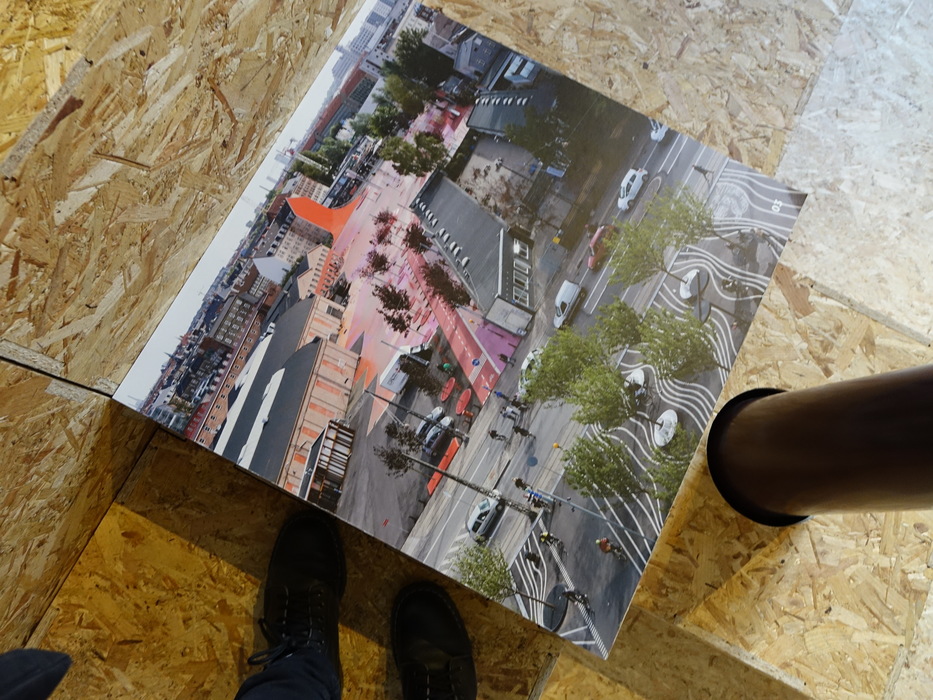
The next part of the exposition was dedicated to the Superkilen city park . The park is divided into three color zones: The Red Square (modern - cafes, music, sport), The Black Market (past - fountain and benches) and The Green Park (for walking with dogs, picnics, sports). Since it turned out that emigrants of more than fifty nationalities live around the park, they were asked to illustrate the ethnic diversity of the population, to fill the park with objects from their countries. More than a hundred objects - benches, urns, signs, plants, playgrounds - are brought from more than fifty different states or copied. Five groups of artists went to Palestine, Spain, Thailand, Texas and Yamaika to bring specific objects. They brought the Earth from Palestine, from Spain - a bull, from Thai - a boxing ring, from Texas - a dance pavilion, and a sound system from Jamaica. The park has a swing from Iraq, benches from Brazil, a fountain from Morocco, urns from England, neon signs from around the world, sewer hatches from the island of Zanzibar, from Gdansk and Paris, a playground from Chernobyl. At the exhibition at the Copenhagen Museum, a bank with orange land is presented and a video is shown about how two girls - Hiba and Alaa - went to Palestine, gained land in bags and then scattered this land on the Copenhagen flowerbed.
A folded sleeping bag was also an important exhibit. He urged visitors to reflect on how the dream was distinguished in a sleeping bag on the street, in the park or on a bench from sleep in his own bed.
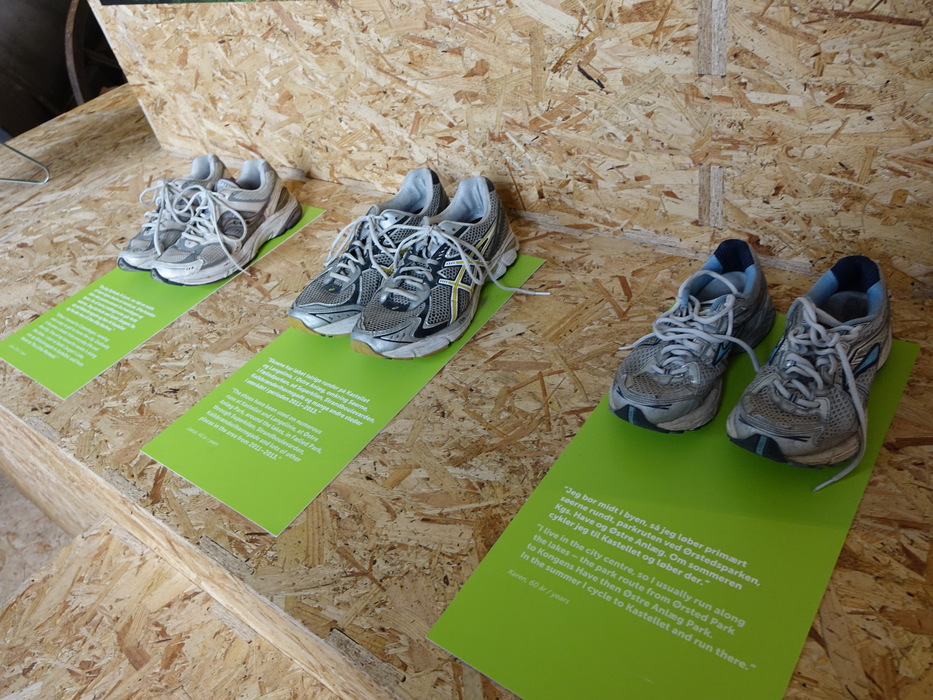
The hall telling about the healing properties of the green zone is decorated with photographs of walking patients of the past. Modern methods of prevention are indicated by three pairs of old sneakers. A story was placed near each pair. Karen, 60 years old; Julia, 26 years old, and Jacob, 40 years old, talked about their favorite running routes that pass through the territory of the parks.
The Black Box Garden corner filled objects from the garden, which Camilla Berner arranged on an abandoned Copenhagen wasteland. This place has been empty since 2004. Camilla worked in the garden for several hours every day from April to November 2011 and kept a diary. She removed garbage, raised plants of 92 species, made sand tracks, attracted volunteers. Camilla talked with curious passers -by, watched the growth of plants, collected seeds and led a photo day, later translated into English and published in the form of a book. I am very glad that now I have one of 300 copies of this book, because the Camille project is really very inspiring.
At the exhibition, I learned about Philip, Rasmus and Johanna from #Vildmedvilje , which have been promoting the idea of “wild” parks for four years, refusing to cut lawns, and monoculture - to move on to biodiversity and enjoy pristine grasses. The Vild Med Vilje website has a curious chronicle of city wild gardening, numerous projects, experiments, landscapes miracles, as well as photographs of many volunteers - wildlife friends.
I am not able to translate all the statements of Danish ecologists and retell the content of all technologies and films that were shown at the exhibition, understand all historical links and evaluate the importance of all exhibits. But you must admit: even a brief description of "urban nature" is impressive. Constantly have to face stereotypes against ecologists and an environmentally friendly lifestyle, with ridicule of people, whose only desire is the preservation of nature. It is good that in the Copenhagen Museum you can see the results of labor of a huge number of enthusiasts who work calmly and confidently, improving the lives of their communities. Each visitor can evaluate his capabilities, everyone gets a chance to change his own life and the life of his city.
After all, small changes at the level of courtyards and areas are formed in changes at the country's level. It was thanks to the efforts of activists that ecology has become an important priority for the Danes. The motto of a backward society: "You will not change anything, if you sort garbage, save resources, grow plants, save nature." The motto of the new society: "Act!"
Here you can see my photos from the exhibition "City Nature".
Lyubava Malysheva-a civil activist, a photographer-documentary, lives in the Norwegian city of Bergen