
Translated material
The most successful dictator
Why will the ideas of Lee Kuan Yu survive the creator of the Singapore "Economic Miracle": Foreign Policy
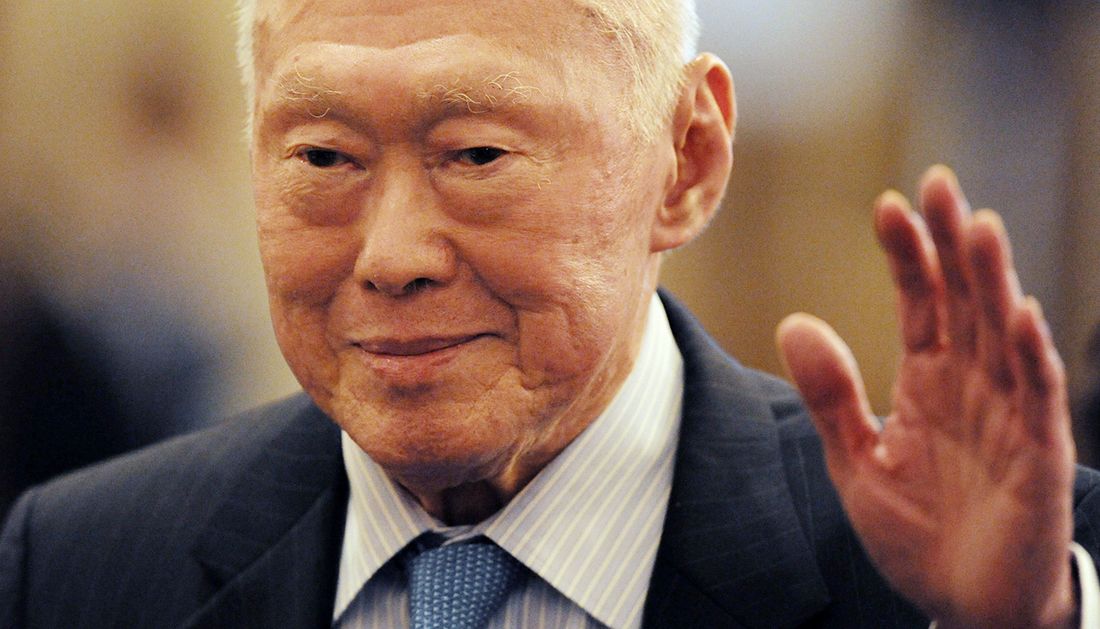
Lee Kuan Yu did not live literally a few months until the 50th anniversary of the independent Singapore, which became precisely thanks to his efforts the most successful postcolonial country in the world. Margaret Thatcher said that Lee Kuan Yu was never mistaken, Tony Blair spoke of him as the smartest world leader, and Barack Obama considered the former leader Singapore one of the most legendary personalities in the history of Asia. Foreign Policy tells what trace in world history Lee Kuan Yu, who died in Singapore on March 23 at the age of 91.
From 1959 to 1990, while Lee Kuan Yu was at the helm of the country, GDP Singapore, in terms of each citizen, grew from $ 500 to 55 thousand. In current international ratings, the country is adjacent not to other former colonies, but with a stable Switzerland, the Foreign Policy journalist Parag Hannah notes.
Singapore gained independence from Malaysia in 1965, when Lee has been the post of Prime Minister of the Republic for six years. The Singapore politician was looking for ways to develop for his country-at first on examples of states with a similar history, that is, independence from European empires (Singapore was a colony of the British Empire until 1963), and then in Holland, where he studied urban planning and corporate governance. Having abandoned direct copying of European and post -colonial experience, Lee created his own model of the state, built both on borrowings and on his own ideas.
Singapore turned out to be a kind of test site for many innovations, which then spread through the planet. Paid entry into the city center - as in London; Electronic passports - as in Estonia and South Korea; Electronic payments for the use of roads - as throughout the Western world. All this - and much more - was first tested and recognized as successful in Singapore. Chinese leader Den Xiaopin created a free economic zone in Shenzhen, inspired by a trip to Singapore in 1978; Subsequently, China began to tightly cooperate with the Singapore authorities in the field of economics and urbanism. India recently turned to the development of cities to the Government of Singapore.
In Singapore, one of the highest percentage of millionaires per capita in the world. The gap between the poor and rich in the city-state still remains significant, however, the probability of getting rich here is twice as high as in the United States.
The bureaucratic system of Singapore is based on constant communication with the population and studying the effectiveness of the work of officials. Now the Singapore public administration model can be called "information state", which is controlled by statistical data and democratic mechanisms, according to Foreign Policy. Obviously, the same model could be adopted by Western countries.
Whether throughout his long career he repeatedly changed political preferences-in the range from socialism to Libertarianism, until the model of the “nyanka state” ideal for Singapore with a high level of social responsibility and at the same time-increased control over the life of citizens.
The formula “Law and Order” in the interpretation is this: first order, and then - the law. Lee was in order to understand social security and political predictability, which he ensured the elimination of all possible competitors. The Western media paid great attention to the strict laws of Singapore (such as the prohibitions of graffiti and chewing gum), while Singapore legislation allows us to plant for performances in public without a license and other manifestations of free thought. During the reign of Lee, most of his critics went bankrupt or went to prison - and sometimes they happened to both of them.
In 1990, Lee transferred power to the Prime Minister GO Choc Tongga, then the country was led by his son Lee Xian Lung. However, all this time, the founder of Singapore advised the leaders and remained their mentor and mentor. Despite the fact that Lee reluctantly parted with the authorities (the 30-year-old term of government and methods of combating competitors speaks about this), in the end he preferred to focus not on himself, but on the system he created, which continues to work.
The standard now is not a person, but an established order. Isn't Kuan Yu, but "Li-Cuan-Yuism." It is he who should be a model for imitation in the 21st century, and not the icon of Western democracy, such as Thomas Jefferson or the Father of Europe, Jean Monet, who was at the origins of the European Union (English.).