
Translated material
Polar show

On the evening of March 17, leaving 90 km south of Moscow from the house, I was surprised at the strange clouds illuminated by the green light. A minute later it became clear that this was not a cloud at all - along the entire northern side of the sky, a bright polar radiance spread almost to Zenit (I know well how it looks, repeatedly observed it from 60 ° to 70 ° C.). Raspberry pillars turning into purple - to the west; To the north - a green curtain, a little to the east - a raspberry spot, two bluish stripes stretched almost to Zenit, between them - “W” Cassiopei.
The picture gradually changed and became dull. I managed to call a few acquaintances, but they found the end of the performance where the colors almost disappeared. Then he returned home, announced on Facebook, and some more, looking out, saw something. Immediately in the tape, the FB found that the radiance was observed by scientific journalist Irina Yakutenko , she even took off the raspberry glow. In about forty minutes, almost nothing was already visible. Then, waking up late at night, I saw a radiance again, but already quite low above the northern horizon and diffuse - without clear details.
The radiance was brighter than I saw in medium Finland, bright, according to local residents. I also saw something pale in Stockholm - then he was seen in St. Petersburg and Yekaterinburg, also as something pale, but many were noted as a rare phenomenon. And here it is on the latitude of Moscow and even, as it turns out, to the south! I don’t know whether it is a record or not, let's see the comments on this subject, which will undoubtedly follow.

What is a polar radiance? This is a glow of atmosphere atoms (nitrogen and oxygen) excited by quick electrons. Nitrogen gives purple and green lines (428 and 573 nm), oxygen - green and red (558 and 630+636 nm). Both oxygen lines are metastable, that is, long-lived, so they are extinguished due to clashes with high gas density and can only be displayed at high altitudes-150–400 km.


This means that the red (raspberry) pillars that I saw near Pushchin were those that Irina Yakutenko photographed under Istroy, and those that Aleksey Kirillov and his wife Nina Shiryaeva took off in the Kaluga region (see photo), is one and the same. The most vivid green glow of nitrogen is radiated below-from 90-100 km, somewhere at this level is the lower boundary of the polar radiance, usually quite sharp. It is from hundreds of kilometers up that green wriggling curtains go up - the most recognizable type of radiance.


Where do these fastest electrons of energy from 1 KV to dozens of KW come from, which excite the atoms? I, being a profane in this area, believed that they flew in the solar wind from the flashes (which are a crossing of the magnetic field loops in the sun), fall into the external regions of the earth's magnetosphere and, circulating along the power lines, enter the polar regions, where the external power lines of the magnetosphere come (see Fig.).

Interestingly, about the same is written in Wikipedia. Earth's magnetosphere is a magnetic dipole deformed by the sun wind. It can be seen from the picture that in this deformed dipole there is a “hole” where it is easy to get to the loaded particles - the so -called “polar cas”. It is projected not to the geomagnetic pole, but 12 ° from the side, so the maximum polar radiance falls on the ring, or rather an oval, around the pole.
As a result, the maximum polar radiance is 67-75 °. But in order for the radiance to drop to a latitudine 50-60 °, as it happened on March 17, it is required that the fast electrons somehow move across the magnetic power lines to a distance, a huge electron in a magnetic field (Larmorovsky radius). In principle, this is possible due to a diffusion caused by the scattering of particles, but in order to make sure of the correctness of the picture and get additional comments, I called the specialist.
* * *
 Anatoly Petrukovich , head. Department of the Institute of Space Research of the Russian Academy of Sciences, member of the corr. RAS, explained that the picture is much more complicated than it is written in Wikipedia:
Unfortunately, the point of view of the first half of the twentieth century is wandering from the encyclopedia to the encyclopedia. Everything is stated correctly, for example, here [1, 2] . The most important role is played by the acceleration of particles directly in the place - in the magnetosphere. Where does acceleration come from?
The magnetic field in the conducting environment (and the conductivity of the cosmic environment on a large scale is huge everywhere) is firmly connected with the substance, due to the fact that charged particles (protons and plasma electrons), which are in space in general, and in the earthly magnetosphere, can only move along the power lines. A field with a substance becomes an elastic environment that transfers mechanical influences from the outside.
The solar wind just has a mechanical effect on the magnetic dipole of the Earth, deforming it, as shown in the figure. However, this stream in the magnetosphere practically does not fall, but flows through it. “Open” and “closes” the magnetosphere of the magnetic field of the solar wind. With an open magnetosphere, solar plasma flows into it, accumulating on the night side in the tail, where it is mixed with plasma atmospheric origin.
However, with all the desire, neither electrons of the solar wind, nor electrons of the magnetosphere, even if all of them are “shaken” into the atmosphere, cannot produce the observed radiance. The electrons lack kinetic energy. In fact, a rather complicated mechanism works. The tail of the magnetosphere gradually accumulates energy in the form of a magnetic field and plasma, and then explosively drops it back into the sunny wind and partially into the atmosphere. Dramatically changing magnetic fields in the tail induce electric fields, including with a non -equal projection onto magnetic power lines, which dock electrons along the way to Earth. It turns out the surge of the northern (and southern) radiance on the night side of the earth.
This process is called "polar subfore" (terminology has also been preserved by a hundred years ago). Subburi occur every few hours, but under normal conditions, magnetic variations and radiance do not go beyond the borders of the polar areas. And when the flash occurs in the sun, the wind turns into a “flurry”, the impulses of which “shake” not only the tail, but the entire magnetosphere, magnetic variations are recorded throughout the Earth. It is this anomalous phenomenon in general that they call a magnetic storm. The larger the energy accumulated in the magnetosphere, the deeper the indignation penetrate inside and the closer to the equator, subfuri and polar radiance are observed - up to very moderate latitudes.
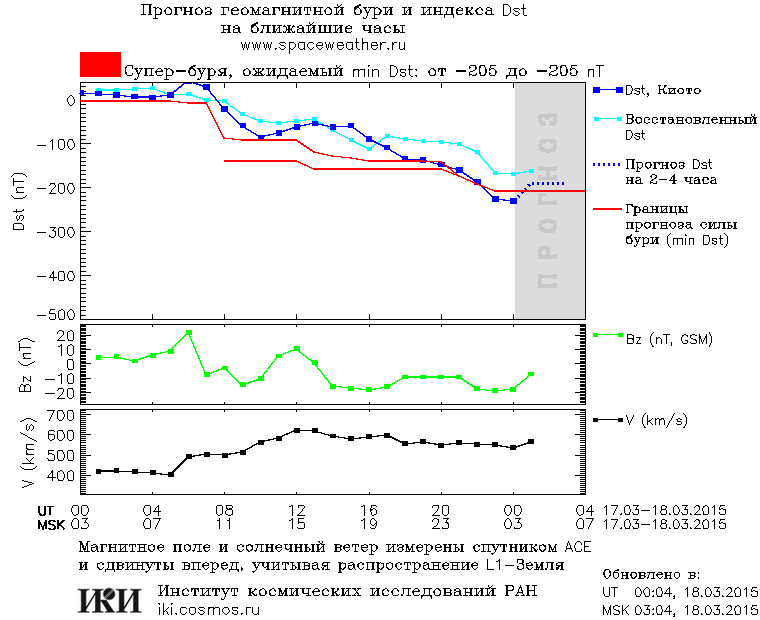
Regarding the specific event of March 17 ... The previous solar outbreaks on March 14-15 were quite weak, on the threshold of the so-called "geo-efficiency", are much stronger. However, the source of indignation, the solar spot, was located in the right (eastern) half of the solar disk, from such a point the hit of plasma ejection on the ground is very likely, which was confirmed in the afternoon of March 17. The storm was strong enough, but, again, not abnormally strong. Although the current maximum solar activity is rather sluggish and even such storms are rare. According to the amplitude of the storm, the polar radiance at the latitude of Moscow was not expected, this happens only with completely unique events. Having received an operational forecast for the expected storm [3] , I did not even think to look out the window, although I live with windows to the north.
However, the magnetosphere once again presented a surprise. The accumulation of energy was very effective - Subburi passed very strong, with a sharp clear beginning, at about 21, 23 and 2 hours of Moscow time, this can be seen in polar magnetic activity - the AL index (on graphics - world time - 3 hours from Moscow) [4] . As a result, the auroral oval (zone of radiance) actually moved 5-10 ° latitude closer to the equator relatively expected on average.
Plus, in the accusatory time of the radiance, the most striking, with clear forms, “discrete”, and in the postpersonal - more blurry, “diffuse”. So it was lucky over time. The atmosphere was also very transparent, there was no smog, which created good visibility and a fairly dark background. That is, both ordinary and magician-inosphere weather turned out to be favorable for the magnificent show.
By the way, at the time of writing these lines (evening of March 19), the magnetic storm was still formally (according to all indices), the pumping of energy from the solar wind continues - the earth is still in a stream of solar release. This is another surprise, usually everything ends faster.
PS on the Web appears more and more photo and video materials about the radiance on March 17. In particular, the GISH Automatic camera MSU was shot by a magnificent video: www.facebook.com/video.php?v=669079686530621&pnref=story
See also the comments of S. Gaidash and V. Burov about the factors that caused polar radiance at low latitudes on page 5.
1. The Little Encyclopedia "Cosmos Physics".
2. Science and life. 2001, No. 7, 10. 2002, No. 5.
3. Iki.rssi.ru/forecast/data/archive/2015/ru/03/18/Predictionrus_20150318_0004.gif
4. Http://wdc.kugi.kyoto-u.ac.jp/ae_realtime/2015/index_20150317.html
5. A picture of an employee of the Planetarium of the Cultural Center of the Armed Forces of Russia ( http://planetarium-cc.ru/ ):www.skyandtelescope.com/online-over-over-moscow-on-march-17-2015-2256-Ut
6. Northern Lights Move South: Magnetic Storm Reveals Aurora Borealis in Central Russia http://rt.com/news/241845-aurora-borealis-central-russia