
Translated material
Russian march: calm down in front of the storm?
In society
 Russian march: calm down in front of the storm?
March 25, 2015 Svetlana Solodovnik
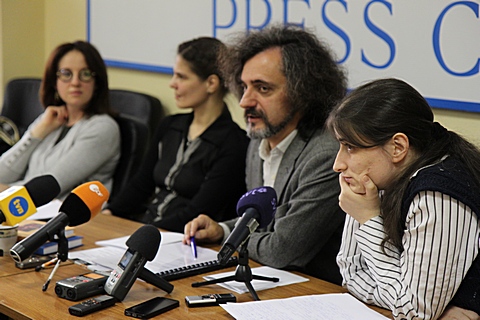
In an independent press center, the presentation of reports of the Nava information and analytical center on nationalism and the unlawful use of anti-estimistic legislation was held yesterday. “Owl” monitors the situation on this front constantly and at the beginning of the year has been reporting for many years in a row how the situation has changed over the past year. With the results of the work done, the interested audience and the press was introduced by the head of the Owl, Alexander Verkhovsky and employees of the Center Vera Alperovich, Natalia Yudina, Maria Kravchenko.
In 2014, everything turned around the events in Ukraine - and Russian nationalists did not show themselves here with originals. The theme of Ukraine and for them became the main one, moreover, seriously split the ultra -right and partly deprived of their “voice”. Nationalists who support the “Russian spring” (this group included the leaders of most nationalist movements: Konstantin Krylov and Vladimir Thor, Igor Artemov, Vladimir Kvachkov, Eduard Limonov, etc.), actually repeat that every day you can hear on federal television channels; Those who are opposed to do, are afraid to do it loudly (this less numerous group can be attributed to Dmitry Demushkin, Alexander Belov, Vladimir Istarkhov, etc.).
Representatives of the second wing mainly believe that the Russian authorities artificially give a conflict an ethnic character (Russian-Ukrainians), that in fact this is a worldview conflict: between the paternalistic, initial supporters of Russia, nostalgic for the USSR, and citizens striving for an independent national state. They do not approve of the war in Ukraine, believing that it is artificially heated by the Russian political regime, which thereby spoils the relationship between the two fraternal countries and wants to prevent the construction of the national state from the fear of the export of the “national revolution”.
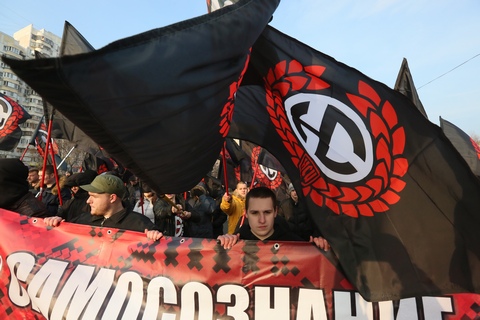
Serious disagreements, which left many years of allies on different sides of the barricades, reduced the activity of the ultra -right. It is enough to say that no more than 2 thousand people gathered for the “Russian March”, which was held in Lublino, which is three times less than usual. The geography of marches also cringed: the action took place in 36 cities of the country, and in 2013-in 49. There are fewer criminal attacks (although the number of murders increased compared to last year: 27 versus 23 in 2013). The main victims are still “ethnic strangers”-natives of Central Asia and the Caucasus. But if here the level of violence decreased (203 beaten and wounded in 2013, 123 in 2014), political violence expanded noticeably. In addition to the usual attacks of neo -Nazi on informals and anti -fascists, cases of attacks by pro -government nationalists on those whom they consider the “fifth column” are noted. For example, “Other Russia” in September tore off the concert of Andrei Makarevich in the House of Music. Most of the "ordinary" nationalists, however, are still focused on the actual violent acts than political.
A decrease in the level of violence, experts of the SOVA Center, unfortunately, cannot be explained by improving the practice of law enforcement, since it, alas, has not improved. On the contrary, a skew towards persecution for propaganda to the detriment of persecution for violence only increases. Convicted in 2014 was mainly ordinary users of social networks for various kinds of xenophobic regions. And although law enforcement officers were sent to bars, including some leaders and activists of the scandalously known nationalist organizations (Evgenia Yevtushenko /Frantic /, Maxim Martsinkevich /Tesak /), in their affairs the political motive of the persecution can be seen, since they were oppositionly in relation to the Russian government, and sometimes to its course in Ukraine. In general, the tendency against the background of the rhetoric “On Ukrainian Nazis” was visible the real acts of their own fascists to hide.
A separate issue is the poor quality of anti -extremist legislation, which the employees of the Owl Center wrote and talked more than once. In its existing form, it makes it possible to arbitrarily form mechanisms for suppressing any undesirable forms of activity in society. Since mid -2012, the peak of protest movement, most often anti -extremist legislation has been applied when it is necessary to restore the opposition. Now, in connection with Ukrainian events, when the sphere of “counteracting extremism” intersects with the sphere of protection of the alleged foreign policy interests of Russia, the role of the FSB has sharply increased in anti -extremist activity. At the same time, neither the constitutional nor the Supreme Court are clearly ready to intervene in the situation from the position of law.
As a result, public interests are violated in a variety of ways: this is the blocking of the network content according to the Lugovoi Law (which created the extrajudicial mechanism of blocking on the Internet), and the unlawful persecution of believers and unbelievers related to religion (the witnesses of Jehovah and followers of the Religious and Political Party suffer Ut-Tahrir "). But at the moment, in connection with the political line taken by the political line, the federal authorities are not ready to carry out the liberalization of anti -extremist legislation, but even eliminate the most egregious absurdities in its wording - the decoding of the concept of “extremism”, for example, according to the Owls experts, it would be necessary to reduce only socially dangerous acts.
Meanwhile, the turn of Russian official policy towards greater traditionalism, authoritarianism and militarism creates a nutritious environment for the assimilation of nationalist ideology. The new radical movements, which were in motion of Antimaydan and maintaining official rhetoric, will probably become serious competitors for traditional ultra -right groups are predicted by Owls experts. They are able to incorporate part of the xenophobic Russian majority, after the relevance of the Ukrainian conflict will decline and the ethno -nationalist agenda will again be in demand.
Photo: 1. Russia. Moscow. November 4. Participants in the “Russian March” action, dedicated to the Day of National Unity. Pavel Smertin/TASS
2. Presentation of a report on monitoring and analysis of abuse of anti-extremist legislation in an independent press center. Photo of the press service of the Center "Owl".