
Translated material
Whimper less, draw more
On March 15, the XXIV Fumetto Comics and Swiss Exhibition Pas de Deux ended in Lucerne on March 15 . Its participants - artists Victoria Lomasco and Lika Nyusli, Olga Lavrentieva and Pierre Wazh, Askold Akishin, duet Milva Stuttz - Julia Marty - divided into pairs and for several months came up with drawn stories. Russian spectators will be able to see what happened from this in September at the Boomfest festival in St. Petersburg. Olga Mamaeva talked with artists Olga Lavrentieva and Pierre Vasem, who turned their comics into a series of letters to each other and tied an unexpected - even for themselves - a conversation.
- Tell us how your “correspondence” arose. Who started her?
Olga Lavrentieva: The idea of the Russian-Swiss project arose several years ago by Yana Yakubek, the organizer of the Fometto festival in Lucerne, and Dmitry Yakovlev, the organizer of Boomfest in St. Petersburg, but only last autumn was realized. Here, in St. Petersburg, Russian and Swiss artists met and began joint work. Each pair of artists has its own topic and its own way of communication. Pierre and I had a comic book correspondence. We worked at a great distance from each other, each in our country, for several months we exchanged letters in the form of drawn stories.
- Are these real stories from life?
Pierre Wazem: Absolutely! We did not have a clearly defined line of conversation, it developed by itself. We simply recognized each other, shared with each other the most intimate things - we talked about children's memories, love, death, even about who spends how much.
Lavrentieva: Yes, the idea of our correspondence was the search for common topics. It was difficult, unpredictable, but very interesting. It was an experiment to find mutual understanding between the two artists with the help of drawn stories. There were no frames, restrictions, so our correspondence turned out to be quite chaotic, the story is jumping from one to another, but this is even good, in my opinion, because it is a living correspondence. We told each other stories from our life, what is important to us, and what should be clear and interesting to a foreigner.
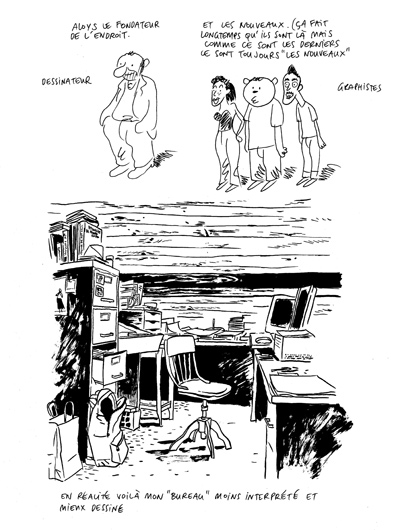 © Pierre Wazem
- For example?
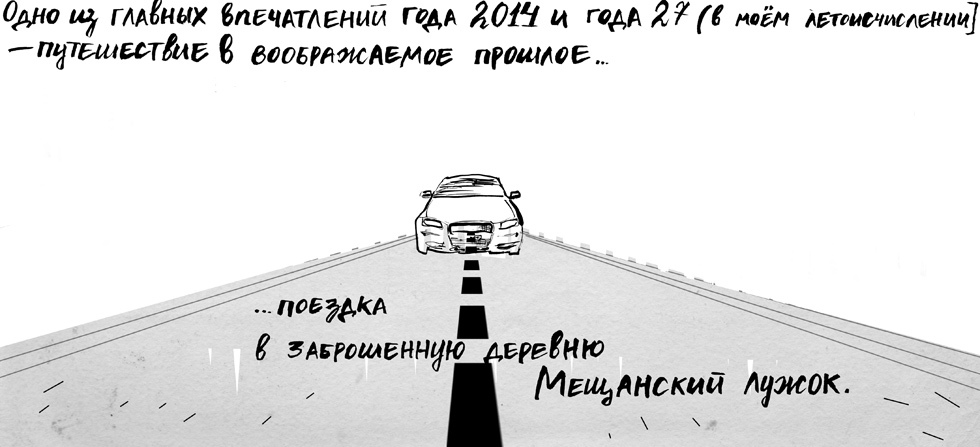
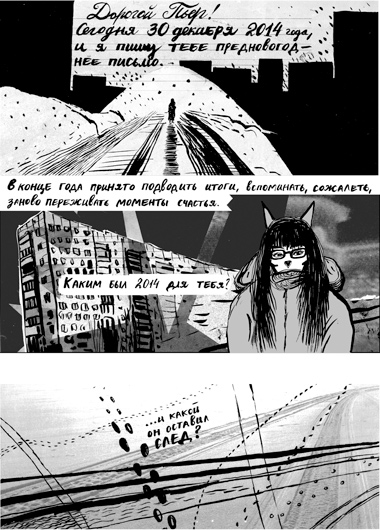
Lavrentieva: I am talking about a trip to an abandoned village in the Pskov region, about the events of 2014 in my life, about love (where without it), about the release of my book, about death. In total, I wrote him five letters, these are 29 sheets of 40x30 cm format. Probably, all stories are dear to me. I wrote/painted what was spinning in my head at the moment when I sat down at the table to draw, it was improvisation, and not following the plan. If not for this project, I would hardly have painted these stories, they would be forgotten and lost.
- For you, is this the first such experience of joint work?
Lavrentieva: Yes, two of his previous books - “The process of twelve”, a graphic report from the court, and a series of semi -documentary comics “Unrecognized states. Eleven stories about separatism ” - I did it independently, from idea to layout and pre -printing. Shortly before the project “Pa-de-de-de” began, I thought how great it would be to try to work on comics with someone, in the team or in pairs. And then there was an opportunity to do this.
Wazem: I had a similar experience - with one American artist, my friend. It seems to me that this is more therapy, creative interchange than the collaboration in the usual sense of the word.
 © Olga Lavrentieva
- I was a little surprised by this political bias, about which Olga says, because he contrasts sharply with what you are discussing in his “correspondence”. What topics do you usually work with and how do they arise?
Wazem: I always push myself away from myself and my own experience - that which is interesting to me will probably be interesting to the audience. I, like everyone, are concerned about social topics - relations between people, their values, aspirations and troubles. Real life is a kind of clay, from which I will make a pot of a pot today, and tomorrow - a vase.
Lavrentieva: I have always been interested in unreliable stories, plots that are simply impossible to invent. It doesn’t matter if they are about politics or something else: the main thing is that these are interesting stories about people, sometimes tragic, sometimes comic, sometimes all together. I like to be a researcher, collect material, find relationships and parallels. I hate fantasy, science fiction. More precisely, I don’t hate, I'm just very bored. Fictional characters are most often uninteresting to me. It so happened that my previous drawn stories are about politics, and now I am working on a semi -detective story, it is also based on real events. Pierre mainly draws about himself and his life, so we decided to look for ways to understand the understanding in the field of personal stories, impressions, and memories. We told each other very personal things, this is a rather intimate correspondence: about feelings, about pain, sadness, love and joy.
 © Pierre Wazem
- How difficult was it to find a common artistic and human language? You are stylistically at different poles.
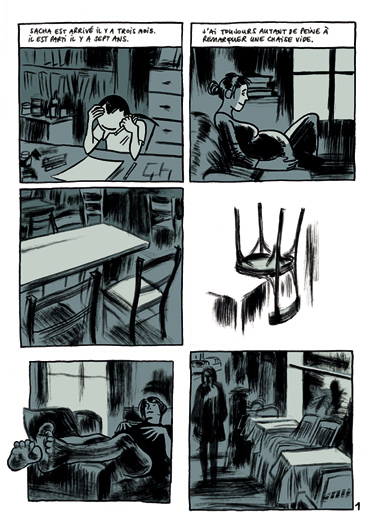
Wazem: You know, it was amazing to find the points of contact, despite the fact that I had a very nervous, expressive style that is not at all characteristic of Olga, which for me is the personification of calm and severity. Contents are always more important than stylistic discrepancies.
Lavrentieva: Yes, I agree. Pierre draws expressively and quickly, I saw how he made sketches in the bar last fall. He draws a brush, very vividly and expressively, subtle, emotionally, but confidently and boldly. I connect the drawing with a brush with old photos, geometric shapes, graphic elements. It turns out rather complex, multilayer pages. Pierre style can be called the exact opposite of my style. We have different equipment, different plots, a different approach to working with information. Pierre's works are much more realistic and narrative than mine. Perhaps the style is the only contradiction between us. Otherwise, we perfectly understood each other, the language barrier and the distance did not bother us at all.
Real life is a kind of clay, from which I will make a pot of a pot today, and tomorrow - a vase.
- How did the project technically prepare: did you fly to each other or everything was done at a distance ?
Lavrentieva: Pierre and I first met in St. Petersburg, at the Boomfest festival, last fall. We already knew that we would work in a couple, but we still did not know how it would look. There was very little time, we briefly discussed the upcoming project, and he flew back to Geneva. After that, for several months we talked only by e -mail, and we saw each other again in Lucerne, on the eve of the opening of our exhibition. Our correspondence in the form of comics was conducted by e -mail, we sent each other scanned pages and translation. Pierre wrote his letters in French, I have my own in Russian, then we transferred them to each other into English. And our letters “live” were connected only at the exhibition.
- It is clear why the comics were not popular in the Soviet Union - nevertheless, a hostile culture. But today the situation has not changed much. What can be the explanation?
Wazem: Honestly, I never understood why the comic book culture did not develop in Russia. In your country there is a great tradition of children's illustration, animation, which is recognized all over the world. Comics, in theory, should have become part of this culture, but did not. Apparently, the ideology in this case was stronger.
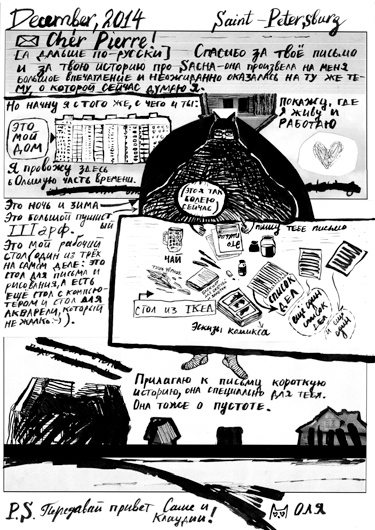 © Olga Lavrentieva
Lavrentieva: Although in the Soviet Union there were drawn stories for children, history in pictures, this type of art was not massive. Serious European and American graphic novels, this huge part of culture, were inaccessible to Soviet readers, they were not translated, readers simply did not know about them. The reasons can be discussed for a long time, but it happened. In the nineties in Russia, comics were published and painted, but this was also not widespread. For socio-economic reasons, the comics culture began to develop recently, and in other countries it has many decades. Despite the endless nagging of all comics involved in the culture in Russia about difficulties, lack of money and crises, today the picture is very different from what was just a few years ago. I think that the genre has already taken root and will live on, despite all the troubles and sorrows. Whether the culture of mass comics in Russia will ever become is difficult to say. But this type of art will certainly take its place, its niche. And is it necessary to strive for superpopularity? Probably, a generation that is accustomed to read comics from childhood should grow. Many older people are trying to read a graphic novel, but for them it is too difficult. Reading a comic book is actually much more difficult than “just text”, although unfamiliar with this issue think that the opposite is true. We need a skill of reading drawn stories. I am sure that we will never have a comic book market on the American model, as we will not work for us much more. All attempts to imitate, for example, to the American mass comic book we get weak.
- Is it possible to talk about national schools in relation to comics?
Wazem: Yes, of course, but actually comics are a universal language that is understandable to everyone.
Lavrentieva: There is a school of an American, European, Japanese comic book, each has its own characteristics, history, traditions. To imitate them outwardly, in my opinion, is somehow stupid. It is necessary to create your own "face". The comic book market is slowly growing, but the Russian school of comics is not now, and this is a great difficulty. Russian comixists learn everything themselves, usually on their mistakes, themselves master the foundations of composition, laws of perception, and the structure of the script. But if they go through all this, they become strong artists. There are beautiful authors in the field of the Russian author's comic book. I think that this should be betted on this: on original authors and their history, on intellectual graphic literature. Perhaps in the absence of the national comic book school there is a plus: the authors have completely different, unique styles. It is necessary to whimper less and complain about life, and draw more (I constantly say this to myself). Enough to consider ourselves blue and wretched, we can all.