
Translated material
Why are we so smart?
The lecture of the Polytechnic Museum with a lecture on the riddles of the human brain was performed by Philip Khaitovich, a Russian biologist, who currently conducts a research project at the Institute of Computing Biology in Shanghai.
Let's get acquainted. My name is Khaitovich. In 1995, I graduated from the Department of Molecular Biology at Moscow State University and almost immediately went to America to study further. Then I went to Germany and worked at the Max Institute for about seven years. Then he ended up in China, where I have a laboratory now. What I will talk about is not quite my work today. Let it be just an overview of things that you need, it seems to me, to know.
The brain is a very complex organ. It has about one hundred billion neurons and even more - about one hundred thousand billion - synapses. What are synapses? These are compounds between neurons. Neurons themselves are cells that are connected to other neurons using processes. What are they needed for?
 © Polytechnic Museum
Here is the brain of the mouse. Look at the picture - now it will become completely transparent, and we will see all the neurons of which it consists. Different colors show different types of neurons and neural networks. The mouse runs through the labyrinth, and it is clear what neurons in her brain are activated. It is more complicated with a person. When you listen to this lecture or, for example, look at the traffic light, this does not mean that some specific ten neurons participate in action. The action is controlled by a whole crowd of neurons, and they are woven into huge neural networks. Remember, I said that in addition to neurons, we have one more thousand billion contacts between them? Naturally, it will be assumed that our brain is unique precisely because of this colossal number of neurons. But - is it really so? Is it really possible to explain the difference between the human brain and the brain of the mouse only size? Some people say that the brain of an elephant or dolphin is the same as a human brain, or a little more. Others - that you need to look not at the brain, but at the number of neurons and the size of the frontal lobes.
 © Polytechnic Museum
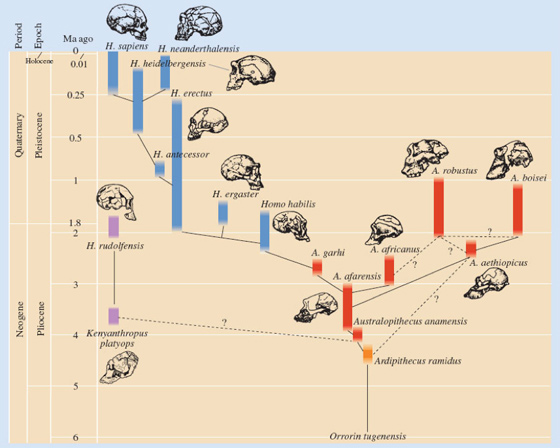
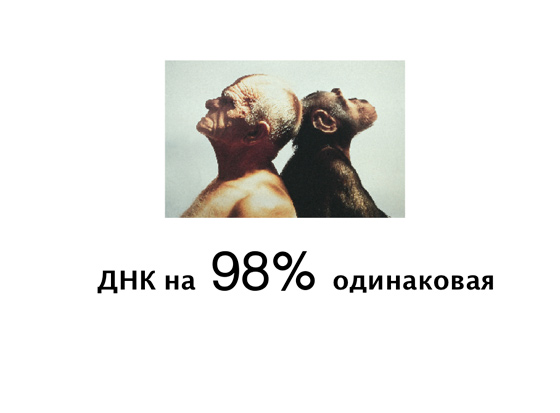
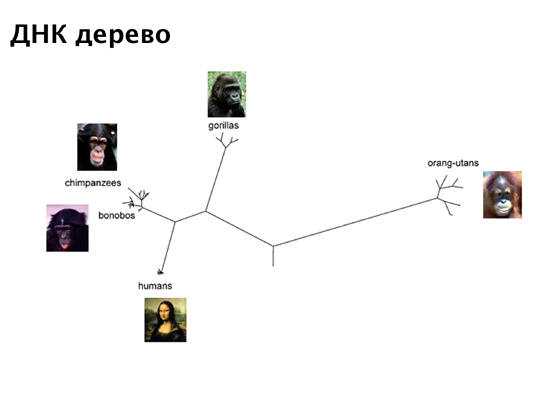
Here is the skull of a person, here is the skull of a Neanderthal. About half a million years ago, our paths parted. And here - chimpanzees. And from the chimpanzee we parted about eight million years ago. And this is the Makaki, with whom we dispersed thirty million years ago. You may ask: why does the Tree of History look like that? Why do we have a kinship with Neanderthals? And how can we prove our relationship with the chimpanzee? You can start answering like this: look at the skulls. In principle, they are similar, right? Especially with Neanderthals. But this is not a very good argument, because dolphins, for example, are also similar, but there is no big kinship between them. Dolphins are mammals, and their closest relative is a cow. How can we say that a person really has a closer relationship with Neanderthals than with chimpanzees or macaques? Of course, this is not based on the basis of the similarity of the bones, but on the basis of DNA. Deoxyribonucleic acid is the same that Watson and Scream deciphered in 1953. Double spiral containing the genetic information of each of us. Each person has its own DNA, and it is very, very similar to the DNA of other people. But about one of a thousand nucleotides each has its own, unique. DNA is a biological molecule, and when it is reproduced, that is, when it is intertwined, errors occur. That is, when I was produced, genetic information from my mother and dad was compatible, but I got a DNA from them, which was not quite an exact copy, there were some small corrections there. When they say that it is possible to establish paternity in DNA, they mean that if the child has one of the chromosomes - daddy, then they are really relatives. And with the same success, one can equalize a person with DNA of a different species. For example, my DNA with monkey DNA. Or with a DNA mouse. In principle, you can just look at me, then at the monkey and say: "Well, of course, he looks a little like her, but still not quite." However, if we compare our DNA, it turns out that they are 98% the same.
 © Polytechnic Museum
“But how is it? - You ask. “98% is almost the same thing.” Not really. DNA contains positions that do not affect anything, but there are such positions that affect a lot. For example, each of you knows about the existence of genetic diseases. Let's say muscle dystrophy. Its reason is in the mutation of the same nucleotide. And in our DNA nucleotides - about six billion. But if you change at least one nucleotide, I will have a disease. That is, even two percent of six billion is a huge amount.
All the people of the planet-from Africa, from Asia, from Australia, from everywhere-are actually very, very similar genetically. And if we take Gorilla from Africa? They can have much more differences than between the African and the European. Therefore, when we talk about someone “came up”, we must remember that from the point of view of genetics we are all so the same that it is even funny to talk about some differences. They, of course, exist, these differences, cultural or social. But this means little - a person has grown in Moscow or in Khabarovsk, with black skin or with white. We are all very similar. And from a genetic point of view, this is easily explainable.
 © Polytechnic Museum
For example, gorillas. Or chimpanzees, or orangutans. It seems to us that they are all the same. For example, Bonobo - for chimpanzees are the same relatives as for us Neanderthals. Outwardly, they differ only in that the chimpanzees have brown muzzle, and the bonobo has black. And it is very interesting that, despite the genetic similarity, they are completely different in behavior. Chimpanzees have tribes led by a strong leader - almost like primitive people. And in Bonobo, the main place in the group is occupied by a female - and sexual life is very developed. That is, they are like hippies who said: "Let's make love, not war." Bonobo all aggression goes into sexual activity. That is, if the two tribes of Bonobo are found, then instead of fighting and killing each other, they simply arrange a huge orgy. And all with everyone: men with men, women with women, children with children. And therefore, when you say that genetically the difference is very small - “only two percent” - know that between chimpanzees and bonobo the difference is even less: only 0.2%! And how do they behave differently, right? And if they meet, then the chimpanzees will think: “Oh, these crazy people, what kind of life they have! Only with each other they have sex and do not fight at all. ” And Bonobo will think: "These strange chimpanzes, they do not make love at all, but only kill each other." In fact, a very insignificant difference in DNA can lead to radical differences in behavior. But this is about distant relatives.
Two million years ago, countless species existed on the planet. We know about all of them only in the found skulls (we still do not know how to restore the DNA of the two -million aguing). Homo sapiens , our predecessor, who lived about half a million years ago. The famous Homo Erectus , settled the entire planet. We look at them and see that there is no one similar to us here. Some monkeys are running through the forest. But do not be mistaken. As science shows, our predecessors constantly crossed with each other, they had children, and these children, in general, are. That is, each of us has a certain amount of DNA of Neanderthal. And the only point is that all these guys died out, and we stayed. We are the winning look. And since we destroyed everyone and exterminate more, as it were, we set about each other. But this is already politics, so let's return to the size of the brain.
 © Polytechnic Museum
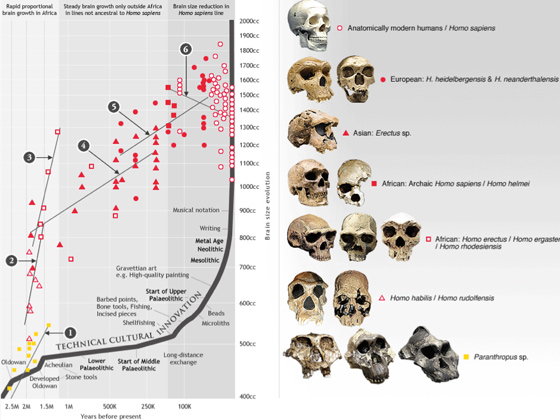
The skulls of extinct species are completely ancient tribes. The brain is still small, but over time, as you see, it gradually increased. Compare our skull and skull Homo Heidelbergensis . But the Neanderthal - see what kind of superfluous arcs he has. Like Nikolai Valuev. In fact, it is very interesting to explore the DNA of Valuev. Here you are laughing, but, although we everyone has a Neanderthal DNA, Valuev, perhaps, was the nucleotide that is responsible for the shape of the skull.
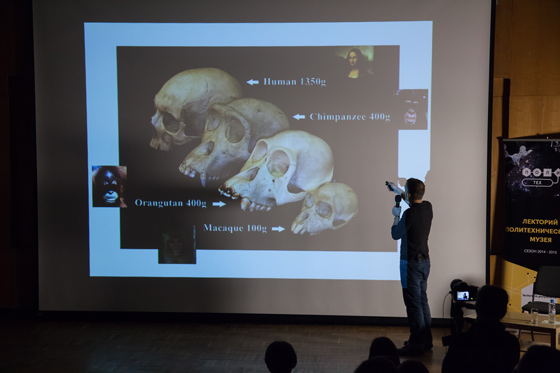
What you see in this rather complicated picture is just the ratio of time with the size of the brain. Two million years ago, the brain was small, only about four hundred cubic centimeters, and then suddenly the brain began to increase, and here it is already the size of a liter. And then it only increased. But what is interesting: the brain volume of a modern person is from a liter to one and a half (more precisely, on average 1300-1350 ml), and among ancient people there were guys whose brain was almost two liters. But is it possible to say that since their brain was more, they were smarter than us? What did they have various technologies, civilization and the like? No, unfortunately. This can be judged by investigating the tools that ancient people have used for millennia: some scrapers, axes. For one and a half million years, practically no changes happened - they did not even improve their scrapers in any way. And suddenly, about a hundred thousand years ago, an amazing cultural revolution began. There are hooks for fish fishing, bone products, the first objects of art, and this, as we see, is in no way connected with an increase in the brain. On the contrary, over the past hundred and fifty thousand years, the human brain has even decreased slightly. Maybe this is due to the fact that the frontal lobes have become more? It is sometimes noted that the Neanderthal has large occipital shares, we have frontal ones. Or maybe we have more neurons? No, Neanderthals had as many. And now attention: a fragment of news.
It's not in the size of the brain and not even in the frontal lobes - and certainly not in the number of neurons. And I don't know what. No one knows.
A girl from Holland speaks English, Gollandic and in some kind of language. And this girl is from America. Both have a rather rare disease. Here is the scan of their brain, which shows that one part of the brain is empty, is simply filled with liquid. When they were about two or three years, they had increasing epileptic seizures, and in order to save them, the doctors had to remove the hemisphere. One girl was removed the left hemisphere, the other had the right. That is, at a very early age, they simply took them and cut out a half -star. And now they are for some years, they study at a regular school, teach different languages and, in principle, develop normally. It is clear that if half of the brain is deleted now, the effect will be much brighter, because I am not three years old and my brain is no longer so plastic. At the same time, I want to note that the girl from Holland was removed the left hemisphere, in which the zones of Brock and Wernik, responsible for the ability to talk. Nevertheless, this girl speaks this girl perfectly in several languages. So, the point is not in size at all and not even in the frontal lobes - and certainly not in the number of neurons. And I don't know what. No one knows. Recent studies are hinting that the mission is not in the brain itself, but in its development.
When the child is born, he still does not know how to talk or use a mobile phone. He is generally not a person. Later, he will learn everything, communicating with his parents and peers. Scientists asked for a long time: or maybe the Chimpanzees are simply lacking in human society? After all, if you take a child and put him in a dog flock, then he, like Mowgli, will not become a man at all. It will behave like a dog or it is not known as someone, but definitely not like a person. Maybe if the cimpappanze cub grow among people, then he will learn all those things that we can do? After all, they teach to smoke them in the circus and drink what they later do with great pleasure. They tried to raise a child and chimpanzenka together, but after a while they threw this matter. The chimpanzenok did not learn anything, but the human cub began to more and more copy the behavior of the chimpanzenka, which, of course, upset his parents, who did not want their son to end up in the zoo. What does this indicate? On our important feature - we love to copy and copy the behavior of peers, the behavior of parents. For us, this is an important aspect. But chimpanzates copy less. In general, these are very interesting experiments - with children and chimpans. For example, it was like this: you need to click on the button to get some kind of toy or sweets. The experimenter comes and suddenly presses the button not with his hand, but with his head. Children immediately begin to poke their heads into the button, and the chimpanzates do not let their heads in the course and press on the button with a paw. It was somehow more clear to them that it was not necessary to copy-you just need to press.
 © Polytechnic Museum
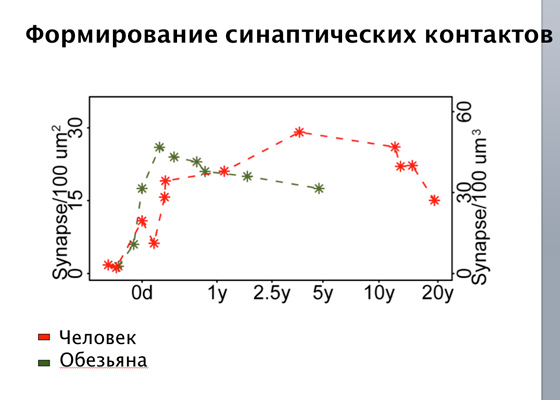
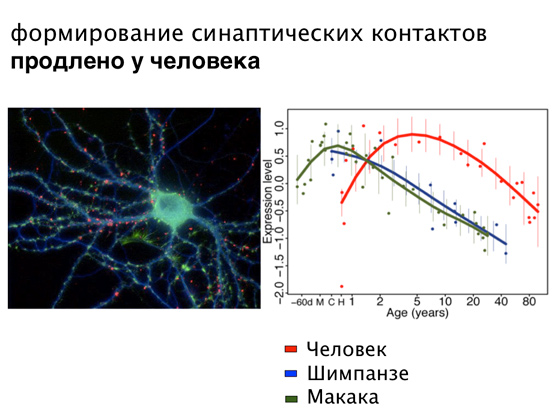
When a person or monkey is born, there are practically no mature synaptic contacts in their brain. All cells are in their places, are ready to work, but still do not know how to work. Of course, there are brain departments that are responsible for breathing and control of internal functions - they are formed in the first place. But we are talking about bark and frontal lobes that are responsible for how the brain reacts to the environment. For example, someone approaches you and beats. Will we hit in response or run away? Or, if this is the boss, just smile? The frontal lobes are responsible for solving this problem, and we see that at birth there are no synaptic contacts in the frontal lobes. Neither the monkey nor the child still know how to answer a blow. For example, when they see a hot iron, they still do not know what to do with it: eat it or grab it. And only over time, through interaction with the same iron, a monkey and a person understand that it is better not to touch him. So synaptic contacts are formed. In humans, their number approaches the maximum somewhere in the area of the first ten years of life, and then we see that it is gradually decreasing. A twenty -five -year -old person has fewer synaptic contacts than a five -year -old child, because he has already optimized his decision -making system. In a certain situation, we choose something from a certain number of scenarios. Because if there are many scenarios, it is difficult to make a choice. For example: What do you want for breakfast if you know that everything is available at all? You will probably think for an hour. But if you know that porridge or scrambled eggs is available to you, then you are likely to quickly take a decision. The same thing is our brain: it selects a large number of options, but leaves only those that are more or less accessible.
 © Polytechnic Museum
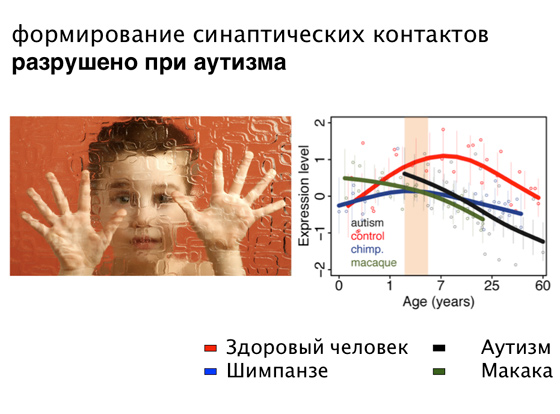
But what is interesting. If we look at the green macaque curve, we see that, in principle, the monkey’s formation of neural contacts ends after the few months of life. In a year, this is already an adult, smart monkey. A window of plasticity, that is, the period during which Makaku can be taught something more, significantly less than that of a person-only a few months, after which it is densely slammed forever. We have this window openly longer and, in principle, never completely closes. That is why we are still able to learn a foreign language at the age of 80, and for the first time to sit on a bicycle of 70. It is very interesting, because it proves that not only synapses, but also deeper molecular formations behave differently in the human brain. Of course, you may ask: how is this process related to our brain functions? Maybe it's still in size? We have more brain, we need more synaptic contacts, does it take more time? Of course, if we were dealing with mice, we could produce some mutations and see if a person will become stupid. Or, conversely, whether mice will become smart, like people. In the first case, this is impossible, in the second it is difficult. In short, science is not crazy to do this. But what can be done after all is to look at the disease. For example, autism: a good example for scientists and very bad - for parents. Autism is when, together with the development of the brain, all our human functions are violated: the ability to communicate, the ability to make non -standard decisions, change routine.
 © Polytechnic Museum
 Here is the results of the study that our laboratory has conducted together with one American company. These are completely new results - they are not even published. On the graph, it is absolutely clear that in children with autism the formation of synaptic contacts is violated. It, of course, is not the same as that of Makak or chimpanzees, but it returns to the archaic structure. The autists destroyed the formation program, cognitive function. And this confirms that the long formation of synaptic contacts - even in adulthood - is, of course, not the only, but an important mechanism that helps our consciousness and our cognitive abilities to form. What does this mean practically? Bell for parents. From year to five years is the time when your child has neural networks. And if this time, as in my case, is spent with my grandparents, then the brain will be formed precisely under their influence. I constantly notice this in myself-I react to some events as my grandparents would react to them, and not like my parents. And if you want to raise a child in some in a certain way, then do it in the first five to ten years of life. After, of course, there will also be a lot of things, and some kind of plasticity even remains, but it will be much more difficult to instill some habits, skills. That is, the whole thing is not in the size of the brain and not in the number of synapses, but in development. Понятно, что это частичный ответ на вопрос, поставленный в названии лекции, но — не нужно думать, что все загадки уже раскрыты.
Записала Наталья Кострова