
Translated material
Ivan Kushnir: "It is necessary to swing life"
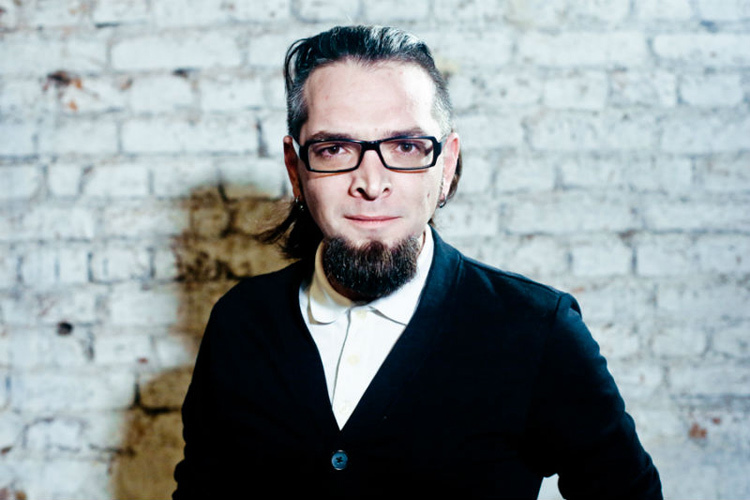
Today in the capital's Gogol Center, a series of premiere shows of the play “Harms. Myr ” - the new work of one of the protagonists of the young Russian theater Maxim Didenko, who has just become the owner of the main directorial prize of the St. Petersburg Prize for the young“ breakthrough ”. Music for Harms. Myr ”was written by the permanent co -author of the director, composer Ivan Kushnir, who had previously put his hand in Lenka Panteleev (2012), with the shows of which the metropolitan glory of Didenko began on the“ Golden Mask ”, and to the sensational Konarmia in the workshop of Dmitry Brusnikin. After at the end of this winter, Kushnir released in St. Petersburg the play “Zombie-Zombie-Zabi”, which violated all the usual ideas about how the modern Russian musical may look and sound, Alexander Dunaev decided to talk with the composer again.
-“Zombies” is called a musical, but it seems that it is closer to what is now customary to call a hip choper, or a rap opera.
-It seems to me that the “zombies” can generally be called a hardcore opera. There is no literal hardcore there, but in the spirit it is definitely him. And, of course, I agree that this is never a classic musical. The constant in the genre does not interest me at all, on the contrary, it is interesting to bring something new in the genre. When we did Zombies, I, of course, focused on the California hip-hop of the 1990s, but there are also mixed Limp Bizkit , Marilyn Manson , Massive Attack and the Soviet Estse of the 80s are embalmed guys from the Blue Light.
- It seems to me that in “Lenka Panteleev”, your very first musical, and now in “zombies” you seem to be fighting with windmills, trying to break, outwit the bourgeois nature of the genre. Whatever superstar Jesus Christ, I do not care if I do not understand how the plot develops. You are wrapping complex plots, sometimes uncomfortable, with a bunch of different confusing the layman for the thick of cultural references, you are mocking in your music over the same pop, over chanson ...
- The perception of the musical as a bourgeois genre is our local atavisms, such questions in the world do not really excite anyone in the world. The musical, after all, actually got out of the cabaret, jazz and ensembles of Jewish emigrants who flourished in the resorts of the so-called borscht belt, Borscht Belt , near New York. There they are on improvised instruments - clarn, a breeding harmonica and an accordion - all sorts of Jewish songs played. And so, when the Jews made friends with the blacks, a chemical reaction began, as a result of which the musical language arose. Brekhtovsky zongs, by the way, from the point of view of the language, is also quite “borsch Belt” - Jewish thieves' thieves interspersed with jazz rhythms. That is, a musical is initially an absolutely garbage, a semi -basement story. The aesthetics of the musical, in my opinion, is absolutely proletarian: this is a genre for everyone, and not for the elect. The fact that he subsequently hung pearl necklaces and ostrich feathers is a matter of the development of the genre, and not its nature. We do not fight with anything - I, at least, do not consider myself a revolutionary at all. I just don’t do what I do not like, I write music that I would like to listen to myself, and I do not write the one that I would not want.
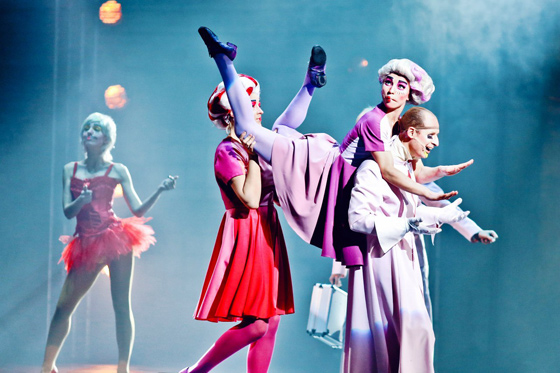 © Maria Mitrofanova Scene from the musical "Zombie-zombie-zombie"
- You make the impression of an absolutely “omnivorous” composer. Even knowing all your performances, it is difficult to understand what is closer to you - the Gregorian choral, Shostakovich, Snoop Dog or Portishead .
- My main characters are Beethoven and Nirvana . Arvo Pyart and Prodigy is also in the leaders.
- That is, in half the “classics” and “contemporaries”.
-The fact of the matter is not. Such a division for me never existed at all. Obviously, from a technological point of view, the difference between Beethoven’s symphony and raw, poorly played music of Cobain is huge. But there is no emotionally this difference. They are all as if in one field.
- It turns out that you exist in a non -ilierarchic musical space?
- Not really. It’s just that I do not divide this space into the past and the present, and the genres are high and low. Mozart, Beethoven and many other composers at one time wrote the so -called applied music to order - about what we call “pop” today. Roughly speaking, some person in a wig, a nobleman comes to Mozart, and makes an order: “Friend, we have a party tomorrow, we need a minuet”-this is dancing technology today, and then the menuets danced. And Mozart writes brilliant music. After all, it is clear that Menuet, like a symphony, can also be written both brilliantly and mediocre. So for me the main thing is that the music is of high quality-this applies equally to both pop and academic music. The composer's task is to own the widest tools. The real virtuoso in this sense is Eric Serra , the constant co -author of Luke Besson: he knows how to write a symphony, rap, industrial, and an embibio. He can add any picture that life will offer him. I do not see anything shameful in the classes with popular music. On the contrary, I am sure that without this a modern composer, like a modern musician, cannot exist - life does not stop on a snick. And for 90% of the students of our conservatory, it ended about somewhere in that area.
The musical is initially an absolutely dragging, semi -basement story. The fact that pearl necklaces and ostrich feathers subsequently hung it is a matter of the development of the genre, and not its nature.
- I feel, we felt for a pain point. What is wrong with the conservative education?
- Recently, in one of the performances, I tried to put on the installation of a conservative drummer - and he turned out to be completely unprofitable. Maybe he is a virtuoso on the xylophone, but he simply does not know what, for example, the Gruv, for example. A person seemed to have not heard Rock in life and does not understand how to achieve the necessary sound recovery: the level of expression, return, clarity - everything by. You need to understand the genre, but where will this understanding come if it plays Tchaikovsky all day? When he leaves the conservatory, then Tchaikovsky on the xylophone will not help him very much. I’m not talking about the fact that the musician must love hip-hop or metal, but he is elementary to know about their existence. This is a matter of the education system of academic musicians - now it is very conservative. Perhaps, for this reason, the world of academic music in Russia for the most part is not just non -modern - it is anti -artistic.
I myself wrote symphonic opuses and works for the choir, went on tour with them. It was a rather ornate segment of life, which I would love to forget with pleasure. He ended when during the next tour, I realized that everything that was happening had nothing to do with art: how exactly it should be, I did not know, but the academic party showed me how to not be.
Now I am wildly cool in the Moscow House of Music at concerts of Batagov or Martynov or in any other alternative space. It's really interesting. But going to the Philharmonic is completely uninteresting.
 © Stas Levshin / Youth Theater named after A.A. Bryantseva Scene from the musical "Lenka Panteleev"
“But still, people from the academic environment brought you to the profession.”
- Let's just say, not quite ordinary people. When I was six years old, a group of enthusiasts gathered in St. Petersburg, incredibly steep teachers - from the Glinka Church School, a ten -year -old at the conservatory. They united in a small circle, gathered fifteen children and engaged in five years with them without recruiting new students. It was a private musical lyceum at the Finnish school. Money from Finland is teachers from Russia. My friend Ilya Demutsky - thereby that the ballet for the Bolshoi Theater is now writing - came to Igor Efimovich Rogalev. In fact, all my training is connected with it from 6 to 25 years. Why did he consider it necessary to take two six -year -old boys to him, for me still a mystery.
I do not deny that there are excellent teachers in the conservatory. But several people cannot destroy the closed system that exists there today. Students are growing with some antediluvian ideas about the great art, completely not seeing the wealth and diversity of this art itself-remaining at the exit with a narrow horizons and a lack of erudition. The most passionate, of course, dig something themselves, manage to watch, listen.
-The theater played a role in the fact that you changed your attitude to the academic environment?
- Yes, sure. Still touring with the orchestra, I began to work with Danila Korogodsky at the Generation Theater . And the contrast against people to what they are doing just struck me. You can evaluate the performances of the theater of generations in different ways, but the people there were really sick for what they did. I have not seen this either in the choir or in the orchestra.
- And how did you get to Danil?
- This is a funny story. I remember that I ended up with one of the artists of the theater in the bastion of the Peter and Paul Fortress, where the theater was then, and that we drank all night right in the scenery of some performance. The next day they had a premiere, and Danila, having come to a rehearsal in the morning, was, frankly, in shock. But this did not stop him from calling me to a new performance. The dialogue then happened about this: "Have you worked in the theater?" - "Of course not". - "Is it interesting?" - "Yes, sure". I then had no idea what theater, performance is, but there is no swing, no play or script-immediately a visual-plastic performance. "Will you play with us in this game?" - "Let's". And we began to compose. So I immediately got into the environment that is close to me now.
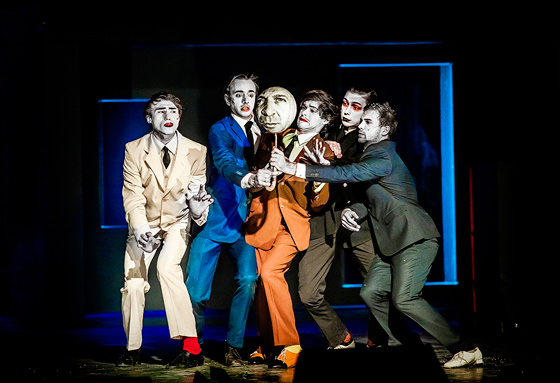 © Ira Polar / Gogol-center Scene from the play “Harms. Myr "
- How does the composition of music for the theater differ from other composer work?
- Theater is an interaction with reality, which greatly affects the form. And this is wildly pleasing. You never know in advance how you will work with the material. What will happen in the "Earth" (the performance of Maxim Didenko based on the movie of the same name Alexander Dovzhenko, the premiere on the new stage of the Alexandrinsky Theater in May 2015. - Ed. )? Yes, I don’t know until I see the artists until the rehearsals begin. If I knew, then I would immediately become bored. Everything is simpler with the musical, there the text and genre set the conditions, the form is already born from them. In working with Max Didenko, it is generally not clear how everything happens. He always sets tasks that at first start a dead end. For example, Konarmia. All is well: summer, Komarovo, rehearse. Max brings a paragraph of prosaic text and says: "I want it to be a song." And you walk for two days, not understanding what you need. Then a breakthrough occurs in some way, and the song arises. At the same time, you also take into account a lot of parallel tasks: there are no musicians professionally playing on the instruments. Creating a form, you need to understand that a talented, singing, but still artist of the drama theater will cope with it. Here the conditions themselves are part of the game. If we rehearsed not in Komarov, but in the Congo, then these would be additional circumstances. So in the theater, reality means much more than my composer will. And in general, does it exist? I'm not very sure.
“But you have repeatedly admitted love for symphonic music.” Doesn't it pull in this direction at all?
- pulls, of course. I'm going to this. In the footsteps of the play “Overcoat. Ballet ”We, for example, recorded a disc. This is a completely independent thing. The same story with Zombie-Zobi-Zombie. This music can also exist in isolation from the visual series. Now I want a symphony avant-garde hip-hop. And there are already texts.
- ABOUT! Here I will ask my question. You and Maxim Massian Didenko, Vladimir B-Boy Shantaram Barnava and the company Hip-Hop Project "Good people of Evil Songs". Tell me, Vanya DJ Hugo Kushnir, what the hell did you suffer in this hip-hop?
“What we do in“ Good people ”is a game in the 1990s, a kind of old-school, not related to a modern hip-hop, which, of course, is simply monstrous. I am interested in the form of experimental, intellectual hip-hop-for example, the same Buck65 , a Canadian who made an excellent symphonic hip-hop. In St. Petersburg there is a group “The largest simple number” - in their first album, experimental poetry in the form of a recitative falls on the original bats. As for “good people of evil songs”, then this is also nostalgia - and, of course, an energetic, irresponsible form of rest. You can dance, throw out your demons, remove the mask, tear yourself away, simply put. As a child, we all dreamed that we would be the leaders of the rock bands, and this dream sits somewhere in the subcortex. Hip-hop is about this, about the way to remain one foot in childhood-because if you leave, then n **** C to everything, and symphonism as well. You cannot be infantile in life, but it is necessary that life is downloading.