
Translated material
Business on the falsehood
On April 22, the long -term speaker of the Moscow City Duma Vladimir Platonov risks losing his own degree - at the Russian University of Friendship of Peoples, where the politician teaches, the issue of plagiarism in his doctoral dissertation will be considered. He discovered plagiarism (a quarter of all scientific labor) the same “disserter” - the free network community of experts, which developed its methodology for identifying “fraudsters, falsifiers and liars”, as written on its page on the Internet. On the results of two years of work and laws in a business called “Dissertation” - especially for The New Times, one of the leaders of the project tells, a physicist known in the blogosphere under the nickname “Doctor Z” in antiquity in the Middle East (Lolium Temulentum) were considered the same plant as wheat and not separate. This is evidenced, for example, a treatise Kil'ayim (chap. 1, Article 1) in the Babylonian Talmud. Otherwise, the troops growing on the same field with wheat would be subject to immediate eradication on the basis of the instruction of “your field do not sow with two clans (seeds)” (Levita, 19:19). It is in this regard that in the Gospel of the beels and wheat is allowed to grow together up to the harvest (Matthew 13:30). The tares are the same wheat, only reborn, is explained in another ancient text.
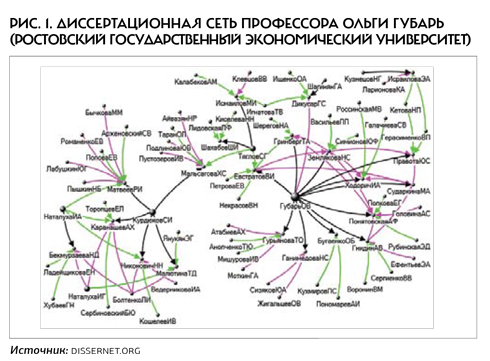
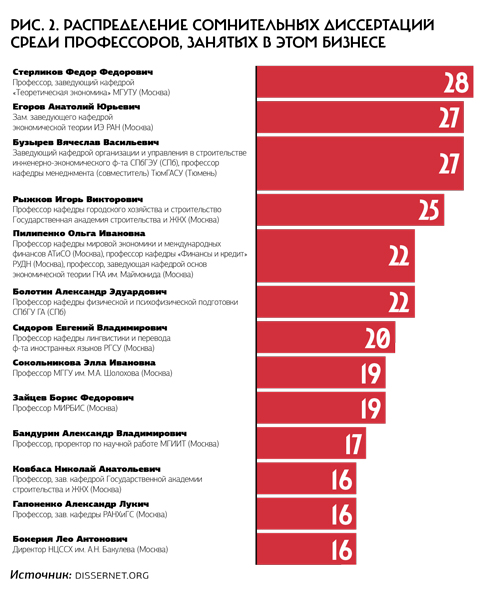
To increase the drummers of anti -scientific labor for two years of Dissernet’s work gave us a unique understanding of how the “tares from science” grow and how the once normal scientists, dissertation councils and entire universities are reborn into weed grass. The network "dissertation factories" that entangled the country has a pronounced structure of polycentric bushes. Here, for example, one piece of such a network (see Fig. 1): in different colors on it, roles were highlighted on it in which one or another professor participated in another false defense: black - as a leader, lilac - as a donor of text, green - as an opponent. Dissernet experts have many such pictures: they give us extensive ground for conclusions about the structure of the dissertation industry in Russia. Firstly, plagiarism is not making negligent applicants, but put on the stream of their leaders. You can believe that two or three paragraphs without proper quotes in the work of the applicant and slip past the eye of the chef. But to believe that the work, which differs from the source only by the re -re -titular page, went unnoticed by the scientific leader? Do not laugh. What, one wonders, was the graduate student for all three years? And where were the eyes of the leader when it was incomprehensible to him from where the “brick” came from? The leader in the personal standings, according to Dissernet, was the head of the Department of Theoretical Economy, Moscow State University of Technologies and Management (MGUTU), Fedor Sterlikov, whom experts suspect of 28 clients dissertations (see. Fig. 2). With a margin of just one dissertation, the deputy follow him. Head of the Department of Economic Theory of the Capital Institute of Economics (IE) of the Russian Academy of Sciences Anatoly Egorov and the head of the Department of Organization and Administration in the construction of the Engineering and Economics Faculty of St. Petersburg State Economic University (SPbGEU) Vyacheslav Buzyrev.
Increasing the search under the lantern of the Dissernet methodology is as follows: if we accidentally stumble upon a dissertation with extensive plagiarism, we immediately begin to look for a bush - other works done under the guidance of this scientific director. And they will be found! We throw any suspicious professor into the Mill - a program that analyzes not expensive dissertations, but free -available abstracts. The program allocates a subset of those in which this professor appears in the database of abstracts and is further looking for direct text matches with other abstracts. If there are coincidences with abstracts, it means that it is necessary to take the dissertation directly and compare full texts. Thus, we do not search for “chases” throughout the garden, but carefully pull out the rohs of weed from the ground. That is why we always refuse to answer the question: "What is the percentage of dissertations in Russia with borrowings?" We fundamentally do not give an answer to it, since the trick of “disserte” is to work with a displaced sample and look for a lantern. With all the fantastic capacities of the project - 10,000 dissertations passed through our hands in two years, 2000 examinations of the plagiarism found in the bins, 8OO examinations were published on the site - we will never overpower the entire dissertation corps - about 8OO works of works stored in Lenin (the Russian State Library). But no one sets such a goal. But to identify the main nodes of the network of dissertation factories - such a task is quite realized by our methods. As we have already said, plagiarism is always a professor’s shop, but no professor can put anyone with his will by his will by his candidate or doctoral degree - he needs a dissertation council. And here the principle of the bush works again: if the dissertation made up in the Council, he will almost never be there! So, the famous council of 212.198.01 in economics at the Russian State Humanitarian University, headed by Professor Valery Minaev, was born, as Dissernet believes, 67 fake work. This is not just a factory - it is an industrial giant for the manufacture of dissertations by processing a secondary intellectual product. In this council, we discovered 13 disperse.
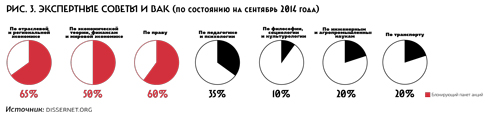
The organization of business is an important part of the dissertation business is the cooperation of various "firms". Often members of the dissertation council, which can be considered relatively clean, serve as opponents in some “bench” recently the author studied the dissection bush of the Moscow State Construction University, in which such a character was found-Anastasia Safronova. In her dissertation council, she did not distinguish anything, but constantly turned out to be the opponent of graduate students of Professor Anatoly Egorov at the State Academy of Investment Sphere (GASIS). All three works that she opposed (according to the author - NT) differed from the source only by a title sheet. The structure of the dissertation business is crowned by the highest certification commission. It is there that the real "godfathers" of this fishing are sitting. In the Higher Attend, the dissertation is considered by expert tips. For example, our studies show that the expert advice of the Higher Attestation Commission on Economics and Law hold 50-65 % of the “voting shares” of this business. Almost every self -respecting factory of fake dissertations sends its representative to the expert council. So, the mentioned Council 212.198.01 in economics at the RSUSU had as many as two representatives in the VAK Expert Council. From the above diagrams, it is clear which areas of science are primarily in demand by scammers: there are no fundamental natural science disciplines, but humanitarian directions, especially in the field of economics and jurisprudence, are represented in all their diversity-the degree of economics and law are especially in demand by the Russian bureaucracy-from deputies to leaders (see Fig. 3).
To increase the degree with the guarantee, the function of representatives of the dissertation councils of universities in VAK is obvious: they ensure the passage of fake work when considering a certification case and save their customers from a fair analysis of the case. Perhaps the most egregious case of this kind of “warranty service” was the case of Katrina Dobrova Katrina from the engineering and economic institution of the MAI. In her dissertation, which she made at the Russian Academy of Entrepreneurship on the topic “Strategic Management of Innovation Industrial Corporations”, 266 pages of someone else's text, taken from one source, with which the professor had no joint work or monographs, were discovered. However, the Deputy Minister of Education Lyudmila Squodova found this dissertation “original”, and the awarded degree - not subject to seizure. According to Dissernet, the corresponding expert council of Vaka tried well, demonstrating to his clients that the business is reliable, and obtaining a scientific degree is guaranteed. Dissernet repeatedly turned to the Ministry of Education and Science, in writing and verbally, in the press and non-publicly, with detailed lists of those who represent the dissertation and retirement business in the highest certification commission. At the end of 2014, 23 people were removed by the Minister from work in expert councils (mainly the changes affected the Expert Council on the industry and regional economy). Unfortunately, this is a small fraction of those who make money on fake dissertations in the most popular sectors of this dirty business (see the drawing above). In the parable of the tares with which the author began this note, the final says: "Gather before the tares and tie them in ligaments to burn them, and remove the wheat to my granny." Why should the tares need to be collected before? Obviously, no science can coexist near the merchants of other people's letters. Dissernet many times offered the Ministry of Education and Science his expertise, his experience, his competence in the field of collecting the lumps - will this proposal finally be heard?