
Translated material
The man of war
In the Moscow theater.dos, an underground show of the Ukrainian performance was held about the war called "ATO"
At the performance of the “ATO” of the Ukrainian director Andrei May, the artistic director of theater.doc, Elena Gremina, invited everyone separately through Facebook, explaining the secrecy of the event by the political context and fears for the fate of the theater: on December 30, the former premises of the theater. Dos came up to the police officers during the presentation of the film of Ukrainian documentaries. Guests from the fraternal republic are now equal to enemies, so it’s better not to take risks.
After the Maidan's Diaries, Andrei May - director and ideologist of the Ukrainian documentary theater and new drama. Last year, May and the playwright Natalya Vorozhbit brought to Moscow their play “Diaries of the Maidan”, which they showed on the Golden Mask as part of the Mask Plus program. It was March 10, 8 days before Crimea became "ours." There was no military confrontation with Russia, although the word "Maidan" was already perceived by the supporters of the Kremlin as a red rag. "Diaries of the Maidan" were born from monologues of participants and witnesses of Kyiv events. Then the performance played at the National Theater. Franco in Kyiv, in Gdansk-in the homeland of "Solidarity", in London, Vilnius, Berlin, New York. The official premiere of "ATO" will be held in early April in Kyiv, on the stage of the National Theater. Franco. Spectators of the underground Moscow show saw and heard this text one of the first.
Simple questions The basis of the performance is the days of the 25-year-old military psychologist Alexei Karachinsky, who made friends with the participants of the Ukrainian “Doc” before the war and even tried to compose plays. But the peaceful life ended, and the playwright that failed so far had to return to his main profession of a military psychologist and go to the southeast of Ukraine to fulfill his official and civil duty. Alexey immediately said to Andrei Maya: I take a recorder, I will bring the text. And brought.
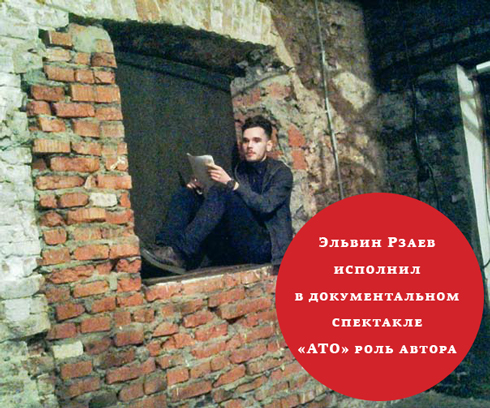
The role of the author is played by the young actor Elvin Rzaev. Before starting to speak, he gives the audience the "fighter's memos" printed on the printer. “Memo” is recommendations for maintaining psychological stability and combat effectiveness in extreme conditions. Something like a set of tips that will help soldiers and officers not go crazy in the war zone. To cope with the consequences of insomnia and monotony of existence, to overcome attacks of claustrophobia and agorathobia, get used to the smell of blood, to the appearance of bodies torn by explosions and torn limbs. Learn to lead yourself out of a state of stress with the help of simple exercises. The hero makes the audience rub their palms and ears, massage points on the forehead, under the nose, under the lips, make waves with arms and legs. He will resort to these saving exercises more than once during his monologue, gradually turning from a doctor into a patient.
The play "ATO" is trying to answer simple questions. What happens to a person in war? How does fear disappear? How does it transform into a hysterical panic, then into complete deaf apathy? What are the origins of heroism and combat courage: in fearless or, conversely, in an irresistible desire to bring death and end this fear? Why is the dead body heavier than living? What happens to you when you break in half the body of a deceased friend, which prevents you from taking his place in the car? How does your hearing change, starting to distinguish between the nuances of the roar from the shells? How many gray hair appears after the battle, and what does this verb “turn gray” mean physically?
War as a disease in the text of the ATO there is almost no emotions, it is extremely concise when it comes to the psychological and physical characteristics of the “man of war”. Not even like that: a person thrown into a war, not ready and not prepared for it, who perceived the war as part of history, as part of someone else's craft.
“There are no bad people there,” the hero says and is surprised at his thoughts. No patriotic slogans, no political cod, no rebirth of the hero of the performance in the hero with a capital letter. War is like an incurable disease from which there is no healing. War is like a cancer tumor that cannot be trained or cut out of yourself. The war will never end in the world for those who got into it. One of the spectators saw the “anti-Poroshenkovsky” aspect in this monologue, and there is a share of truth in this-the authors of the performance of their attitude to the current government do not hide. It is also a matter of unreasonableness to such a war of the Ukrainian army, which is poor and lagged behind from a technical point of view - without the help of volunteers, the soldiers would not have uniforms or ammunition. We are talking about the inability to plan military operations, about helplessness before the pressure of gang associations. And about one very important one-about some inexplicable disunity in the country: a huge part of Ukrainian society lives as if nothing was happening, as if it does not hear either the roar of explosions or the groans of the mortally wounded. After the performance, there was, as always, a discussion: in his final, director Andrei May asked a question to the few viewers: “Tell me, why do you need to listen to this? Why did you come? ” And in the hall there was immediately a grave silence. Indeed, why did we come? So you know that we are nearby.
Photo: Elena Gremina
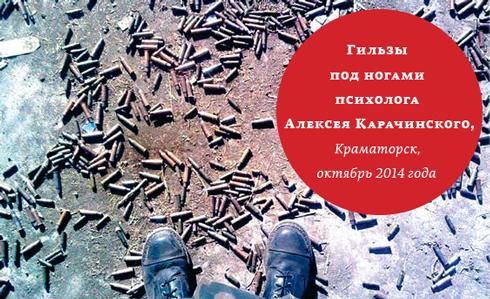
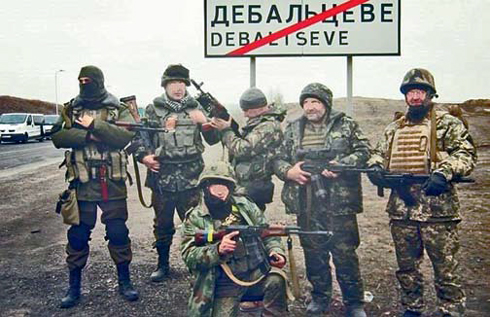
Excerpts from the diary of Alexei Karachinsky * two weeks ago went to Debaltsevo and neighboring villages - Olkhovatka, Kamyhatka. There I had the first experience of psychological assistance during the fighting. Only twelve days were there, but there were a lot of emotions, and there was a feeling as if he had lived a whole year. Probably because the memory is so arranged: you remember the brightest moments and how it all ended. You do not remember everything else. And there there were these vivid moments - well, a lot. I imagined very approximately where I was going, for which I was going. I had never shot from the machine gun before. And I never went to the armored personnel carrier either.
And here - thanks to the volunteers - equipped with everything they need. The clothes are warm. If I was in what was given from the army, then I would have frozen there. They gave a body armor, a helmet, and went. I realized that I need to ride in the lenses. Because when you go from above on the armor, the strong wind constantly blows into the eyes, and you have to be in a balaclava all the time. And because of the balaclava pairs rises in glasses, and you are blind. And then you need to make sure that no one with a grenade launcher is exhibited and does not shoot at you. Well, for example, there is a bombed house-someone came out of it, shot, and that’s it. Or sniper. For two and a half kilometers they can get into you from sniper.
<...> At first there was a very bad dream. There we bombed us seventeen to twenty times a day. And somehow you get used to the roar. And you return (to Kiev. - NT ), go to bed, and a very terrible silence around. And dreams like Chechens torture, their hands torn off and everything else. Interestingly, there you begin to distinguish all sounds - when the “city” works when self -propelled guns (self -propelled artillery installation. - NT ).
***
Monotony and boredom from an excess of time - during a period of long expectation, can destabilize your activity. What to do: improve shelters, build and equip new firing points in the direction of the enemy’s possible appearance. To study the materiel. Build plans for the future. Magazine, observation of the situation in the territory around the location of the unit.
***
Time deficiency, increase in the pace of action, extreme complexity of solutions, excess information, combination of several types of activities at the same time. What to do: the experience of hostilities in Afghanistan showed that the involvement of fighters in the solution of a combat mission is facilitated by the division of units into “troika”, “five”, led by an experienced, strong -willed military person who can mentally support and mobilize colleagues.
Claustrophobia is a fear of closed space, for example, in shelter when striking the enemy (accompanied by an unconscious desire to leave this shelter, despite the even more increasing threat of security), and agorathobia is a fear of open space (the desire to hide from sound and visual combat exposure). 2-3 breath-senior. Be sure to inhale with your nose, exhale with your mouth. Do not wander around the sides. Find a point at eye level and focus on it. Typically, such conditions pass in 3-5 minutes, in a maximum of 10-15 minutes.
Blood and type of serious injuries, destruction are severe injuries and the death of combat comrades, the destruction of shelters, buildings and military equipment, as a rule, paralyze the psyche of a person unprepared for cold -blooded perception. Know and study your reactions. Grind about the dead. Protect yourself. Do not deny and do not pretend that you do not feel anything. What you feel allows you to remain a person. But do not let the feelings control your actions. Do not act under the influence of emotions. Allow tears, rage, horror, sadness, grief. Talk about this with your comrades. Find time and place for this. Do not be afraid to scare loved ones with your stories. Find a person (friend, priest, psychologist) to whom you can tell.
* The diary of the Ukrainian military psychologist Alexei Karachinsky formed the basis of Andrei May's documentary performance “ATO”. NT publishes excerpts from this diary.
** NT publishes excerpts from the “fighter’s memo”, which is distributed to the audience during the performance of Andrei May “ATO.” Photo: from the archive of Alexei Karachinsky